
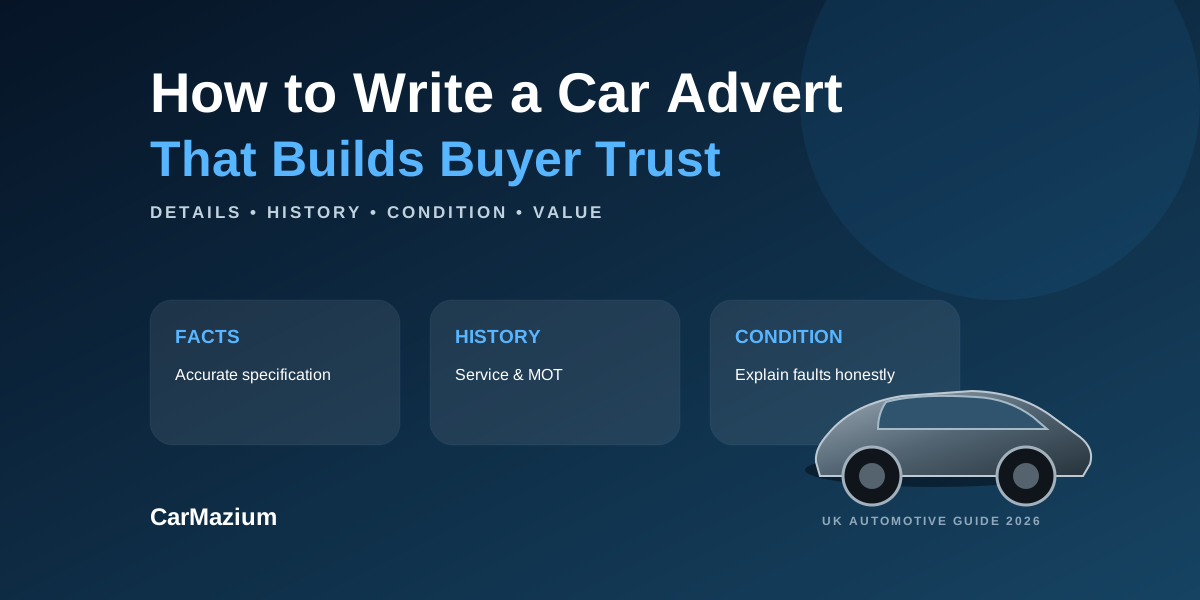
How to Write a Car Advert That Builds Buyer Trust: UK Guide 2026
Write a stronger used-car advert with accurate details, service history, condition, specification, recent maintenance and honest fault disclosure.
In this article
A good car advert does not need to sound clever.
It needs to make the buyer feel that they understand the vehicle.
The strongest adverts answer the questions a serious buyer is already thinking:
- What exactly is this car?
- Why is it being sold?
- What condition is it in?
- Has it been maintained?
- What has been replaced recently?
- Are there faults?
- Does the price make sense?
- Can I trust the seller?
If the advert answers those questions clearly, the buyer is more likely to enquire.
If it avoids them, the buyer may simply move to the next car.
Start With Accurate Vehicle Details
Before writing anything creative, check the basics.
Make sure the advert shows the correct:
- registration-derived model,
- year,
- derivative,
- engine,
- fuel type,
- transmission,
- body style,
- mileage,
- colour,
- and number of doors.
Many platforms auto-fill vehicle data from the registration.
Auto-fill is useful, but it can still be worth checking the information before publication.
An incorrect trim or gearbox description can create problems later.
Write for a Buyer, Not a Search Engine
SEO matters to the platform.
Trust matters to the buyer.
Do not fill the advert with repetitive phrases such as:
BEST CHEAP CAR FOR SALE CHEAP LOW MILEAGE CAR BUY NOW
That looks unprofessional.
Use natural language.
A buyer should be able to scan the advert and understand the vehicle quickly.
Open With the Strongest Selling Points
The first paragraph should explain why the car deserves attention.
For example:
2018 petrol automatic hatchback with 54,000 miles, full service history, two keys and MOT until August 2027. Recently serviced with two new front tyres. Clean interior and strong specification including reversing camera, heated seats and cruise control.
That paragraph immediately gives useful information.
Compare it with:
Lovely car. Drives perfect. First to see will buy.
The second version says almost nothing.
Mention Service History Properly
Do not simply write:
Full service history.
if you cannot support it.
A better description may be:
Service history with six recorded services, including the latest service in July 2026 at 52,900 miles. Invoices available.
If the history is partial, say so.
For example:
Part service history with four invoices; no evidence for 2022 service.
Accuracy creates more trust than exaggeration.
Read our guide to service history and car value.
State the MOT Position Clearly
Useful wording includes:
- MOT until March 2027,
- passed latest MOT with no advisories,
- latest MOT had two tyre advisories, both tyres since replaced,
- or short MOT remaining, reflected in price.
Do not say "12 months MOT" unless the car genuinely has it.
Buyers can check MOT history independently.
The advert should match the public record.
See how MOT history can affect car value.
Describe Recent Maintenance
Recent maintenance can be valuable because it tells the buyer what they may not need to pay for immediately.
Examples:
- timing belt replaced,
- water pump replaced,
- new battery,
- recent clutch,
- gearbox service,
- brake discs and pads,
- four new tyres,
- air-conditioning service,
- suspension work,
- or EV battery inspection.
Include the date or mileage where possible.
For example:
Timing belt and water pump replaced at 61,000 miles in May 2026; invoice available.
That is stronger than:
Loads spent.
Explain the Specification
List features buyers actually care about.
Examples:
- automatic gearbox,
- reversing camera,
- parking sensors,
- heated seats,
- cruise control,
- Apple CarPlay/Android Auto,
- panoramic roof,
- leather interior,
- navigation,
- climate control,
- adaptive cruise,
- lane assistance,
- electric seats,
- keyless entry,
- tow bar,
- seven seats.
Do not copy a generic equipment list without checking the car.
A feature shown in a brochure may not be fitted to your exact trim.
Mention Optional Extras Where Useful
If the car has desirable factory options, explain them.
But do not calculate the selling price by adding the original new-car cost of every option.
Used-car buyers may value certain features, but they rarely repay the original option cost pound for pound.
See our guide to optional extras and car value.
Describe Condition Honestly
A private used car does not need to be perfect.
Buyers expect age-related wear.
But they do not like surprises.
Useful wording might be:
Bodywork presents well for age. Small scrape on the lower rear bumper and light kerbing on the nearside front alloy, shown in photos.
That is much more credible than:
Mint condition.
when the photos show obvious damage.
Avoid Absolute Claims Unless You Can Prove Them
Be careful with phrases such as:
- faultless,
- perfect,
- immaculate,
- never had paint,
- never been in an accident,
- mechanically perfect,
- needs nothing,
- one owner from new,
- full dealer history,
- genuine mileage guaranteed.
If you cannot prove an absolute claim, use factual wording instead.
For example:
No warning lights present during my ownership.
is different from:
This car has never had a fault.
Disclose Category S or N History
If the vehicle has a recorded insurance category, say so clearly.
Do not hide it in the final sentence.
Example:
Recorded Category N in 2022 following front-end cosmetic damage. Repaired before my ownership. HPI report available.
If you have repair evidence, mention it.
Buyers can check category history independently, so omission damages trust.
Read Cat S vs Cat N.
Mention Warning Lights and Mechanical Faults
If a warning light is present, disclose it.
Example:
Engine-management light currently illuminated. Diagnostic scan indicates oxygen-sensor fault. Vehicle drives, but fault has not yet been repaired. Priced accordingly.
Do not write:
Just a sensor.
unless that diagnosis is confirmed.
An unknown warning light creates uncertainty and can affect value.
See our dashboard warning-light guide.
Mention Tyre Condition If It Is a Selling Point
If the car has:
- four recent matching tyres,
- premium-brand tyres,
- two new front tyres,
- or strong tread,
say so.
If tyres are close to replacement, do not claim they are "like new".
Buyers can inspect them immediately.
Our worn-tyres guide explains why tyre condition can influence negotiation.
Explain Why You Are Selling — If Helpful
A genuine reason for sale can make the advert feel more human.
Examples:
- moving to an EV,
- company car arriving,
- need a larger family car,
- reducing number of vehicles,
- no longer commuting.
You do not have to provide personal detail.
A simple factual explanation is enough.
State What Is Included
Buyers often ask about:
- number of keys,
- locking-wheel-nut key,
- service book,
- handbook,
- charging cables,
- parcel shelf,
- spare wheel,
- tyre repair kit,
- roof bars,
- removable tow bar,
- mats,
- and accessories.
If they are included, say so.
That reduces repetitive questions.
Do Not Hide Outstanding Finance
If the vehicle has outstanding finance, understand the settlement process before selling.
The buyer needs confidence that the finance will be cleared correctly.
See our guide to selling a car with outstanding finance.
Use Clear Paragraphs
A wall of text is difficult to read.
Break the advert into short sections:
- overview,
- history,
- recent maintenance,
- specification,
- condition,
- included items,
- reason for sale.
You do not need formal headings if the platform does not support them.
Spacing alone helps.
Avoid Writing Everything in Capitals
ALL CAPS CAN LOOK LIKE SHOUTING.
It also makes long descriptions harder to scan.
Use normal sentence case.
Save capitals for recognised abbreviations such as:
- MOT,
- HPI,
- ULEZ,
- EV,
- ABS.
Do Not Copy Another Seller's Advert
Your car has its own:
- mileage,
- service history,
- condition,
- specification,
- faults,
- and ownership story.
Copying a similar advert can accidentally introduce incorrect information.
Write from your own records.
Private Sellers Still Need to Describe the Car Accurately
A private sale is not the same legal relationship as buying from a motor trader.
However, a private seller should still not misdescribe the vehicle.
Citizens Advice provides complaint guidance specifically for goods, including cars, bought from private sellers where the item does not match its description.
The safest approach is simple:
say what you know, do not invent what you do not know, and do not conceal material facts.
Motor traders have additional legal obligations when selling to consumers.
Use Photos to Support the Words
If you write:
Excellent interior
show the seats.
If you write:
Two new front tyres
show the tyres.
If you write:
Small bumper scrape
show the scrape.
The description and photos should reinforce each other.
See our guide to taking better car-sale photos.
A Strong Advert Structure
Use this as a template:
Opening
Year, model, mileage, key history and strongest features.
History
Service history, MOT, number of owners where known, keys.
Maintenance
Recent important work.
Specification
Useful equipment and factory options.
Condition
Honest bodywork/interior/mechanical description.
Faults
Anything the buyer should know.
Included Items
Keys, cables, books, accessories.
Sale Details
Reason for sale, viewing arrangements and preferred contact method.
Example: Weak Advert
Nice 2017 car runs drives good clean inside cheap to run first to see will buy no time wasters.
Problems:
- no mileage,
- no service history,
- no MOT,
- no specification,
- no condition detail,
- no maintenance,
- no faults,
- no reason to trust the seller.
Example: Stronger Advert
2017 petrol manual hatchback, 68,400 miles, two keys and MOT until June 2027. Service history with invoices, most recently serviced in August 2026. Front discs and pads replaced this year. Specification includes cruise control, Bluetooth, rear parking sensors and climate control. Interior is clean; bodywork has age-related marks and a small scrape on the rear bumper shown in photos. No warning lights present. Selling because a larger family car has been purchased.
That buyer knows much more before making contact.
How Long Should the Description Be?
Long enough to answer important questions.
Short enough to remain readable.
A strong advert does not need 2,000 words.
For most cars, several focused paragraphs can be enough.
The more unusual the car, the more detail may be useful.
Specialist vehicles may need explanation of:
- modifications,
- restoration,
- battery health,
- performance options,
- history,
- or rare specification.
Frequently Asked Questions
Should I Mention Every Scratch?
You do not need to describe every stone chip, but material damage should not be hidden.
Should I Say "No Offers"?
You can, but it may discourage genuine buyers. Price the car realistically and decide your negotiation limit privately.
Should I Include the Registration?
The platform may display or use the registration for vehicle data. Protect the V5C reference number and other personal information.
Should I Mention Recent Repairs?
Yes, particularly meaningful maintenance with invoices.
Should I Include My Phone Number in the Description?
Use the platform's contact tools and privacy controls where possible rather than publishing unnecessary personal details in the body of the advert.
The Bottom Line
A strong car advert is not about hype.
It is about reducing buyer uncertainty.
Use accurate vehicle details.
Explain the history.
Show recent maintenance.
List useful specification.
Describe condition honestly.
Disclose faults.
Support the words with clear photos.
When a buyer feels they already understand the car, they are more likely to make a serious enquiry.
You can start a CarMazium listing here.
Sell your car your way
Ready to turn your research into a real sale?
List in the CarMazium dealer auction for £0, or advertise retail from £1. Qualifying successful auction sales can receive a £100 seller incentive.
Keep reading
Related automotive guides
How to Handle Viewings and Test Drives Safely When Selling a Car Privately in the UK
A practical UK guide to safer private car viewings and test drives, including buyer identity, insurance, keys, documents, payment and DVLA handover.
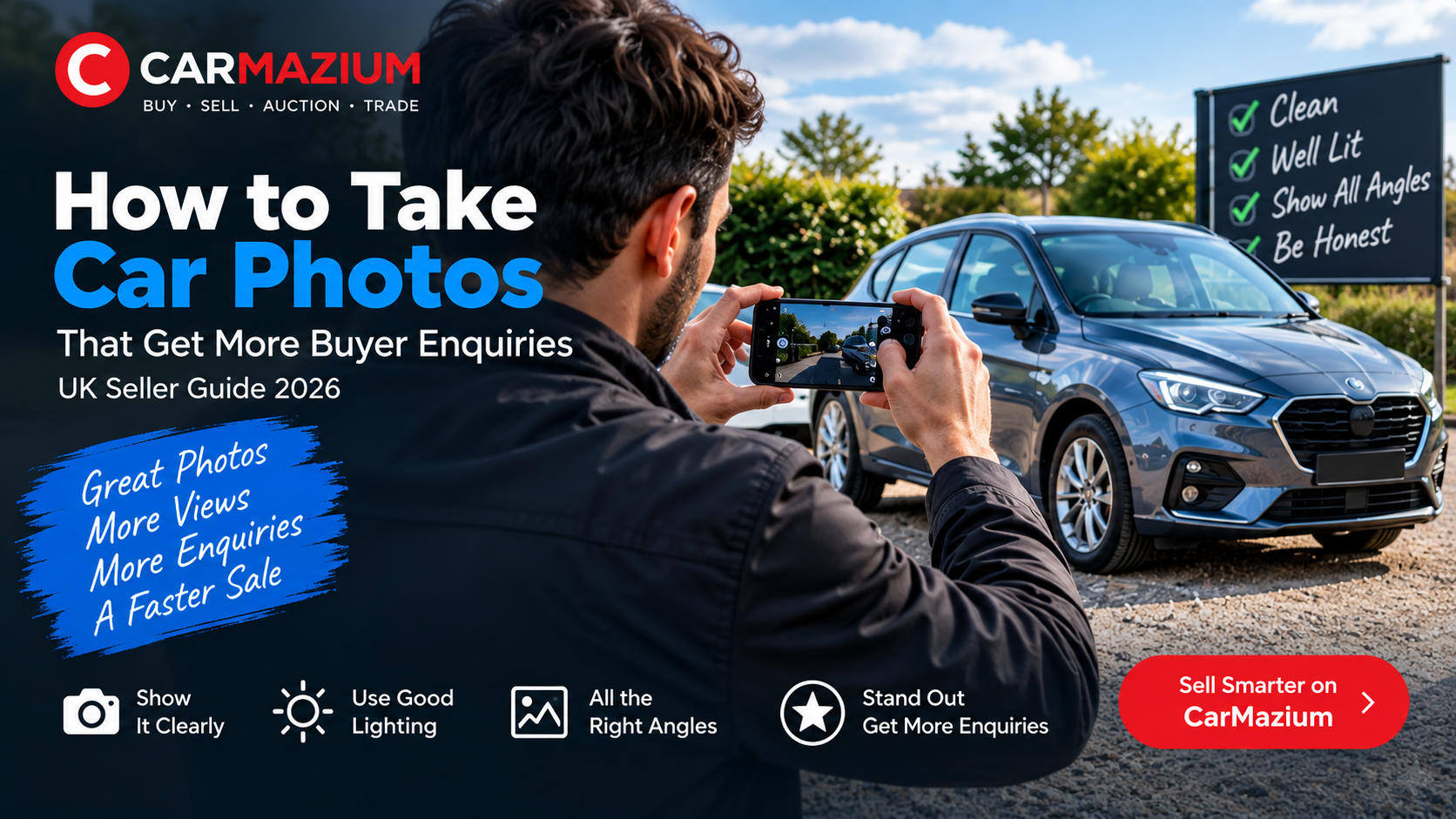
How to Take Car Photos That Get More Buyer Enquiries: UK Seller Guide 2026
Learn how to photograph a car for sale in the UK, including the best main image, essential exterior and interior angles, lighting, damage photos and common mistakes.
Why Isn't My Car Selling? 12 Common Reasons UK Sellers Get No Enquiries
If your car is getting views but no serious buyers, check these 12 common causes including price, photos, advert quality, condition, trust and buyer friction.
From the marketplace