
Cat S vs Cat N Cars: What Do They Mean and How Do They Affect Value?
What do Cat S and Cat N really mean? Learn the difference between structural and non-structural write-offs, how category markers affect value, and what UK sellers should know.
Cat S vs Cat N Cars: What Do They Mean and How Do They Affect Value?
You enter your registration into a vehicle-history checker.
Everything looks normal.
Then you see:
Insurance write-off: Category S
Or perhaps:
Category N
Immediately, several questions appear.
Can you still sell the car?
Is it safe to drive?
What exactly was damaged?
And perhaps most importantly for a seller:
How much has that category marker affected the car's value?
Cat S and Cat N vehicles are bought and sold throughout the UK, but they aren't valued in exactly the same way as equivalent cars without an insurance write-off history.
Understanding why starts with understanding what those letters actually mean.
What Is an Insurance Write-Off?
When an insured vehicle is damaged, the insurer assesses what has happened and determines how the claim should be handled.
A vehicle can be declared a total loss — commonly called a write-off — rather than being repaired by the insurer.
Importantly, the word “write-off” does not always mean the car can never be driven again.
The UK system distinguishes between vehicles that must not return to the road and vehicles that can potentially be repaired.
The current categories are:
Category A — Scrap
Category B — Break
Category S — Structurally damaged, repairable
Category N — Non-structurally damaged, repairable
The Association of British Insurers updated its Salvage Code of Practice in 2025 and continues to use these four classifications.
For most ordinary used-car buyers and sellers, Cat S and Cat N are the two categories they're most likely to encounter on cars that have returned to the road.
What Does Cat S Mean?
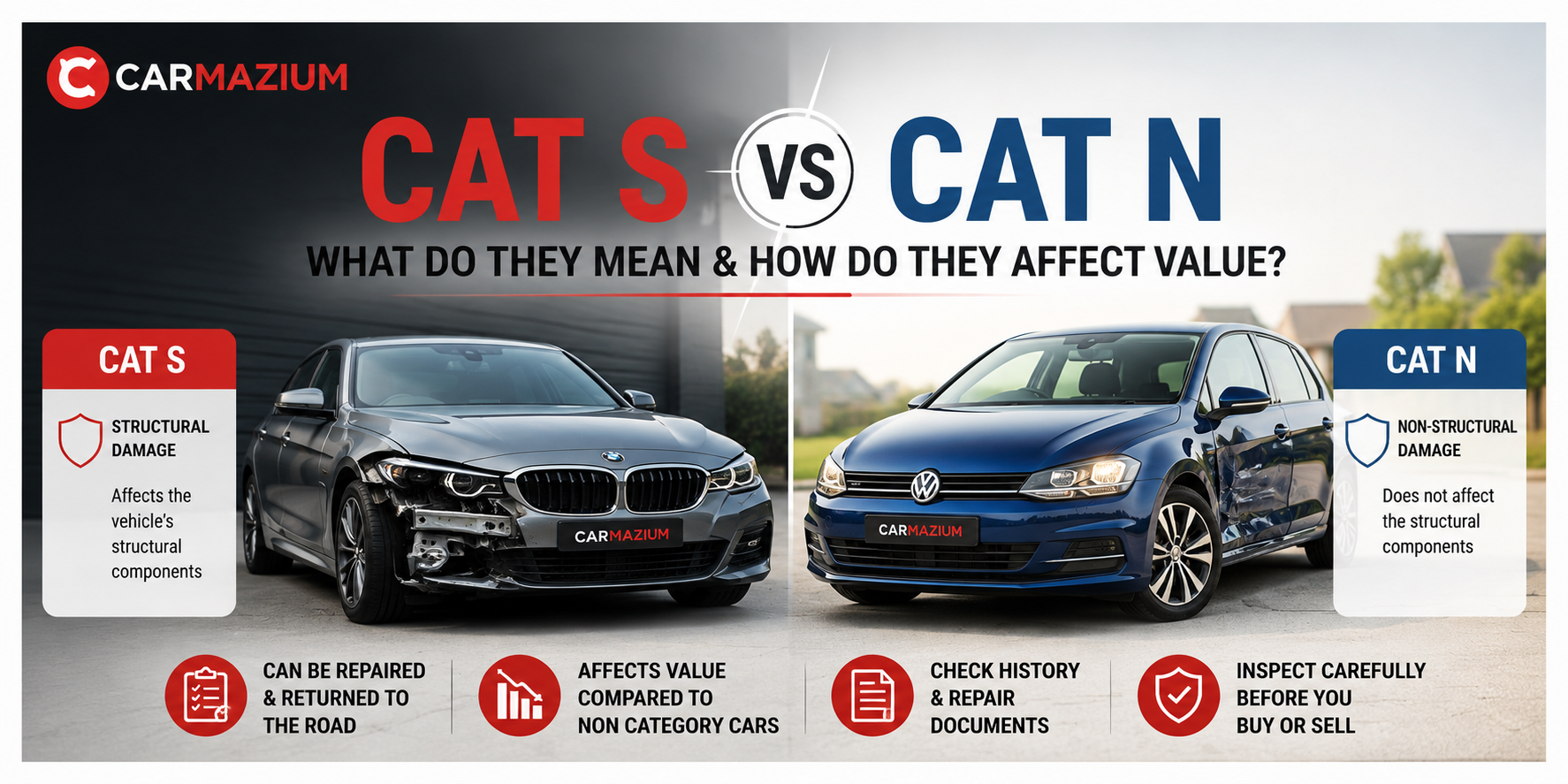
Cat S means Category S — structurally damaged repairable.
The vehicle has suffered damage involving its structural components.
That could involve areas forming part of the vehicle's structural frame or chassis.
The key point is:
Cat S = structural damage.
It doesn't mean the vehicle must automatically be scrapped.
GOV.UK states that Category S vehicles can be repaired and used again provided they are repaired to a roadworthy condition.
That's very different from Category A or B.
What Does Cat N Mean?
Cat N means Category N — non-structurally damaged repairable.
The insurer has classified the vehicle as a write-off, but its structural frame or chassis wasn't damaged in the way required for Category S.
Again:
Cat N = non-structural damage.
But don't make the mistake of interpreting “non-structural” as:
“Only cosmetic damage.”
A Cat N vehicle may still have damage involving components that are important to safe operation.
Auto Trader specifically notes that steering or suspension components, for example, can still require repair on a Cat N vehicle.
So the correct distinction is:
S = structural
N = non-structural
—not “serious” versus “nothing important.”
Cat S vs Cat N: The Simple Difference
Imagine two accident-damaged cars.
Car A
The accident damaged part of the vehicle's structural frame.
If the insurer writes it off under the salvage classification system, that may result in:
Category S
Car B
The vehicle suffered significant damage, but the structural frame wasn't damaged.
That may result in:
Category N
Both vehicles may potentially be repaired and returned to the road.
But their histories remain important to future buyers.
Does Cat S Mean the Car Is Unsafe?
Not automatically.
The category tells you about the type of damage that caused the insurance write-off.
It doesn't tell you that every repaired Cat S car currently on the road is unsafe.
GOV.UK explicitly permits Category S vehicles to be used again once repaired to a roadworthy condition.
The more useful question when considering a particular car is:
How well was it repaired?
That's why documentation and professional inspection can become particularly important with previously written-off vehicles.
Is Cat N Automatically Safe?
The same principle applies.
Don't assume:
“It's only Cat N, so there's nothing to worry about.”
Non-structural damage can still be expensive and significant.
Electrical systems, suspension, steering and other components can require substantial repairs without the vehicle necessarily falling into Category S.
A category marker should therefore be the beginning of your investigation — not the end of it.
Why Are Cars Written Off When They Can Still Be Repaired?
This is one of the biggest sources of confusion.
People often imagine that an insurer only writes off a completely destroyed vehicle.
That's not necessarily what happens.
A vehicle can become a total loss because repairing it isn't economically viable for the insurer.
The ABI explains that total-loss classification can occur where repair is uneconomical, as well as where repair isn't viable from a safety perspective.
Consider an older vehicle worth relatively little.
It might need:
Body panels.
Paintwork.
Lights.
Sensors.
Labour.
Replacement components.
Those costs can accumulate quickly.
Even though the vehicle could technically be repaired, doing so through the insurance process might no longer make economic sense.
Does Cat S or Cat N Affect Car Value?
Usually, yes.
A previous insurance write-off is material vehicle-history information.
Auto Trader says Cat S and Cat N vehicles are generally worth less than equivalent vehicles that haven't been written off and warns owners to expect a lower resale value later.
Why?
Because a future buyer isn't comparing only:
Make + model + year + mileage.
They're also considering:
Vehicle history.
Imagine two otherwise equivalent cars.
Vehicle 1
No recorded insurance write-off.
Vehicle 2
Previous Category S insurance write-off.
Many buyers will expect Vehicle 2 to cost less.
The discount compensates them for the additional history and uncertainty they're accepting.
How Much Does Cat S Reduce a Car's Value?
This is where sellers should be careful with online claims.
There is no universal percentage applicable to every Category S vehicle.
The effect depends on factors including:
Make and model
Age
Mileage
Current condition
Type of previous damage
Quality of repair
Repair documentation
Specification
Market demand
Buyer appetite
Auto Trader currently suggests a 20%–40% reduction from valuation as a guide when advertising certain category-marked vehicles, but that should not be interpreted as a guaranteed valuation formula for every Cat S or Cat N car.
In fact, Auto Trader says its standard private-advert valuation system may not be able to value vehicles carrying an insurance write-off category marker because there isn't always sufficient comparable information.
That's an important point.
Category cars need individual market assessment.
Is Cat S Worth Less Than Cat N?
Often buyers may view structural history more cautiously.
But don't assume you can simply apply one fixed discount to Cat S and another fixed discount to Cat N.
Consider:
Cat S Car A
Professionally repaired, comprehensive photographs, invoices, inspection documentation and excellent current condition.
Now compare:
Cat N Car B
Poor repair quality, incomplete records, warning lights and obvious problems.
Which would you rather buy?
The category matters.
But the quality and evidence of the repair matter too.
Repair Documentation Can Be Extremely Valuable
If you own a Cat S or Cat N car and have documentation relating to its repair, keep it.
Useful evidence could include:
Photographs before repair
Photographs during repair
Parts invoices
Bodyshop invoices
Alignment reports
Inspection reports
Receipts
Details of replacement components
Photographs after completion
Why?
Because a buyer wants to understand:
What actually happened to this car?
Auto Trader recommends providing documentation explaining the damage and repairs because evidence can improve buyer confidence.
A vague statement saying:
“Minor damage, fully repaired.”
is far less informative than actual evidence.
What If You Don't Know What Damage Happened?
This situation isn't unusual.
Perhaps you bought the vehicle after it had already been repaired.
You know it's Cat N or Cat S, but you don't have photographs of the original accident.
Don't invent a story.
Don't tell buyers:
“It was only a bumper.”
unless you can support that claim.
Instead, be precise about what you actually know.
For example:
“Vehicle is recorded as Category N. It was already repaired when I purchased it, and I don't have photographs of the original damage.”
Accuracy is better than speculation.
Should You Get a Category Car Professionally Inspected?
It can be a sensible option, particularly where repair history is limited.
Auto Trader recommends considering a professional inspection when buying Cat S or Cat N vehicles to check that repairs have been completed appropriately and that the vehicle is roadworthy.
For a seller, an independent assessment may also help answer buyer concerns.
That doesn't erase the category.
But it can provide additional information about the vehicle's current condition.
Does Cat S Show on the V5C?
There is an important distinction between Cat S and Cat N here.
GOV.UK states that if an owner retains a Category S vehicle following an insurance write-off, a replacement V5C must be obtained, and DVLA records the category on the log book.
Category N is handled differently.
That's another reason buyers shouldn't rely on simply looking at one document.
A proper vehicle-history check is important.
Can You Sell a Cat S Car?
Yes.
A properly repaired, roadworthy Category S vehicle can be sold.
The same applies to Category N.
But its history should be dealt with transparently.
When advertising one, provide as much useful information as possible about:
Category
Known previous damage
Repairs
Current condition
Supporting documents
Inspection evidence
The objective shouldn't be to hide the category.
The objective should be to give buyers enough information to make an informed decision.
Don't Try to Price It Like a Non-Category Car
This is one of the biggest mistakes sellers make.
They find an identical model online:
Same year.
Same engine.
Same mileage.
Advertised for £12,000.
Then they advertise their Cat S example for £11,900 because:
“Mine drives perfectly.”
But buyers aren't comparing identical histories.
The non-category vehicle and Category S vehicle occupy different positions in the market.
Your car may indeed drive beautifully.
But the recorded history still exists.
Your asking price needs to reflect the market's perception of that history.
Category Cars Can Still Have Buyers
A category marker doesn't make a vehicle impossible to sell.
For some buyers, a well-repaired Cat S or Cat N vehicle can offer an opportunity to buy a model they want at a lower price.
The trade-off is straightforward:
Lower purchase price in exchange for accepting the previous write-off history.
But buyers are likely to scrutinise:
Repair quality
Documentation
Insurance availability
Current condition
Resale implications
more closely.
Check Insurance Before Buying
Insurance should not be an afterthought.
Auto Trader notes that some insurers may charge more for Cat S or Cat N vehicles, while others may decline to cover them.
So anyone considering buying a category vehicle should check insurance availability and price before completing the purchase.
For sellers, understanding this helps explain why some potential buyers may be more cautious.
Cat S and Cat N vs the Old Cat C and Cat D System
Older used vehicles may still show the previous classifications:
Category C
and
Category D
The modern Cat S and Cat N system replaced the old approach in October 2017.
Broadly, the newer classification places greater emphasis on whether the damage was structural or non-structural, rather than primarily distinguishing vehicles according to repair economics.
That's why older cars can still appear in vehicle-history databases with Cat C or Cat D markers.
What About Category A and Category B?
These are fundamentally different.
According to GOV.UK:
Category A vehicles cannot be repaired and the entire vehicle must be crushed.
Category B vehicles cannot return to the road; the body shell must be crushed, although certain parts may be salvaged.
So don't confuse:
Cat S / Cat N
with:
Cat A / Cat B.
Cat S and N are repairable classifications.
A and B are not vehicles that can simply be repaired and returned to normal road use.
Vehicle History Checks Matter
When you're buying a used car, appearance alone doesn't tell its whole history.
A beautifully polished vehicle may still have:
Outstanding finance
Write-off history
Mileage discrepancies
Previous registration changes
Other recorded history
Auto Trader says its vehicle checks use Motor Insurance Bureau Vehicle Salvage & Theft Data to identify recorded insurance total-loss claims and category markers.
That's why vehicle-history information matters before money changes hands.
Selling a Category Vehicle Through CarMazium
If you're listing a previously written-off vehicle, accuracy is particularly important.
Provide the correct category.
Include clear photographs.
Describe known damage.
Upload or retain repair evidence where appropriate.
Mention relevant inspections.
Don't hide defects.
Different professional motor traders may assess the same category vehicle differently.
One dealer may specialise in repaired vehicles.
Another may be comfortable with Cat N but avoid Cat S.
Another may want the exact make and model you're selling.
That means market demand can still vary significantly between buyers.
The Most Important Rule: Be Transparent
A category marker isn't something sellers should try to disguise.
Instead, make it part of an accurate vehicle description.
A buyer who discovers undisclosed history after becoming interested in the car immediately loses confidence.
A buyer who sees:
“Category N — professionally repaired, photographs and repair invoices available”
knows what they're considering from the beginning.
Transparency doesn't remove the history.
But it makes the transaction clearer.
Frequently Asked Questions
What does Cat S mean?
Category S means the vehicle was written off after suffering structural damage but can be repaired and returned to the road if made roadworthy.
What does Cat N mean?
Category N means the vehicle was written off following non-structural damage. It can also return to the road once repaired to a roadworthy condition.
Is Cat S worse than Cat N?
Cat S specifically indicates structural damage, whereas Cat N indicates non-structural damage. However, the current condition and quality of repairs still need to be assessed individually.
Can you sell a Cat S or Cat N car?
Yes. Repairable Cat S and Cat N vehicles can be sold once properly repaired and roadworthy.
Does Cat S reduce car value?
Generally yes. Category-marked vehicles commonly sell for less than equivalent vehicles without recorded write-off history. The actual reduction varies by vehicle and market.
Does Cat N reduce value?
It can. Even though Cat N is non-structural, the insurance write-off remains part of the vehicle's history and can affect buyer demand and resale value.
Can a Category S car be safe?
A Cat S vehicle can return to the road after being repaired to a roadworthy condition. Buyers should still investigate the quality of structural repairs carefully.
Should I buy a Cat S or Cat N car?
That depends on the individual vehicle, price, repair quality, documentation and your attitude to its previous history. Consider an independent inspection and check insurance before buying.
Final Thoughts
Three things matter when dealing with Cat S and Cat N vehicles:
What happened.
How it was repaired.
What it's worth now.
The category tells you an important part of the vehicle's history, but it doesn't tell you everything about the car sitting in front of you today.
A properly repaired vehicle with comprehensive evidence is very different from one with unknown damage and questionable repairs.
For sellers, the best strategy is therefore simple:
Know the category.
Understand what you can prove.
Describe it accurately.
Price it realistically.
And allow the market to decide what the vehicle is worth.
Sell your car your way
Ready to turn your research into a real sale?
List in the CarMazium dealer auction for £0, or advertise retail from £1. Qualifying successful auction sales can receive a £100 seller incentive.
Keep reading
Related automotive guides

Selling an Electric Car in the UK: Battery Health, Range & Value Guide 2026
Selling an electric car? Learn how battery health, real-world range, charging speed, warranty, service history and charging cables can affect buyer confidence and your EV's value.
Do Previous Owners Affect a Car's Value? UK Guide 2026
Does a one-owner car really sell for more? Learn how previous keepers can affect used-car value, why ownership history matters and what sellers can do when a car has changed hands several times.

Do Optional Extras Increase Your Car's Value? UK Guide 2026
Panoramic roofs, heated seats, upgraded wheels and technology packs can make a used car more desirable. Find out which optional extras can add value and which may add very little when you sell.
From the marketplace