
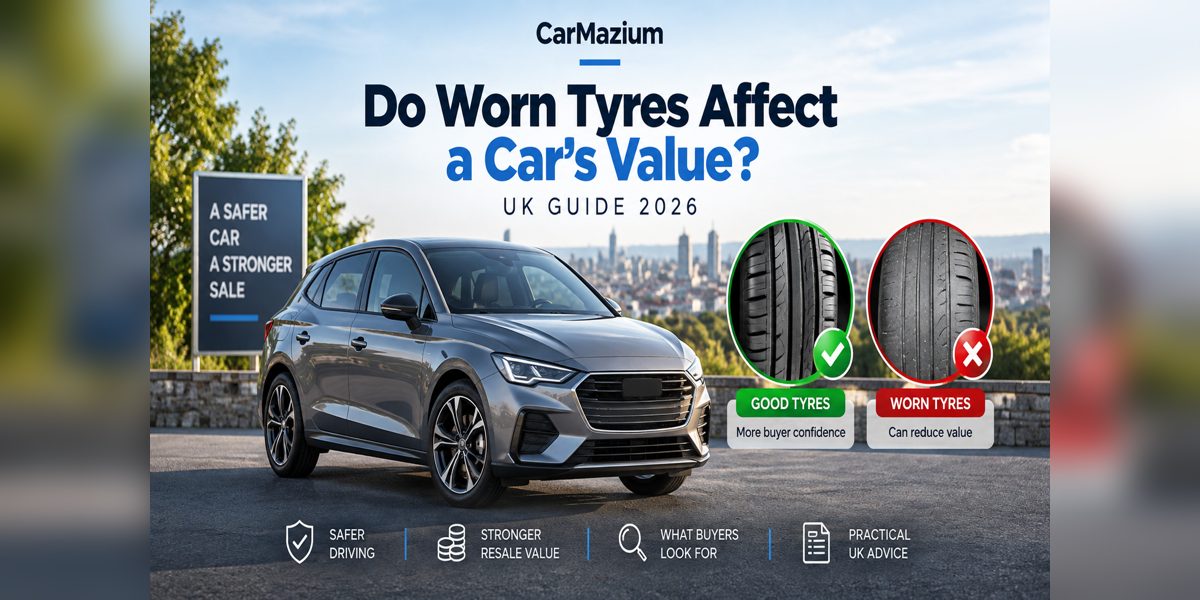
Do Worn Tyres Affect a Car's Value? UK Guide 2026
Do worn tyres reduce a car's value? Learn the UK tyre rules, what buyers and dealers notice, and when replacing tyres before selling may be worthwhile.
In this article
Tyres are one of the first mechanical wear items a buyer can inspect without opening the bonnet.
They are visible, easy to understand and expensive enough to influence a negotiation.
That makes them more important to a used-car sale than many sellers realise.
A vehicle with four healthy, correctly matched tyres can give a buyer confidence that the car has been maintained properly. A similar vehicle with tyres close to the legal limit, uneven wear or visible damage can immediately create questions about safety, maintenance and the cost of putting the car right.
But that does not mean every seller should automatically fit four new tyres before advertising.
The right decision depends on the condition of the tyres, the value of the car, the type of buyer and the likely replacement cost.
Do Worn Tyres Really Affect a Car's Value?
Yes, tyre condition can affect both buyer confidence and the price a buyer is prepared to pay.
Auto Trader's current valuation guidance says private valuations assume a vehicle is in good condition for its age, while overall condition can move the real-world value above or below a guide price.
Tyres form part of that condition.
RAC's used-car buying checklist specifically tells buyers to inspect the tyres and factor replacement cost into the deal when tread is getting low.
That is the practical reason worn tyres can affect resale value.
The buyer is not only looking at what the car is worth today.
They are also asking:
How much will I need to spend immediately after buying it?
If the answer includes two or four tyres, that cost can become part of the negotiation.
What Is the Legal Tyre Tread Depth in the UK?
For cars, light vans and light trailers, the legal minimum tyre tread depth is 1.6 mm.
According to GOV.UK vehicle-safety guidance, that tread must be present across the central three-quarters of the tyre and around its entire circumference.
Tyres should also be free from serious cuts and other defects.
The Highway Code gives the same 1.6 mm minimum for cars and says tyres must be correctly inflated to the manufacturer's specification.
This is a legal minimum, not a target for a car being prepared for sale.
A tyre can still be legal while being close enough to the limit that a buyer expects to replace it soon.
Why Buyers Care Before the Tyre Becomes Illegal
RAC's current used-car buying guidance tells buyers that tyres below 3 mm are getting close to the legal limit and that replacement cost should be considered when assessing the vehicle.
That does not create a new legal threshold.
The legal minimum remains 1.6 mm.
But it shows the difference between:
- legal, and
- commercially attractive to a buyer.
A buyer who sees four tyres at around 2 mm may reasonably think:
I will probably be buying four tyres soon.
That can change their offer.
A seller who says "they are still legal" may be technically correct but may not remove the buyer's concern.
Tyres Can Affect More Than the Final Price
Poor tyres can influence several parts of the sale.
They can affect:
- the number of enquiries,
- the buyer's first impression,
- negotiation,
- test-drive confidence,
- dealer appraisal,
- MOT confidence,
- and how quickly the car sells.
That means tyre condition can affect saleability even where it does not create a precise pound-for-pound reduction.
What Buyers Usually Check
A careful buyer may look at more than tread depth.
Common tyre checks include:
- remaining tread,
- cuts,
- bulges,
- cracking,
- uneven wear,
- tyre pressure,
- mismatched tyres,
- damaged sidewalls,
- evidence of poor tracking,
- and whether the tyres suit the vehicle.
RAC's buying checklist also tells buyers to look for even tyre wear and notes that uneven wear can indicate alignment problems.
So a badly worn tyre can raise a second question:
Why has it worn like that?
That can be more important than the tyre itself.
Uneven Tyre Wear Can Suggest Another Problem
Suppose one front tyre is heavily worn on the inside edge while the other three look normal.
A buyer may wonder whether the car has:
- poor wheel alignment,
- worn suspension components,
- incorrect tyre pressures,
- accident damage,
- or another geometry issue.
The tyre may be the visible symptom rather than the whole problem.
If you are preparing a car for sale and the wear pattern is unusual, simply fitting another tyre without investigating the cause may not be enough.
Have the underlying issue checked.
A Recent MOT Does Not Mean the Tyres Are Perfect
This is an important distinction.
A valid MOT shows that the vehicle met the relevant test requirements at the time of the test.
It does not guarantee that the tyres remain in the same condition months later.
GOV.UK explicitly says a vehicle can be unsafe even if it has a current MOT certificate.
Tyres wear every time the car is driven.
So a seller should check the current condition rather than relying only on the MOT date.
Our guide to MOT history and car value explains why buyers increasingly look at the pattern of advisories and failures as well as the latest certificate.
Tyres and MOT Advisories
Tyre advisories can attract attention in the vehicle's MOT history.
Examples might relate to:
- low tread,
- cracking,
- uneven wear,
- damage,
- or tyre condition.
If the latest MOT contains a tyre advisory and the same tyre is still fitted when a buyer arrives, the buyer may assume the issue has not been addressed.
If the tyres have since been replaced, keep the invoice.
That gives you simple evidence that the advisory was dealt with.
It can also help the advert.
For example:
Two front tyres replaced after the last MOT — invoice available.
That is more reassuring than leaving the buyer to guess.
Should You Replace Tyres Before Selling?
Sometimes yes.
Sometimes no.
The decision should be commercial rather than emotional.
Replacing Tyres May Be Worthwhile When
Replacement can make sense if:
- the tyres are illegal,
- they have dangerous damage,
- they are extremely close to the legal limit,
- the car is otherwise in excellent retail condition,
- the vehicle is relatively valuable,
- a tyre advisory is likely to dominate negotiations,
- or the car's buyer group expects high-quality tyres.
A premium or performance car on obviously poor tyres can create a particularly bad impression.
RAC notes that buyers of more expensive or performance cars may expect matching premium tyres rather than a mixture of budget brands.
Replacement May Not Be Worthwhile When
It may make less financial sense if:
- the vehicle is very low value,
- the tyres are legal and have reasonable life remaining,
- the buyer is a trader who will prepare the car themselves,
- you would need to fit expensive tyres but cannot recover the cost,
- or the car has larger mechanical or cosmetic issues that matter more.
Do not spend £600 trying to gain £300.
The aim is not to make the car perfect.
The aim is to present it honestly and sensibly for its market.
Four New Tyres Do Not Automatically Add Their Full Cost to the Car
This is a common seller mistake.
Imagine four tyres cost you £500.
That does not mean the car's market value automatically increases by £500.
Why?
Because a buyer already expects a used car to be roadworthy and reasonably maintained.
New tyres can improve desirability and remove a reason for negotiation, but they do not necessarily create a separate £500 premium.
Think of them as protecting value rather than always adding value.
This is similar to other preparation work.
Our guide to repairing scratches and dents before selling uses the same principle: spend where the improvement is likely to matter to the buyer.
Two New Tyres or Four?
If only two tyres need replacement, sellers sometimes wonder whether they should change all four.
There is no simple resale rule requiring four new tyres on an ordinary car.
The decision depends on:
- the condition of the remaining pair,
- manufacturer guidance,
- tyre type,
- drivetrain,
- and whether matched tyres are especially important for the vehicle.
For some performance and four-wheel-drive vehicles, tyre matching and tread differences can matter more mechanically.
If you are unsure, follow the manufacturer's guidance or ask a competent tyre specialist.
For the advert, be accurate.
If two tyres are new and two are older, say so if it is a useful selling point.
Matching Tyres Can Improve the Impression of the Car
A buyer may feel more comfortable seeing four tyres of the same brand and model, particularly on:
- performance cars,
- prestige vehicles,
- sports cars,
- premium SUVs,
- and enthusiast models.
A random mixture of very cheap tyres can create a different impression.
It may lead the buyer to ask whether maintenance was always done at the lowest possible cost.
That does not mean budget tyres automatically make a car bad.
It means the tyres can become part of the car's maintenance story.
Premium Tyres on a Cheap Car
The opposite mistake is overspending.
Putting an expensive set of premium tyres on an inexpensive older hatchback shortly before selling may not produce a financial return.
The buyer may appreciate them, but the market ceiling for the car remains the market ceiling.
If replacement is necessary, choose a reputable tyre that is appropriate for the vehicle and the likely buyer.
Do not assume the most expensive option creates the highest resale price.
Tyre Damage Matters Even With Good Tread
Tread depth is not the only issue.
A tyre may have plenty of tread but still be unsafe or unattractive because of damage.
Look for:
- bulges,
- deep cuts,
- exposed cords,
- major cracking,
- foreign objects,
- sidewall damage,
- and obvious deformation.
The current DVSA MOT inspection manual treats serious tyre defects as major or dangerous failures depending on the issue.
A tyre with a bulge caused by structural failure, for example, is not something to ignore because the tread is still deep.
Check the Spare Tyre Too
Not every modern car has a full-size spare.
Some use:
- a space-saver,
- a tyre repair kit,
- run-flat tyres,
- or no spare at all.
If the car originally came with a spare or repair kit, make sure the equipment is present where reasonably expected.
A missing compressor, expired sealant kit or flat spare may not change the value dramatically, but it can create another small buyer objection.
Several small objections together can weaken the sale.
Tyre Pressure Can Affect the Viewing
A car sitting on visibly soft tyres creates a poor first impression.
It can suggest the vehicle has been standing for a long time or has not been checked before the viewing.
Before advertising or showing the car:
- check the recommended pressures,
- adjust them when appropriate,
- and inspect the tyres for obvious leaks or damage.
Correct tyre pressure also makes the test drive feel more representative.
Clean Tyres, But Do Not Hide Damage
Presentation helps.
Cleaning road grime from the wheels and tyres can make the car look better in photographs.
Auto Trader's preparation guidance recommends cleaning the wheels and checking that the tyres are in good condition before sale.
But do not use presentation to disguise problems.
Heavy tyre dressing should not be used to hide:
- sidewall cracking,
- scuffs,
- cuts,
- or other damage.
A buyer should be able to assess the true condition.
Should You Photograph the Tyres in the Advert?
For an ordinary used car, you do not necessarily need four close-up tyre photographs.
But tyre pictures can help when:
- all four tyres are recent,
- premium tyres are fitted,
- the car is performance-focused,
- there is a recent receipt,
- or tyre condition is an obvious selling point.
One clear photograph showing a healthy tyre and wheel can support the description.
For an enthusiast car, buyers may actively care about the exact tyre brand and model.
Mention Recent Tyres in the Description
If you have recently spent money on good tyres, tell buyers.
Useful wording includes:
Four matching tyres fitted recently.
Two new front tyres with receipt.
Matching premium tyres with strong tread.
Avoid exaggerated wording such as:
Brand-new tyres
unless they genuinely are new.
If the tyres have already covered several thousand miles, "recently replaced" is more accurate.
Worn Tyres and Dealer Offers
A dealer preparing a car for retail has to consider preparation cost.
If your car needs:
- two tyres,
- wheel alignment,
- an MOT,
- and cosmetic work,
those costs can influence the offer.
A dealer is not only valuing the car as it sits.
They are considering what it will cost to make it retail-ready.
That is why correcting obvious tyre issues before sale can sometimes improve an offer or at least reduce deductions.
But it is not guaranteed.
Different dealers have different preparation costs, stock needs and buyer profiles.
CarMazium's dealer auction gives verified traders the opportunity to compete for the vehicle rather than relying on one appraisal. You can start with a CarMazium valuation and see how the market responds.
Worn Tyres and Private Buyers
Private buyers often react differently from traders.
A trader may already know the wholesale cost of replacement tyres.
A private buyer may search retail tyre prices on their phone and deduct the full visible cost from their offer.
They may also add a margin for inconvenience.
For example, if a buyer believes the car needs four tyres immediately, they may negotiate more aggressively than the actual replacement cost justifies.
Removing that objection can sometimes make a private sale easier.
How Tyres Interact With Mileage
High mileage does not automatically mean poor tyres.
Low mileage does not automatically mean good tyres.
A car can cover very few miles and still have tyres with:
- cracking,
- pressure problems,
- flat spots,
- or age-related deterioration.
Likewise, a high-mileage motorway car may have recently fitted tyres in excellent condition.
So tyre condition should be checked independently from the odometer.
For the broader valuation picture, see how mileage affects car value.
How Tyres Interact With Service History
Tyres are not normally the main feature of a service history, but maintenance records can help demonstrate responsible ownership.
Invoices for:
- tyres,
- alignment,
- suspension repairs,
- wheel refurbishment,
- and MOT work
can make the vehicle's history easier to understand.
This matters especially if the MOT history previously showed tyre or suspension advisories.
A documented repair closes the loop.
Our guide to service history and car value explains why paperwork can strengthen buyer confidence.
What If the Tyres Are Legal but Cheap?
Do not panic.
Budget tyres do not automatically make the car difficult to sell.
On an inexpensive city car, buyers may care more about:
- tread,
- safety,
- matching condition,
- recent MOT,
- service history,
- and overall value.
On a high-performance or premium car, tyre brand and matching specification can matter more to the target buyer.
Context matters.
What If the Wheels Are Damaged Too?
Tyres and wheels are visually connected.
A car with healthy tyres but heavily kerbed or corroded wheels can still look neglected.
If the wheels need attention, decide whether refurbishment makes financial sense for the value of the vehicle.
Again, do not assume every pound spent returns a pound in resale value.
Focus on the issues most likely to affect buyer confidence.
A Practical Pre-Sale Tyre Checklist
Before photographing the car, check all four tyres.
Look at:
- tread depth,
- cuts and bulges,
- sidewall condition,
- uneven wear,
- tyre pressures,
- whether the tyres match appropriately,
- any MOT advisories,
- invoices for recent replacements,
- the spare or repair kit,
- and whether the wheels suggest alignment or impact damage.
If anything looks questionable, have it inspected before inviting buyers to test drive the vehicle.
Frequently Asked Questions
Do Tyres Affect Part-Exchange Value?
They can.
A dealer may reduce an offer if the car requires tyre replacement before retail sale.
The amount depends on the vehicle, tyre size, replacement cost and the dealer's own preparation process.
Should I Replace Tyres at 3 mm Before Selling?
Not automatically.
3 mm is not the legal minimum for a car; 1.6 mm is.
But buyers may view tyres near the lower end of their usable life as an upcoming expense.
Whether replacement is worthwhile depends on the car's value and the likely negotiation.
Can I Sell a Car With Tyres Below 1.6 mm?
A car with tyres below the legal tread requirement is not roadworthy for normal road use.
Do not treat illegal tyres as a minor cosmetic issue.
Replace or properly address them before the vehicle is driven on the road.
Do New Tyres Increase Car Value?
They can improve buyer confidence and reduce reasons for negotiation.
But they do not automatically increase the vehicle's market value by the full amount you spent.
Often they protect the existing value rather than create a separate premium.
Are Matching Tyres Important?
They can be, particularly on performance, prestige and certain four-wheel-drive vehicles.
For an ordinary car, condition and suitability may matter more than having four identical premium tyres.
Should I Mention Tyre Brand in the Advert?
If the tyres are a genuine selling point, yes.
This can be useful on performance or enthusiast vehicles where buyers care about tyre choice.
For an ordinary car, "four recent matching tyres" may be enough.
The Bottom Line
Worn tyres can reduce a car's resale appeal because buyers see them as both a safety issue and an immediate cost.
The UK legal minimum for car tyre tread is 1.6 mm across the central three-quarters of the tread and around the full circumference, but a tyre does not need to be illegal before it starts affecting a buyer's offer.
Before selling, check tread depth, wear pattern, damage, pressure and recent MOT advisories.
Replace tyres when there is a clear safety or commercial reason to do so, but do not assume an expensive new set will automatically add the same amount to the sale price.
The strongest approach is simple:
present a safe, honest, well-maintained car and remove obvious reasons for the buyer to negotiate.
When you are ready to test the market, sell your car through CarMazium and compare your options.
Sell your car your way
Ready to turn your research into a real sale?
List in the CarMazium dealer auction for £0, or advertise retail from £1. Qualifying successful auction sales can receive a £100 seller incentive.
Keep reading
Related automotive guides
Do Dashboard Warning Lights Affect a Car's Value? UK Guide 2026
Can dashboard warning lights reduce a car's value? Learn what engine, ABS, airbag, ESC and TPMS lights can mean for UK buyers, MOTs and resale negotiations.
Does ULEZ Compliance Affect a Car's Value? UK Guide 2026
Can ULEZ or Clean Air Zone compliance affect a used car's value? Learn the 2026 rules, which cars normally qualify, and how compliance can influence buyer demand.
Does Car Colour Affect Resale Value? UK Guide 2026
Does car colour affect resale value? See the latest UK used-car colour data, which shades attract the widest demand, and when colour can help or hurt a sale.
From the marketplace