

How Does Mileage Affect Your Car's Value? UK Guide for 2026
Does high mileage automatically mean your car is worth less? Discover how mileage, age, service history and condition influence used-car values in the UK.
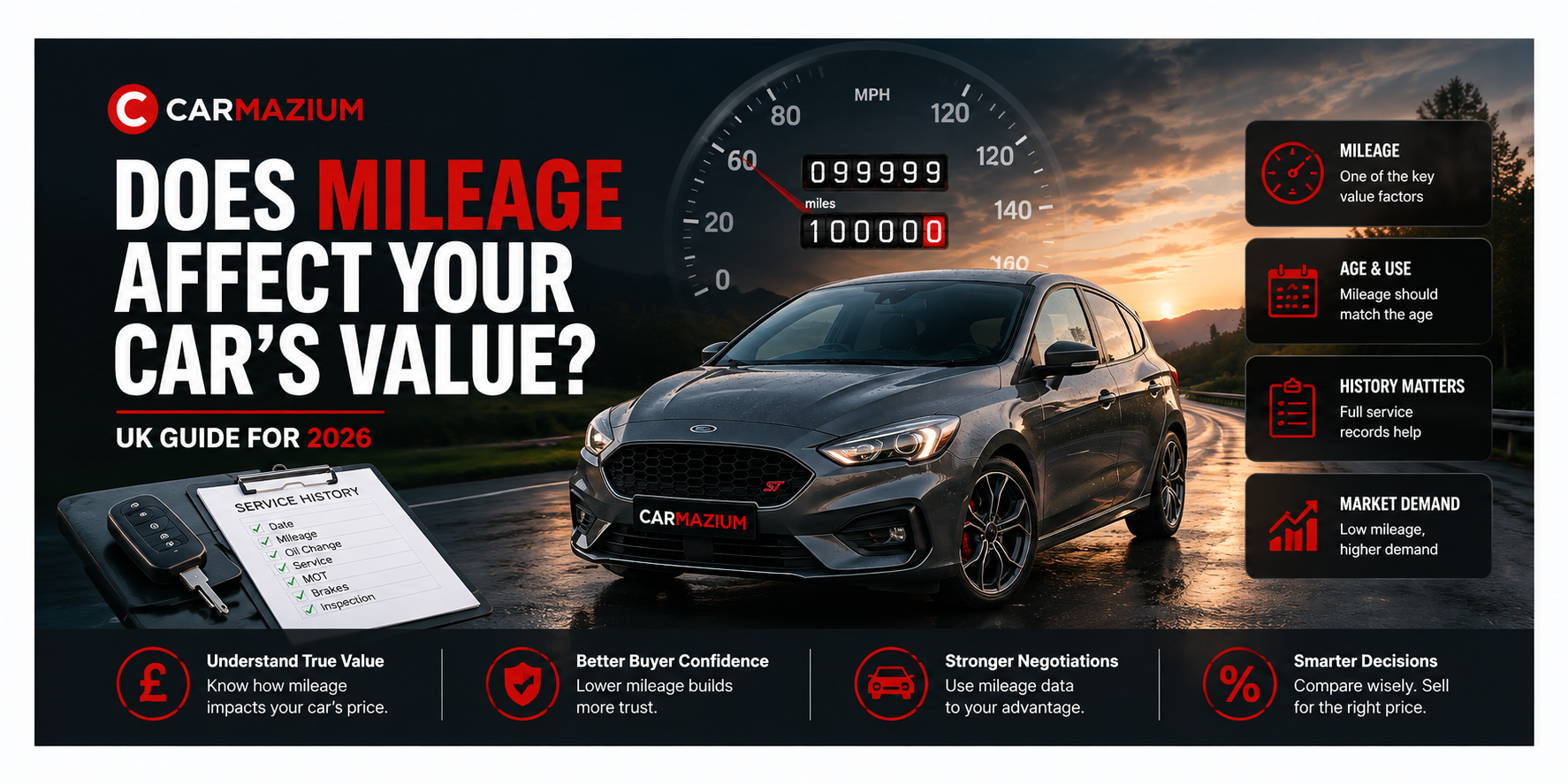
How Does Mileage Affect Your Car's Value? UK Guide for 2026
Two cars can leave the factory on exactly the same day.
They can be the same model, have the same engine, the same gearbox and even the same colour.
Ten years later, one has covered 45,000 miles.
The other has covered 120,000.
Should they still be worth the same amount?
Almost certainly not.
Mileage is one of the major pieces of information buyers and motor traders consider when valuing a used car.
But there's a common misconception:
High mileage does not automatically mean a bad car, and low mileage does not automatically mean a good one.
Understanding that difference is particularly important when you're trying to work out what your car is really worth.
Why Does Mileage Affect a Car's Value?
Every mile represents use.
As mileage increases, components including tyres, brakes, suspension, bearings, clutches and other mechanical parts accumulate wear.
That's one reason higher-mileage cars will generally have lower resale values than otherwise comparable lower-mileage examples.
Professional valuation systems don't look at mileage in isolation, however.
A proper valuation may consider:
- Make and model
- Age
- Mileage
- Engine
- Fuel type
- Gearbox
- Specification
- Optional equipment
- Condition
- Service history
- MOT history
- Previous ownership
- Market demand
- Current supply
Think of mileage as one part of a much larger valuation equation.
What Is Considered Average Mileage in the UK?
There is no magic number that every car should cover each year.
Driving patterns vary enormously.
A person working from home might cover only a few thousand miles annually.
A motorway commuter or company-car driver could cover several times that amount.
As a broad rule of thumb, around 10,000 miles per year is commonly used when comparing a used vehicle's mileage with its age.
So a five-year-old car showing 50,000 miles wouldn't necessarily appear unusual.
A five-year-old car with 100,000 miles, however, would clearly have experienced much heavier-than-average use.
But that still doesn't tell you whether it's a good or bad vehicle.
Is 100,000 Miles Still the Point Where a Car Becomes "High Mileage"?
The 100,000-mile figure has enormous psychological importance in the used-car market.
Buyers see:
99,000 miles
and:
101,000 miles
very differently, even though mechanically those cars may be virtually identical.
Modern vehicles can travel considerably beyond 100,000 miles when correctly maintained.
The real questions should therefore be:
How were those miles accumulated?
and:
How was the vehicle maintained while accumulating them?
A well-maintained motorway car with 110,000 miles can potentially be a more attractive proposition than a neglected 60,000-mile vehicle.
Motorway Miles and Urban Miles Are Not Necessarily Equal
Mileage tells you how far a vehicle travelled.
It doesn't tell you how it travelled.
Consider two cars that each covered 20,000 miles.
Car A
Most of its mileage came from long motorway journeys.
The engine regularly reached normal operating temperature and spent long periods travelling at relatively consistent speeds.
Car B
Its mileage came predominantly from short urban journeys.
It experienced thousands of:
- cold starts
- speed bumps
- gear changes
- braking events
- potholes
- stop-start traffic situations
Both odometers show exactly the same mileage.
But their mechanical lives may have been very different.
This is why mileage should never be used as the only measurement of a used car's condition.
Why Service History Can Matter So Much
Imagine you're choosing between:
Car A: 65,000 miles with incomplete service records.
Car B: 85,000 miles with comprehensive service history and invoices showing regular maintenance.
Which would you prefer?
Many knowledgeable buyers would at least investigate Car B.
A documented service history provides evidence of how a vehicle has been maintained throughout those miles.
Depending on the vehicle, records may demonstrate work such as:
- oil and filter changes
- brake replacement
- timing belt replacement
- gearbox servicing
- coolant changes
- spark plugs
- suspension repairs
- manufacturer scheduled maintenance
When selling your car, don't underestimate the value of keeping these records together.
A pile of invoices might look like paperwork to you.
To a buyer, it can be evidence that the vehicle has been looked after.
Very Low Mileage Isn't Automatically Perfect Either
Low mileage sounds ideal.
Sometimes it is.
But extremely low mileage relative to age deserves investigation too.
Cars are designed to be driven.
A vehicle that has spent long periods stationary can experience problems involving:
- batteries
- tyres
- brakes
- seals
- fluids
- corrosion
Short journeys can create their own problems because an engine may repeatedly operate without spending enough time at full operating temperature.
So when you see a ten-year-old vehicle showing unusually low mileage, don't automatically assume:
"Lower mileage means better car."
Ask why the mileage is so low and look at the overall history.
Mileage Isn't the Same for Every Type of Car
The market doesn't judge mileage equally across every vehicle.
Consider a luxury sports car and a diesel estate.
A buyer might consider 80,000 miles relatively high for the sports car.
The same mileage may appear entirely normal on a diesel estate that has spent its life travelling long motorway distances.
Commercial vehicles provide an even more obvious example.
High annual mileage can be completely normal for a van.
The significance of mileage therefore depends partly on what the vehicle was designed to do.
Age and Mileage Need to Be Considered Together
Mileage without age has limited meaning.
Suppose you see:
60,000 miles
Is that high?
You can't answer until you know the vehicle's age.
For a two-year-old car, 60,000 miles represents heavy use.
For a ten-year-old vehicle, it may be relatively modest.
For a twenty-year-old car, it could be exceptionally low.
That's why buyers usually consider:
Mileage relative to age
rather than mileage alone.
What Happens to a Car's Value as Mileage Increases?
In general, additional mileage reduces the value of an otherwise identical vehicle.
But depreciation isn't a perfectly straight line.
The market often reacts more noticeably around mileage thresholds because buyers frequently search using filters such as:
- Under 30,000 miles
- Under 40,000 miles
- Under 50,000 miles
- Under 60,000 miles
- Under 80,000 miles
- Under 100,000 miles
Crossing one of these thresholds can potentially remove a vehicle from searches performed by buyers who set a maximum-mileage filter.
That's an important point.
Sometimes mileage affects value not only because of mechanical wear, but because it affects how many potential buyers will consider the vehicle.
Current Market Conditions Matter Too
Mileage doesn't operate independently from the wider used-car market.
If affordable vehicles are in particularly strong demand, an older high-mileage car may still attract significant buyer interest.
Likewise, if there is an oversupply of a particular model, buyers may have enough choice to prioritise lower-mileage examples.
That's why a formula such as:
"Every 10,000 miles removes £X from a car's value"
is unreliable.
The adjustment depends on the actual vehicle and the market surrounding it.
What Does Current 2026 Market Data Tell Us?
Recent UK valuation data provides a useful illustration.
Cap hpi's August 2026 market overview reported different movements according to vehicle age and mileage.
Its benchmark for three-year-old vehicles at 60,000 miles moved only modestly, while the older/higher-mileage profiles experienced greater pressure.
Values for the five-year/80,000-mile profile declined by an average of 1.5%, while the 10-year/100,000-mile profile declined by 2.8% in the period analysed.
This doesn't mean every 100,000-mile vehicle suddenly lost 2.8%.
It demonstrates something more useful:
Age, mileage and current market demand interact with each other.
Does Driving Another 5,000 Miles Significantly Reduce Your Car's Value?
Usually you shouldn't stop using a car simply because you're frightened of adding a few miles.
But if you're already planning to sell, mileage can become relevant when the vehicle is close to an important psychological threshold.
For example:
49,500 → 50,500 miles
or:
98,500 → 101,000 miles
may matter more commercially than:
71,000 → 73,000 miles
because the first examples cross commonly recognised mileage boundaries.
That doesn't mean you should rush into a poor selling decision.
It simply means mileage is worth considering alongside timing.
Can You Improve the Value of a High-Mileage Car?
You can't remove genuine mileage.
And you should never attempt to disguise or manipulate it.
What you can do is make the vehicle's history and condition easy for a buyer to understand.
Before selling, consider gathering:
- V5C
- Current MOT information
- Service book
- Digital service records
- Maintenance invoices
- Receipts for major repairs
- Both keys
- Owner's manuals
If important maintenance has recently been completed, keep evidence of it.
For a higher-mileage vehicle, documentation can be particularly reassuring.
Don't Hide the Mileage
When advertising or listing a vehicle, provide accurate mileage.
Trying to disguise a car's mileage is counterproductive.
Professional motor traders routinely assess vehicle history and condition before purchasing stock.
Accurate information allows buyers to value the vehicle properly from the beginning.
Transparency can therefore help create a smoother transaction.
What Actually Determines What Your Car Is Worth?
Mileage matters.
But the market ultimately determines value.
A car is worth what a genuine buyer is prepared to pay for it at that point in time.
Consider two identical vehicles:
Vehicle 1
45,000 miles Poor bodywork Missing service history One key Short MOT
Vehicle 2
65,000 miles Excellent condition Comprehensive service records Two keys Long MOT
The first car has lower mileage.
That doesn't guarantee it will be the more desirable vehicle.
This is why reducing an entire valuation to one odometer reading can be misleading.
How CarMazium Can Help Sellers Discover Market Value
Traditional online valuations are useful because they provide a starting point.
But an estimated valuation and an actual buying offer aren't necessarily the same thing.
CarMazium takes a market-based approach.
When your vehicle is presented to competing motor traders, those buyers can assess factors including its:
- mileage
- age
- condition
- specification
- history
- desirability
- potential resale market
Competition between genuine buyers can help reveal what the trade market is actually prepared to pay.
For a higher-mileage vehicle in particular, that can be more useful than assuming the car has little value simply because its odometer has passed an arbitrary number.
Frequently Asked Questions
Is 100,000 miles too much for a used car?
Not automatically. Vehicle condition, maintenance, model, engine and previous use all matter. A properly maintained 100,000-mile car can still have considerable usable life remaining.
Does high mileage reduce a car's value?
Generally, yes. When comparing otherwise similar vehicles, the higher-mileage example will normally have a lower resale value because mileage is associated with additional use and wear.
Is 10,000 miles per year high?
Around 10,000 miles annually is commonly used as a broad UK benchmark. However, there is no universal "correct" annual mileage because driving habits vary significantly.
Is low mileage always better?
No. Very low mileage can be attractive, but condition and history should still be checked. Vehicles that spend long periods unused can develop their own problems.
Is service history more important than mileage?
Both matter. A higher-mileage vehicle with excellent maintenance records can potentially be more desirable than a lower-mileage vehicle with questionable maintenance.
Should I sell before my car reaches 100,000 miles?
There is no universal rule. However, 100,000 miles remains a significant psychological threshold for many used-car buyers, so it can affect demand and therefore value.
Final Thoughts
Mileage matters, but the number on the dashboard doesn't tell the whole story.
A car's value is the result of several factors working together:
Mileage + age + condition + history + specification + demand + current market conditions.
That's why two vehicles showing identical mileage can be worth very different amounts.
And it's why a high-mileage car shouldn't automatically be dismissed as worthless.
If you're thinking about selling, understand your mileage — but also understand the car behind the number.
Ultimately, the strongest indication of its value comes from what genuine buyers are prepared to pay.
Sell your car your way
Ready to turn your research into a real sale?
List in the CarMazium dealer auction for £0, or advertise retail from £1. Qualifying successful auction sales can receive a £100 seller incentive.
Keep reading
Related automotive guides

WeBuyAnyCar Alternatives UK 2026: Compare Better Ways to Sell Your Car
Looking for an alternative to WeBuyAnyCar? Compare CarMazium, Carwow, Auto Trader, dealer auctions and private selling to find the right way to sell your car.

Selling an Electric Car in the UK: Battery Health, Range & Value Guide 2026
Selling an electric car? Learn how battery health, real-world range, charging speed, warranty, service history and charging cables can affect buyer confidence and your EV's value.
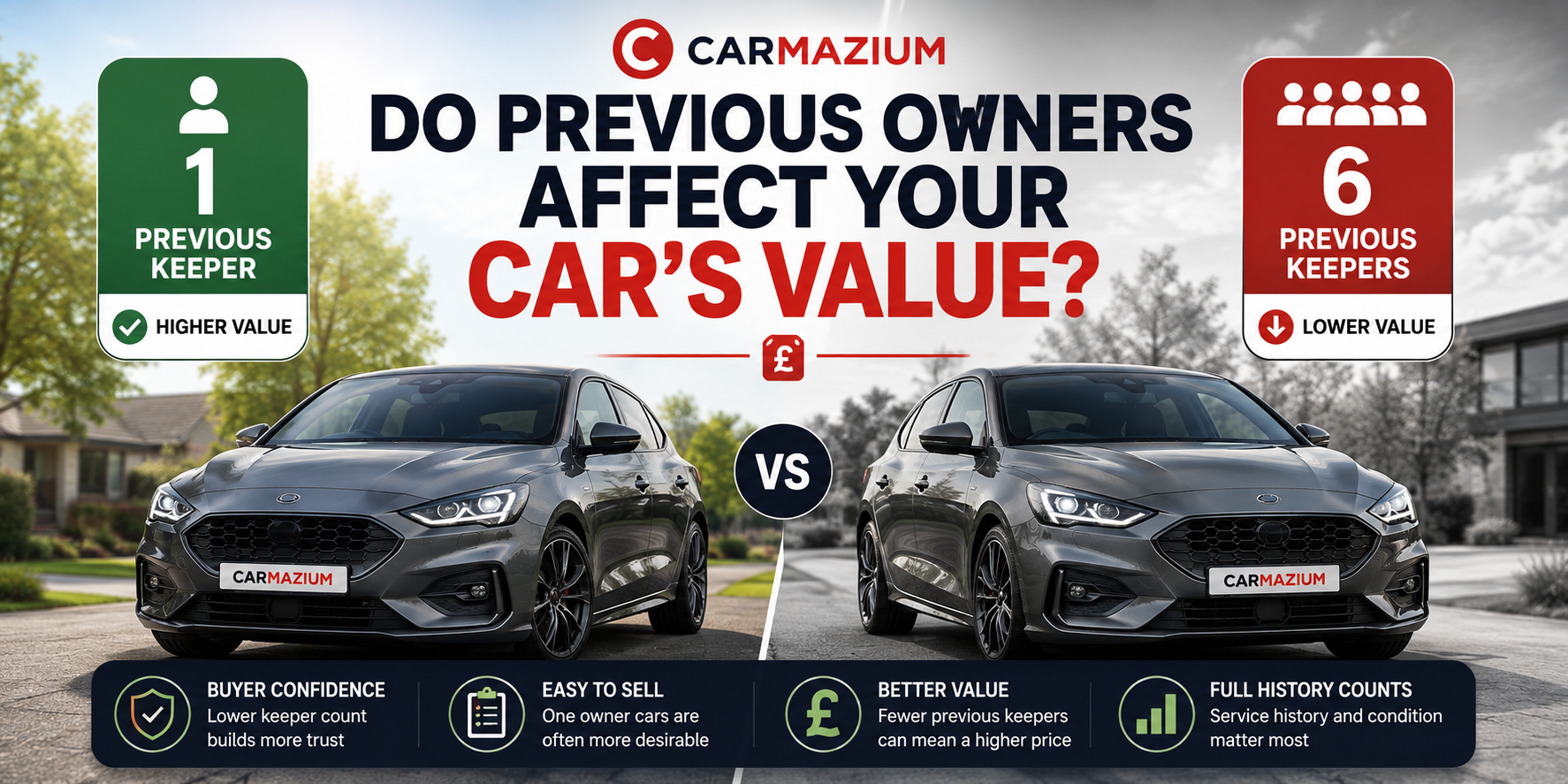
Do Previous Owners Affect a Car's Value? UK Guide 2026
Does a one-owner car really sell for more? Learn how previous keepers can affect used-car value, why ownership history matters and what sellers can do when a car has changed hands several times.
From the marketplace