
Do Previous Owners Affect a Car's Value? UK Guide 2026
Does a one-owner car really sell for more? Learn how previous keepers can affect used-car value, why ownership history matters and what sellers can do when a car has changed hands several times.
Do Previous Owners Affect a Car's Value? UK Guide 2026
You're comparing two apparently identical used cars.
Same model.
Same year.
Same engine.
Same mileage.
Similar condition.
But one has had one previous keeper and the other has had six.
Should they be worth exactly the same?
Usually, no.
The number of previous keepers can influence how buyers perceive a vehicle and therefore what they're prepared to pay. Auto Trader's current valuation guidance says cars with more previous owners are typically worth less, while its buyer guidance gives the example that an otherwise identical seven-owner car could cost considerably less than a one-owner example.
But there's an important point:
A higher keeper count does not automatically mean a bad car.
And a one-owner vehicle isn't automatically a good one.
The complete history matters.
First: “Owner” and “Registered Keeper” Aren't Exactly the Same Thing
People commonly say:
“One owner from new.”
But technically, the V5C registration certificate records the vehicle's registered keeper.
The Department for Transport states that the keeper is responsible for registering and taxing the vehicle but is not necessarily its owner or driver. Leasing is a straightforward example: someone may be the registered keeper while the leasing company legally owns the vehicle.
DVLA documentation also confirms that a V5C includes the number of previous keepers.
So throughout this guide, when we talk about “previous owners,” remember that previous keepers is usually the more technically accurate term.
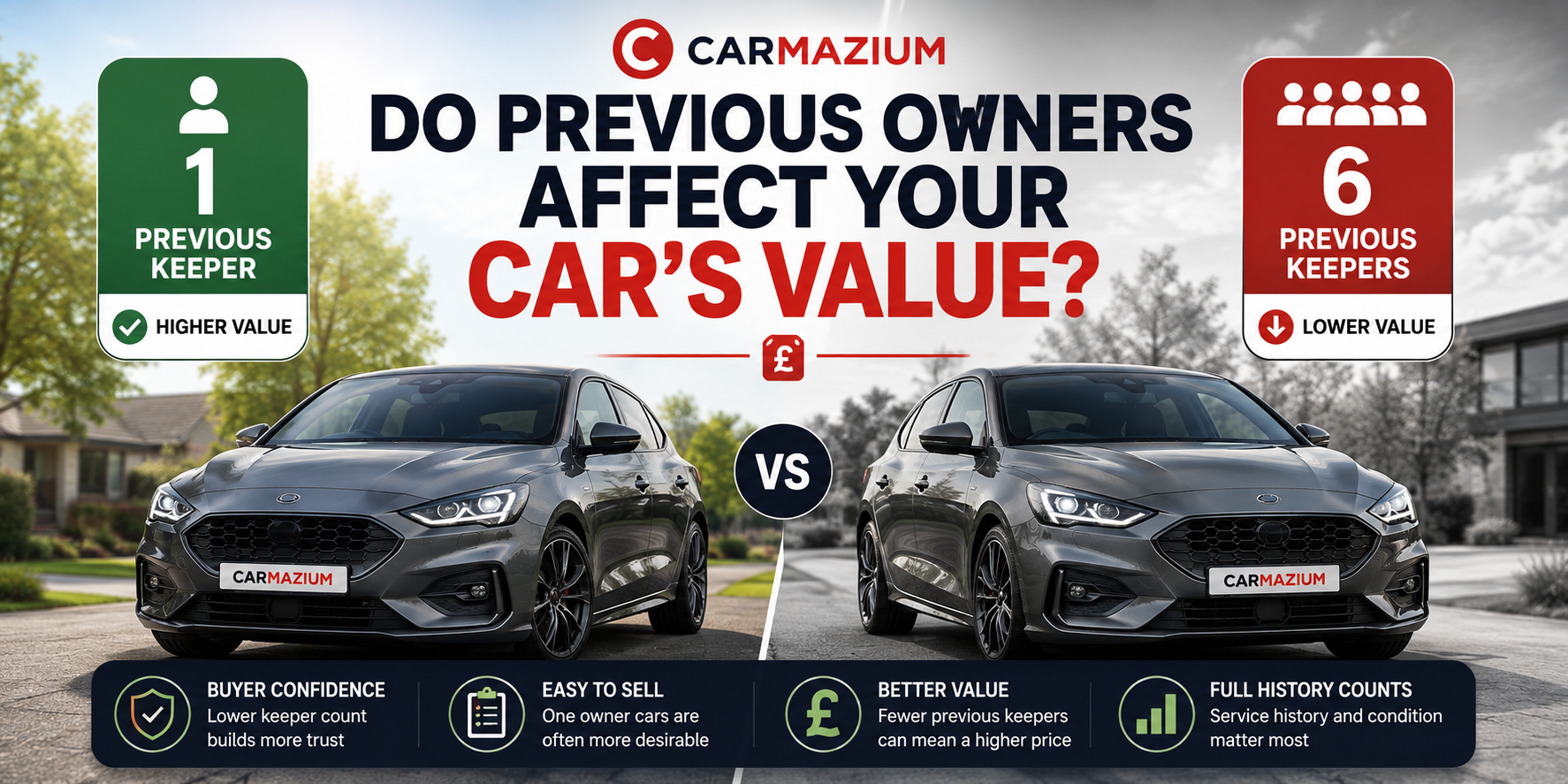
PHOTO IDEA 1 — Keeper history
Place a simple graphic here showing:
1 PREVIOUS KEEPER vs 6 PREVIOUS KEEPERS
with two otherwise identical generic cars.
Avoid reproducing an actual V5C. A stylised vehicle-history card will look better and avoids displaying document details.
Why Do Buyers Prefer Fewer Previous Keepers?
A low keeper count creates a simple story.
Imagine a six-year-old car with one keeper.
A buyer may think:
One person kept this car for six years. They probably knew its history and maintained it consistently.
Now imagine the same vehicle has changed keeper every year.
The buyer may wonder:
Why did so many people sell it?
That question doesn't prove anything is wrong.
But uncertainty affects buying decisions.
This is partly why Auto Trader identifies the number of owners as one of the factors influencing vehicle value.
Is a One-Owner Car Worth More?
Potentially.
Auto Trader's 2026 valuation guidance says fewer owners typically means a higher value, alongside other factors including condition, service history, MOT status, specification and market demand.
But there is no reliable universal formula such as:
One owner = +£500
or:
Every additional owner = -5%.
Used-car valuation doesn't work that way.
Consider:
Car A: One keeper, 80,000 miles, incomplete service history, damaged wheels and poor tyres.
Car B: Three keepers, 60,000 miles, full documented service history, excellent condition and four good tyres.
The keeper count alone cannot tell you which vehicle should be worth more.
Seven Owners Sounds Worse Than Two — But Context Matters
Auto Trader's current buyer guidance specifically says a car with seven previous owners can be expected to cost substantially less than an otherwise identical one-owner car.
That's useful because it demonstrates that the market notices unusually high keeper counts.
But the word identical matters.
In reality, two used cars are rarely identical.
Their:
mileage,
condition,
maintenance,
MOT history,
specification,
colour,
tyres,
bodywork,
mechanical condition
and provenance
can all differ.
Previous keepers are therefore one valuation signal among many.
A High Keeper Count Doesn't Mean the Car Was Neglected
Consider a 12-year-old car with five previous keepers.
At first glance, five sounds high.
But that's approximately one keeper every two years.
That isn't necessarily unusual or concerning.
Now consider a three-year-old car with five previous keepers.
That tells a very different story.
The raw number therefore needs to be considered alongside the vehicle's age.
PHOTO IDEA 2 — Age versus keepers
A useful infographic here:
12-year-old car / 5 keepers versus 3-year-old car / 5 keepers
Headline:
“THE NUMBER NEEDS CONTEXT.”
This would make the article much easier to scan on mobile.
Ownership Duration Can Tell a Story
Keeper count alone tells you how many times registration changed.
It doesn't tell you why.
There is a meaningful difference between a vehicle kept for:
six years,
four years,
three years
and then sold,
versus a vehicle repeatedly changing keeper after only a few months.
Rapid changes may prompt buyers to investigate further.
But again, there can be perfectly innocent explanations.
A person's circumstances change.
They move abroad.
They get a company car.
Their family grows.
They need an automatic.
They stop driving.
They buy something cheaper.
A vehicle changes hands for thousands of legitimate reasons.
What About Ex-Demo Cars?
Here's where keeper count can become misleading.
A dealer demonstrator may have been registered before being sold to its first private customer.
That can create an additional keeper in the vehicle's history even though it hasn't passed through multiple long-term private users.
The same principle can apply to some:
dealer registrations,
company vehicles,
leasing arrangements,
mobility arrangements,
and fleet vehicles.
This is why buyers should investigate what the history actually represents, rather than simply rejecting a car because of one number.
Company Cars and Fleet Cars
A company or fleet vehicle can accumulate substantial mileage while showing a relatively simple keeper history.
Conversely, a privately owned weekend car could have several previous keepers but extremely low mileage.
Which one is better?
You cannot answer from keeper count alone.
Condition and maintenance evidence matter.
This is exactly why modern valuations use multiple data points rather than one simplistic rule. Auto Trader says its valuation methodology draws on market advertisements, dealer pricing, auction results and fleet/leasing disposal data.
PHOTO IDEA 3 — Vehicle history factors
Create a visual wheel with:
KEEPERS
MILEAGE
SERVICE HISTORY
MOT
CONDITION
SPECIFICATION
MARKET DEMAND
with CAR VALUE in the centre.
This reinforces that keeper count isn't considered in isolation.
Service History Can Change the Conversation
Suppose your vehicle has five previous keepers.
That number can't be changed.
But you have:
a complete service book,
digital service records,
maintenance invoices,
two keys,
recent tyres,
a clean MOT,
and evidence of major maintenance.
Now the buyer has substantially more information.
Instead of seeing only:
“5 previous keepers”
they see a documented vehicle history.
Auto Trader's valuation guidance says full documented service history can improve value, while gaps can reduce it.
That's particularly important when a vehicle has changed hands several times.
MOT History Helps Too
The UK's MOT database gives buyers another way to understand a car's life.
A consistent mileage progression and sensible MOT record can increase confidence.
For example:
2022 — 35,000 miles
2023 — 44,000
2024 — 53,000
2025 — 62,000
2026 — 71,000
That creates a logical pattern.
A vehicle with several keepers but a transparent mileage and maintenance record can be easier to understand than one with fewer keepers but poor documentation.
Vehicle History Checks Can Reveal Previous Keepers
A comprehensive vehicle-history check can provide information beyond a basic visual inspection.
Auto Trader says its full Vehicle Check can include information such as the number of previous owners alongside outstanding finance, colour changes and other history information.
For buyers, this helps verify what they're being told.
For sellers, it means trying to hide an inconvenient keeper count is a poor strategy.
Transparency is better.
PHOTO IDEA 4 — History check
Insert a generic vehicle-history report graphic showing:
Previous keepers: 4
Finance: Clear
Write-off: Clear
Stolen: Clear
Mileage: Consistent
Don't reproduce an actual commercial HPI report or official document.
Can You Reduce the Number of Previous Keepers?
No.
If the keeper changes legitimately and DVLA records the change, that becomes part of the vehicle's history.
You can't simply remove genuine previous keepers because you think they hurt resale value.
What you can do is make the rest of the car's history as strong and transparent as possible.
Don't Accidentally Add Another Keeper
This is particularly relevant within families.
People sometimes consider transferring a car into:
their spouse's name,
their child's name,
another family member's name,
or a company name
without considering that a keeper change may become part of the recorded history.
Whether a change is necessary depends on the circumstances, but don't treat the V5C as meaningless paperwork.
DVLA records keeper information and keeper changes form part of the vehicle's history.
What If You've Owned the Car for a Long Time?
This can help explain a higher historic keeper count.
Imagine:
Previous keepers: 5
but:
Current keeper has owned it for the last 7 years.
That tells a different story from:
Previous keepers: 5
with:
Current keeper: 3 months.
Long-term current keepership can provide useful context.
If you've maintained the vehicle carefully during that period, say so — and support it with documentation.
Should You Mention Previous Keepers in the Advert?
Be accurate wherever the platform asks for the information.
If your car has an unusually attractive history, such as genuinely being a low-keeper example, that can also be worth highlighting.
For example:
“One registered keeper from new.”
or:
“Two keepers with comprehensive service history.”
These are more useful statements than vague advertising language such as:
“Excellent history.”
Specific facts build confidence.
Don't Claim “One Owner” Without Checking
This is particularly important if you didn't buy the car new.
Don't assume.
Check the documentation and vehicle-history information.
Remember that the V5C records registered keepers rather than proving legal ownership. Government guidance explicitly distinguishes between keeper and owner.
Accurate terminology avoids misleading potential buyers.
What Matters More: Mileage or Number of Owners?
There's no universal answer.
Imagine:
Vehicle A
One previous keeper 110,000 miles Partial service history
Vehicle B
Three previous keepers 55,000 miles Full service history
You cannot reliably determine their relative values from keeper count alone.
Auto Trader's current valuation guidance considers multiple factors including age, mileage, condition, service history, MOT status, specification and wider market demand.
That is how sellers should think too.
What Matters More: Condition or Previous Owners?
Again, usually the complete vehicle matters.
A pristine, properly maintained three-keeper car may be substantially more desirable than a damaged one-keeper example.
Auto Trader says overall condition can make a major difference to value even between vehicles of similar age.
Previous keepers are not a substitute for inspecting the actual car.
How Dealers Look at Keeper Count
A dealer buying a car isn't only thinking about today's purchase price.
They're considering the next customer.
Will a buyer compare this six-owner vehicle with a similar two-owner vehicle?
Will the keeper count create objections?
Will it take longer to retail?
Will the price need adjusting?
Those considerations can feed into a trade offer.
This is why seller expectations should reflect the complete market position of their vehicle.
Does Another Keeper Always Reduce the Value Immediately?
Not by a fixed amount.
There isn't a standard UK rule stating that every keeper change automatically removes a specific number of pounds from the vehicle.
Market valuations are dynamic.
Auto Trader says its valuations reflect live market conditions and are updated using large volumes of advertisement, dealer, auction, fleet and leasing data.
The effect therefore depends on the vehicle and how comparable cars are actually trading.
How to Sell a Car With Many Previous Keepers
You cannot rewrite the past.
Instead, strengthen everything you can control:
Be completely accurate about the keeper count.
Gather as much service history as possible.
Keep maintenance invoices.
Make sure the MOT position is clear.
Correct obvious mechanical faults where economically sensible.
Present the car properly.
Photograph it well.
Highlight desirable factory specification.
Provide both keys where available.
Explain your own period of ownership accurately.
Price the vehicle according to the market rather than pretending keeper count doesn't exist.
The goal is to remove uncertainty.
A Useful Example
Imagine two 2019 cars.
Both have 50,000 miles.
Car A
1 previous keeper Patchy service history Damaged alloys Several bodywork defects One key
Car B
4 previous keepers Full documented service history Excellent MOT record Two keys Good tyres Clean bodywork Desirable factory specification
Which would you buy?
The answer may differ between buyers.
And that's exactly the point.
Keeper count matters, but it doesn't tell the entire story.
How CarMazium Fits Into This
When a vehicle is presented to potential buyers, accurate history information helps them judge the car as a complete package.
A professional buyer can consider:
age,
mileage,
keeper history,
condition,
service history,
MOT record,
specification,
and current stock demand
together.
That is much more meaningful than assuming every three-owner vehicle is automatically worth a predetermined amount less than every one-owner vehicle.
Frequently Asked Questions
Do previous owners affect car value?
Yes. Auto Trader currently identifies the number of owners as one of the factors that can affect vehicle value and says cars with more previous owners are typically worth less.
Is one owner from new better?
It can be attractive to buyers because it creates a simpler vehicle history. But condition, mileage, service history and other valuation factors still matter.
Is four previous owners a lot?
It depends heavily on the vehicle's age and history. Four keepers on a relatively new vehicle may attract more attention than four keepers over a much longer life.
Does the V5C show previous owners?
The V5C records the number of previous keepers. Government guidance makes clear that a registered keeper is not necessarily the legal owner.
Is a registered keeper the same as an owner?
Not necessarily. The Department for Transport explicitly states that the keeper is responsible for registration and taxation but is not necessarily the vehicle's owner or driver.
Can I remove previous owners from a car's history?
Genuine registered keeper changes form part of the DVLA record. They cannot simply be deleted because they may affect resale desirability.
Should I avoid buying a car with many owners?
Not automatically. Investigate why the vehicle changed hands and assess its condition, mileage, maintenance, MOT and wider history.
What is more important: previous owners or service history?
Both can influence value. Neither should be considered in isolation. A well-documented multi-keeper vehicle can still be an excellent car.
Final Thoughts
Fewer previous keepers can make a used car more desirable.
The market recognises that.
But the number printed in a vehicle's history is not a quality score.
A one-keeper car can be neglected.
A five-keeper car can be meticulously maintained.
What matters is the complete picture:
Who kept it is one part of the story.
How the car was looked after is another.
When selling, don't try to disguise an inconvenient keeper count.
Build confidence around it with accurate information, documented maintenance, a clear history and realistic market pricing.
Sell your car your way
Ready to turn your research into a real sale?
List in the CarMazium dealer auction for £0, or advertise retail from £1. Qualifying successful auction sales can receive a £100 seller incentive.
Keep reading
Related automotive guides

WeBuyAnyCar Alternatives UK 2026: Compare Better Ways to Sell Your Car
Looking for an alternative to WeBuyAnyCar? Compare CarMazium, Carwow, Auto Trader, dealer auctions and private selling to find the right way to sell your car.

Selling an Electric Car in the UK: Battery Health, Range & Value Guide 2026
Selling an electric car? Learn how battery health, real-world range, charging speed, warranty, service history and charging cables can affect buyer confidence and your EV's value.

Do Optional Extras Increase Your Car's Value? UK Guide 2026
Panoramic roofs, heated seats, upgraded wheels and technology packs can make a used car more desirable. Find out which optional extras can add value and which may add very little when you sell.
From the marketplace