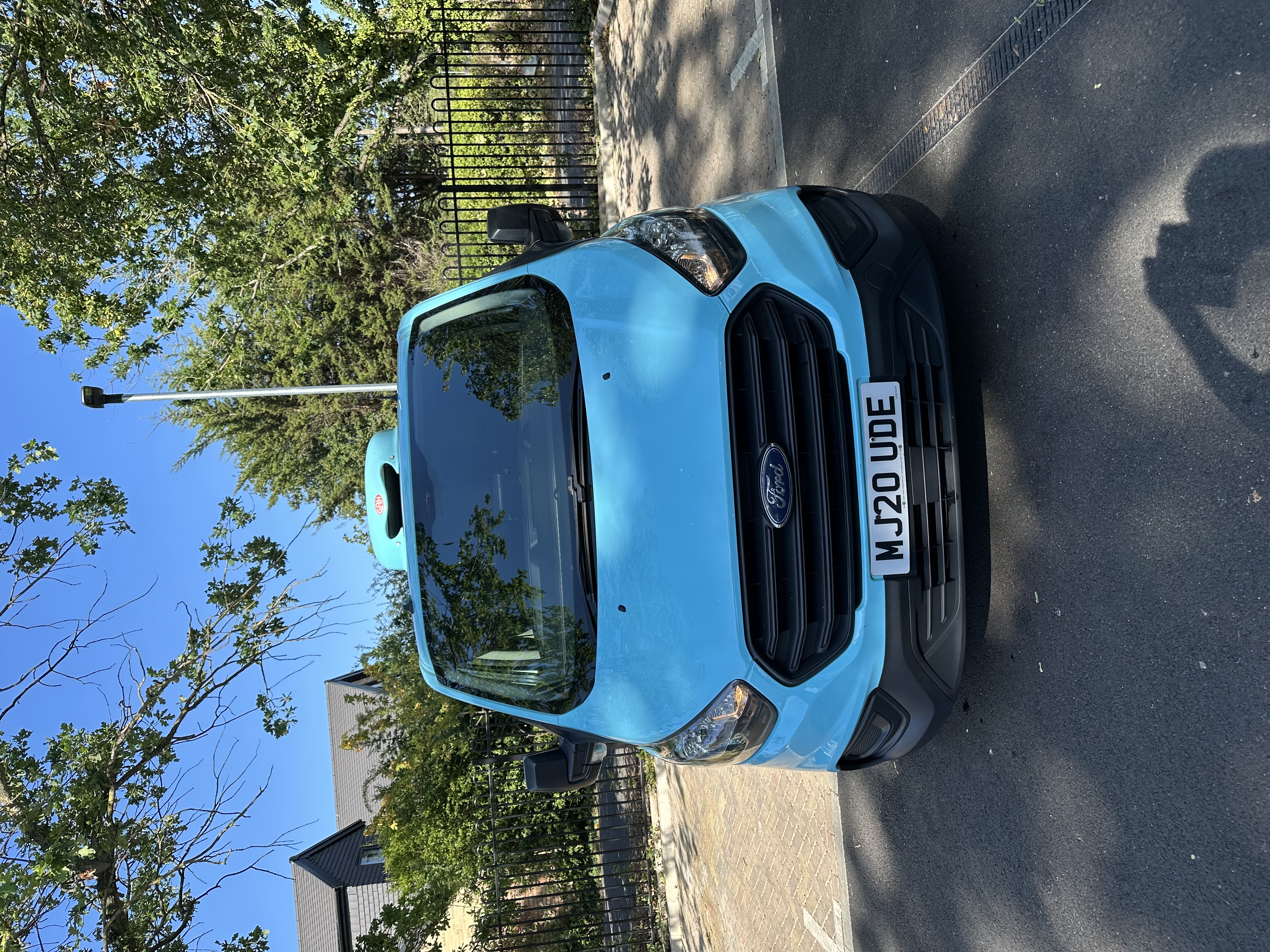

Selling an Electric Car in the UK: Battery Health, Range & Value Guide 2026
Selling an electric car? Learn how battery health, real-world range, charging speed, warranty, service history and charging cables can affect buyer confidence and your EV's value.
Selling an Electric Car in the UK: Battery Health, Range & Value Guide 2026
Selling an electric car isn't quite the same as selling a petrol or diesel vehicle.
The fundamentals still matter:
Condition.
Mileage.
Service history.
MOT.
Specification.
Market demand.
But an electric vehicle introduces another component that can heavily influence buyer confidence:
the traction battery.
A prospective EV buyer may want to know:
How healthy is the battery?
How much range does it still provide?
How quickly can the car charge?
Is the battery still under warranty?
Are all charging cables present?
Has the vehicle received software updates?
And increasingly:
Can you prove the battery's condition?
For EV sellers in 2026, answering those questions properly can make the difference between a buyer feeling uncertain and feeling confident.
Britain's Used-EV Market Is Growing Rapidly
The market has changed significantly.
According to the latest SMMT figures, 110,761 used battery-electric cars changed hands during Q2 2026.
That's an increase of 67% compared with the same quarter in 2025.
BEVs accounted for a record 5.5% of used-car transactions, up from 3.3% a year earlier.
This matters to sellers.
More EVs entering the used market means more potential buyers — but also more cars for those buyers to compare.
A well-presented EV therefore needs to communicate more than:
“Electric. Automatic. Low mileage.”
PHOTO IDEA 1 — Growing used-EV market
Insert a wide photograph of several different electric cars on a modern UK used-car forecourt.
For the supporting statistics, link readers to SMMT's Q2 2026 used-car market report.
Battery Health Is the Big Question
An internal-combustion buyer may worry about:
Timing chains.
Turbochargers.
Gearboxes.
Oil consumption.
DPFs.
An EV buyer has a different major concern:
battery degradation.
Lithium-ion batteries gradually lose some usable capacity as they age and complete charging cycles.
That doesn't mean an older battery suddenly stops working.
It generally means the vehicle can store somewhat less energy than when it was new, reducing its available driving range.
This is why battery condition deserves special attention when selling an EV.
What Is Battery State of Health?
You'll increasingly encounter the abbreviation:
SoH — State of Health.
In simplified terms, it is an indication of how the battery's current condition compares with its original condition.
Imagine a battery had approximately 60 kWh of usable capacity when new.
After years of use, its usable capacity may be lower.
A proper battery-health assessment can give buyers considerably more useful information than simply telling them:
“The battery seems fine.”
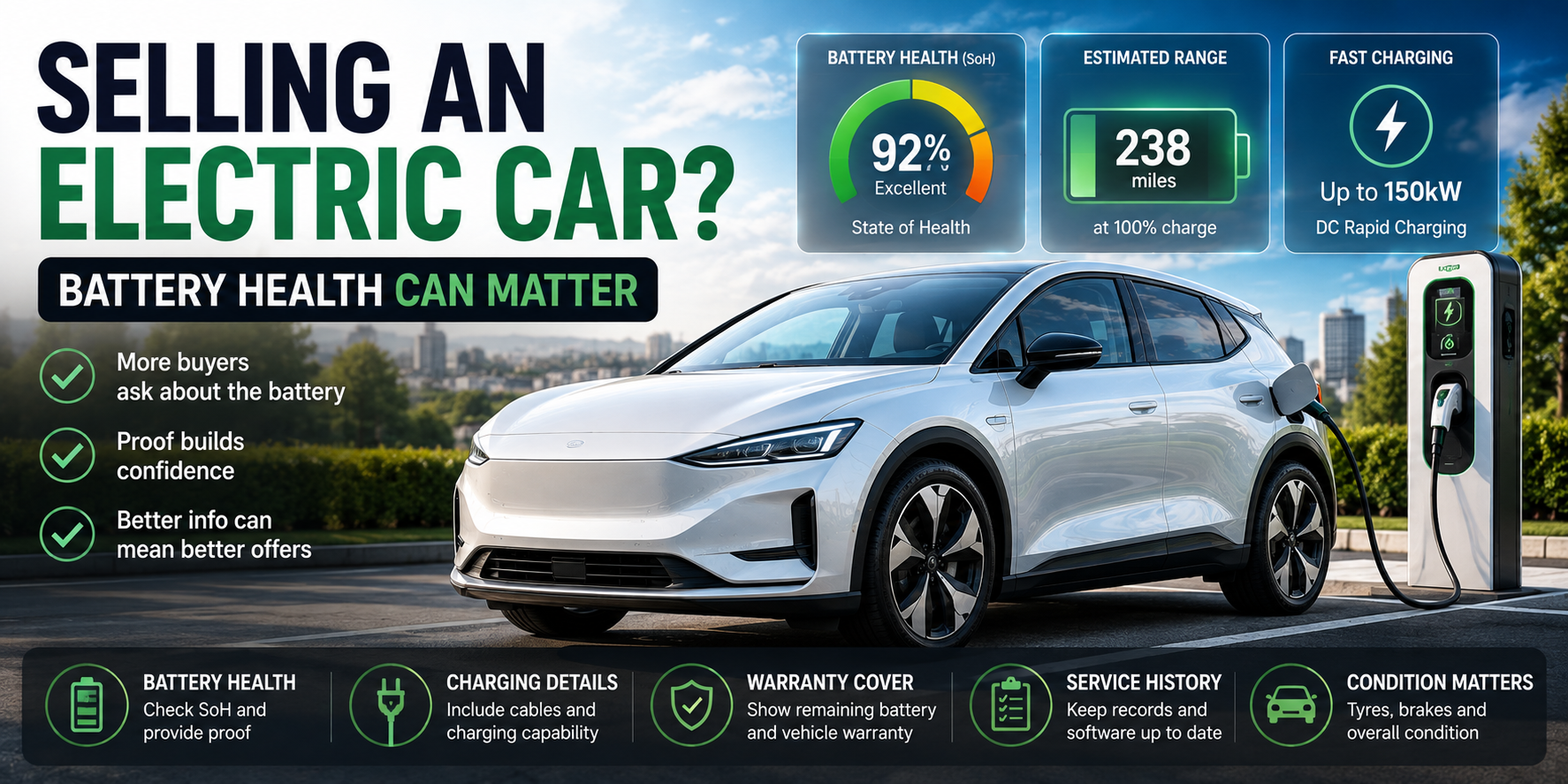
Auto Trader's April 2026 EV-selling guidance specifically recommends considering a Battery Health Certificate and including battery condition and remaining warranty information in the advert.
PHOTO IDEA 2 — Battery health
Insert an infographic here:
EV BATTERY STATE OF HEALTH
100% — Excellent 95% — Strong 90% — Healthy ageing 85% — More degradation
Important: these should be presented as an illustrative scale, not universal pass/fail thresholds.
Battery Degradation May Be Less Severe Than Buyers Think
There is encouraging recent evidence.
A 2026 UK analysis reported by the RAC examined 8,000 electric cars from 36 brands, including EVs up to 12 years old and vehicles with more than 160,000 miles.
Across the whole sample, average battery State of Health was approximately 95%.
For cars aged eight to 12 years, median battery health was 85%.
Interestingly, cars with more than 100,000 miles were reported with battery-health results between 88% and 95%, illustrating why mileage alone doesn't reliably tell you battery condition.
That's an extremely useful point for sellers.
A high-mileage EV shouldn't automatically be assumed to have a poor battery.
Evidence is stronger than assumptions.
Mileage and Battery Health Are Not the Same Thing
Consider two EVs.
EV A
40,000 miles Battery SoH: 87%
EV B
75,000 miles Battery SoH: 94%
If everything else were equal, which battery would you rather have?
Probably EV B.
This demonstrates why traditional mileage thinking doesn't always translate perfectly to electric vehicles.
Mileage still affects the value and condition of the entire car.
Suspension, tyres, interior wear and other components still age.
But mileage alone cannot tell you exactly how much usable battery capacity remains.
Real-World Range Matters
Buyers don't only care about a laboratory range figure from when the vehicle was new.
They want to know:
How far will this particular car travel now?
Auto Trader advises EV sellers to give buyers realistic information about present-day range and even mention cold-weather performance because range normally falls in lower temperatures.
That's good selling practice.
Instead of:
“Range: 300 miles.”
when the vehicle no longer achieves anything close to that, provide useful context.
For example:
“Typically showing approximately 230–250 miles from a full charge during my normal mixed driving, depending on temperature and driving conditions.”
Don't promise an exact range because actual EV range depends on many variables.
PHOTO IDEA 3 — Real-world EV range
Use an image showing an EV dashboard with:
Battery: 100%
and a realistic estimated range display.
Avoid making the image specific to a real manufacturer.
Temperature Changes Range
A buyer new to electric cars may not realise how much environmental conditions can influence range.
Cold weather can reduce available range.
Heating the cabin uses energy.
High-speed motorway driving can also consume considerably more energy than lower-speed urban driving.
So if you're selling in January and the dashboard is showing less range than you normally see during summer, that doesn't necessarily mean the battery has suddenly deteriorated.
Explain the context accurately.
Battery Warranty Can Be Valuable
Check whether the traction battery is still covered.
Many manufacturers provide substantially longer warranties for EV batteries than for the rest of the vehicle.
RAC's current battery guide says most new EV batteries receive warranties of around eight years or 100,000 miles, commonly guaranteeing around 70% minimum capacity during the warranty period, although exact terms vary by manufacturer and model.
Don't simply advertise:
“8-year battery warranty.”
Instead, check the warranty applicable to your exact vehicle.
Then state something like:
“Manufacturer traction-battery warranty remaining until [date/mileage], subject to manufacturer terms.”
That's much more useful.
Don't Confuse the 12V Battery With the Traction Battery
Electric vehicles commonly have more than one battery system.
The enormous high-voltage traction battery powers the vehicle.
But many EVs also have a conventional low-voltage battery that operates various electrical systems.
A fault with the small battery doesn't necessarily mean there is a fault with the main traction battery.
Sellers should understand which battery a diagnostic report or repair invoice refers to.
Charging Speed Matters Too
Two EVs can have similar battery sizes but very different charging capabilities.
A buyer may care about:
AC charging speed.
DC rapid-charging capability.
Maximum charging rate.
Charging-port type.
Battery preconditioning.
Plug & Charge support.
Vehicle-to-load capability.
These features become particularly important for buyers who regularly travel long distances.
So don't advertise only the range.
Explain how the car charges.
PHOTO IDEA 4 — Rapid charging
Place a strong photograph here of an electric car connected to a public rapid charger.
A useful supporting buyer guide is RAC's electric-car guide.
Include Every Charging Cable
Auto Trader specifically advises EV sellers to gather all charging cables and adapters before advertising.
That's easy to overlook.
Depending on the vehicle, you may have:
Type 2 charging cable.
Three-pin portable charger.
Adapters.
Charging accessories.
Storage bags.
If equipment originally supplied with the vehicle is missing, replacing it may cost money and give buyers another negotiating point.
Gather everything before photographs are taken.
Software Is Part of an EV's Condition
Modern EVs can depend heavily on software.
Updates may affect:
Infotainment.
Navigation.
Charging.
Battery management.
Driver assistance.
Phone connectivity.
General vehicle functionality.
Auto Trader recommends checking for outstanding software updates when preparing an EV for sale.
So your preparation checklist should include software as well as physical condition.
EVs Still Need Service History
Electric cars have fewer conventional engine components.
No engine oil.
No spark plugs.
No exhaust.
No conventional cambelt on a pure BEV.
But that does not mean:
“EVs don't need servicing.”
RAC's EV servicing guidance lists checks involving battery health, high-voltage components, cooling systems, electrical systems, charging cables, brakes, tyres and diagnostics.
A documented maintenance record therefore remains useful.
PHOTO IDEA 5 — EV service
Insert a photo or illustration showing a technician carrying out EV diagnostics with the battery, charging system and brakes highlighted.
Tyres Are Particularly Important
EVs can be heavy.
They can also deliver substantial torque immediately.
Tyre condition therefore deserves close attention.
Before selling, check:
Tread depth.
Uneven wear.
Sidewall damage.
Correct tyre sizes.
Matching axle pairs where appropriate.
Tyre pressures.
Don't spend money replacing tyres automatically if the economics don't make sense, but understand that worn tyres will influence how a buyer assesses the vehicle.
Brakes Can Tell a Different Story on EVs
Regenerative braking means an electric car can use its conventional friction brakes differently from a petrol or diesel car.
That doesn't mean brakes never wear or deteriorate.
Discs can still corrode.
Calipers can still develop problems.
Brake fluid still needs attention.
RAC includes brakes among the safety items checked during EV servicing.
So a buyer shouldn't focus exclusively on the battery.
Neither should the seller.
Check the Charging Port
This takes seconds.
Open it.
Inspect it.
Make sure:
The flap operates correctly.
The port isn't damaged.
There are no warning lights.
The vehicle charges properly.
AC charging works.
Rapid charging works if possible to verify.
A buyer discovering a charging fault after travelling to see the vehicle is unlikely to be impressed.
Should You Get a Battery Health Certificate Before Selling?
This could become increasingly valuable.
Auto Trader's current 2026 selling guide explicitly recommends seriously considering one because battery condition remains a major concern among used-EV buyers.
For an older EV in particular, objective battery information may help separate your car from another advert that simply says:
“Battery good.”
Think about the difference:
Advert A
“Battery excellent.”
Advert B
“Independent battery-health assessment available. State of Health: 92%. Manufacturer battery warranty remaining until September 2028 or applicable mileage limit.”
Advert B gives the buyer something measurable.
Photograph the EV-Specific Details
Your standard photographs should still include:
Front.
Rear.
Both sides.
Interior.
Dashboard.
Wheels.
Boot.
But an EV advert benefits from additional photographs.
Consider showing:
Charging port.
Charging cables.
Battery/range display.
Infotainment charging screen.
Service history.
Any battery-health report.
Warranty information where appropriate.
PHOTO IDEA 6 — Seller's EV checklist
A simple CarMazium infographic could show:
BATTERY HEALTH
REAL-WORLD RANGE
CHARGING SPEED
BATTERY WARRANTY
CABLES
SERVICE HISTORY
This would work particularly well halfway through the article.
Don't Advertise the Original Range as Today's Guaranteed Range
Suppose a vehicle was officially rated at 250 miles when new.
That doesn't mean:
“This car will travel 250 miles.”
Range varies according to:
Battery condition.
Temperature.
Speed.
Heating/air conditioning.
Terrain.
Tyres.
Payload.
Driving style.
Weather.
Be precise about whether you're quoting an official original figure or describing your actual experience.
Battery Condition Can Influence Value
Auto Trader's 2026 EV-selling guidance explicitly identifies battery condition as one of the factors affecting EV depreciation and value.
That makes intuitive sense.
For an electric vehicle, the traction battery is an extremely important and expensive component.
Two otherwise similar EVs with meaningfully different verified battery health may not deserve identical valuations.
But avoid simplistic claims such as:
“Every 1% battery degradation removes £200 from the value.”
There is no universal formula like that.
The effect depends on the model, age, range, battery size, remaining warranty and market demand.
Don't Assume EV Batteries Are Finished at 100,000 Miles
This is another area where conventional thinking can be misleading.
The recent UK battery-health study reported by RAC found EVs exceeding 100,000 miles with State-of-Health readings between 88% and 95%.
That doesn't guarantee every high-mileage EV will perform equally well.
But it does demonstrate that:
Mileage isn't a battery-health test.
Actually measure the battery where possible.
Older EVs Need Different Expectations
A 2015 EV shouldn't automatically be compared with a 2026 EV.
Battery technology has developed.
Charging speeds have increased.
Range has increased.
Thermal management has improved.
Infotainment and charging infrastructure have evolved.
RAC notes that older used EVs can have considerably shorter ranges than newer models.
That doesn't make an older EV useless.
A 90-mile real-world range could still be perfectly suitable for someone travelling:
10 miles to work,
doing the school run,
shopping locally,
and charging at home.
The right buyer matters.
Price It Against Comparable EVs
Don't value your electric car solely according to what you originally paid.
The EV market has changed rapidly.
Compare your vehicle against examples with similar:
Age.
Mileage.
Battery size.
Trim.
Specification.
Battery condition.
Range.
Warranty.
Condition.
Auto Trader says its EV valuations draw on market data including live advertisements, dealer websites, auctions and ex-fleet and lease vehicles.
Current market evidence is much more useful than the original invoice.
Buyer Demand Is Increasing
There is another reason not to assume nobody wants a used EV.
Auto Trader reported that used-EV demand on its platform increased 28% during 2025 compared with 2024, and that EVs accounted for more than one in seven enquiries for used cars under five years old.
Then the official SMMT transaction data for Q2 2026 showed used BEV sales rising another 67% year-on-year.
The used-EV market is becoming increasingly significant.
What Information Should Your EV Advert Include?
A strong listing should answer the questions an EV buyer is likely to ask before they need to ask them.
Include:
Exact model and battery version.
Mileage.
Current battery health where verified.
Real-world range context.
Original official range clearly labelled as such if mentioned.
AC charging capability.
DC rapid-charging capability.
Charging cables included.
Service history.
MOT.
Battery warranty remaining.
Vehicle warranty remaining.
Factory specification.
Software status where relevant.
Number of keys.
Tyre condition.
Known faults.
Transparency reduces uncertainty.
How CarMazium Fits Into the EV Market
The EV market makes accurate vehicle information particularly important.
Professional buyers may value the same EV differently depending on:
Their current stock.
Local EV demand.
Battery condition.
Vehicle age.
Mileage.
Specification.
Range.
Warranty.
Retail price.
A clear listing allows buyers to assess the actual vehicle rather than simply treating every EV of the same model and year as identical.
As used EV volumes continue increasing, that distinction becomes increasingly important.
Frequently Asked Questions
Does battery health affect an electric car's value?
It can. Auto Trader identifies battery condition as a factor affecting EV depreciation and recommends sellers provide battery-health information to prospective buyers.
What is EV State of Health?
State of Health, commonly abbreviated to SoH, is an assessment of the traction battery's condition relative to its original state. It can provide more useful information than mileage alone.
Do electric-car batteries degrade quickly?
Recent UK evidence suggests degradation can be less severe than many buyers expect. A study of 8,000 EVs reported by RAC found average battery health of approximately 95%, while eight-to-12-year-old cars had median health around 85%.
Is a 100,000-mile EV a bad buy?
Not automatically. The same study found vehicles above 100,000 miles with battery-health results between 88% and 95%, demonstrating that mileage alone doesn't determine battery condition.
How long is an EV battery warranty?
It varies. RAC says many manufacturers offer around eight years or 100,000 miles, commonly with a minimum-capacity condition around 70%. Always check the exact manufacturer terms for the specific vehicle.
Should I get a battery-health certificate before selling?
It can be worth considering, particularly for an older EV. Auto Trader's 2026 selling guidance recommends considering a professional battery-health certificate to improve buyer confidence.
Should I include the charging cable when selling?
Yes, gather all cables and adapters supplied with the vehicle. Auto Trader specifically includes this in its EV preparation advice.
Are used electric cars actually selling?
Yes. SMMT recorded 110,761 used BEV transactions in Q2 2026, up 67% year-on-year and representing a record 5.5% market share.
Final Thoughts
For years, one of the biggest questions surrounding used electric cars has been:
“What happens to the battery when the car gets older?”
The growing evidence is encouraging.
But that doesn't mean battery condition should be ignored.
Quite the opposite.
As the used-EV market matures, battery transparency becomes more important.
If you're selling an electric car, give buyers the information they actually need:
Battery health.
Real-world range.
Charging capability.
Warranty.
Cables.
Service history.
Condition.
A seller who can demonstrate those things clearly is in a much stronger position than one whose entire EV description says:
“Battery good, drives perfect.”
Sell your car your way
Ready to turn your research into a real sale?
List in the CarMazium dealer auction for £0, or advertise retail from £1. Qualifying successful auction sales can receive a £100 seller incentive.
Keep reading
Related automotive guides
Do Previous Owners Affect a Car's Value? UK Guide 2026
Does a one-owner car really sell for more? Learn how previous keepers can affect used-car value, why ownership history matters and what sellers can do when a car has changed hands several times.
Do Optional Extras Increase Your Car's Value? UK Guide 2026
Panoramic roofs, heated seats, upgraded wheels and technology packs can make a used car more desirable. Find out which optional extras can add value and which may add very little when you sell.

Best Time to Sell a Car in the UK: Does the Month Really Matter?
Is there really a best month to sell your car? Discover how seasons, registration changes, mileage, vehicle type and UK used-car demand can affect when you should sell.
From the marketplace