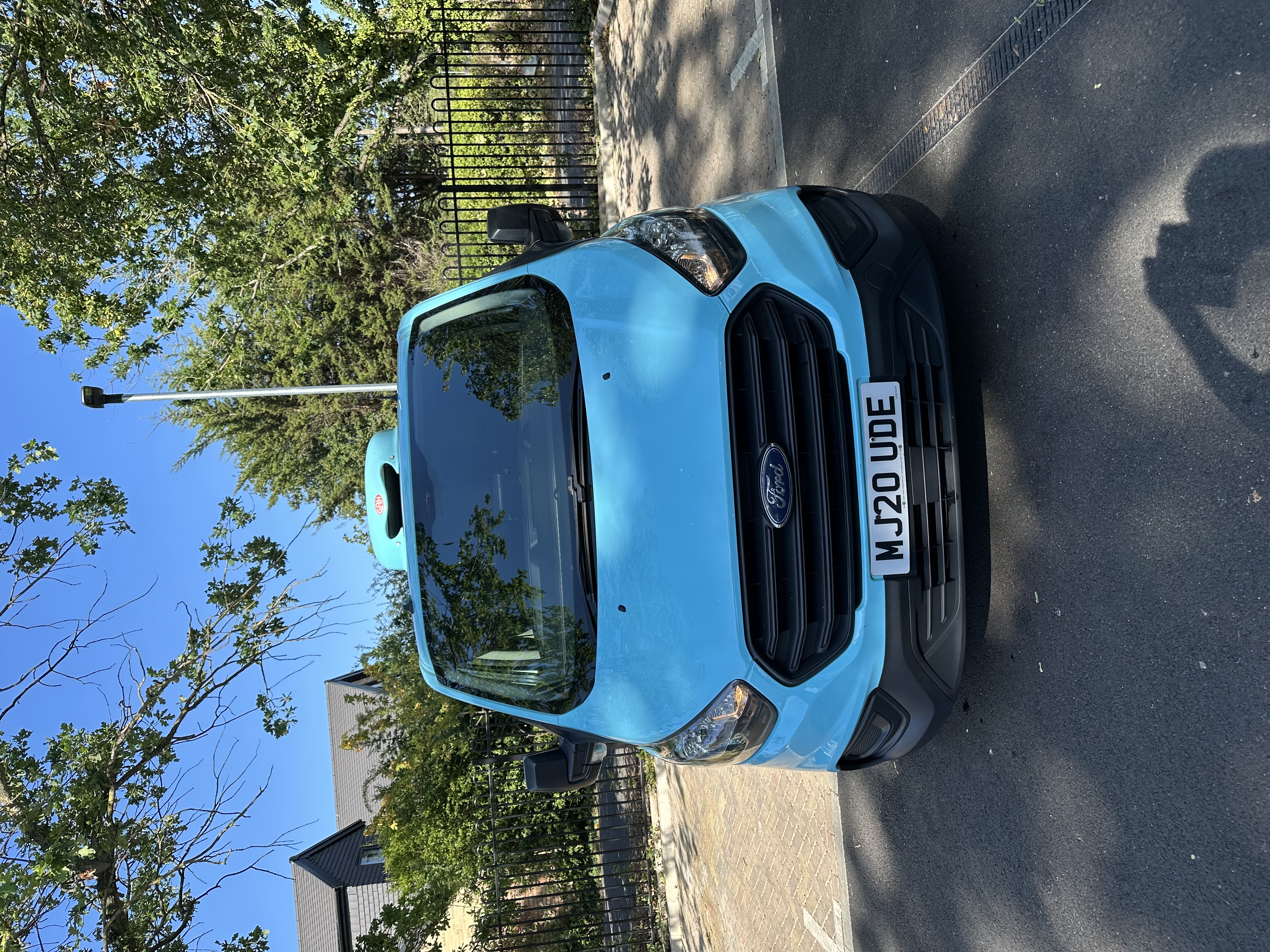

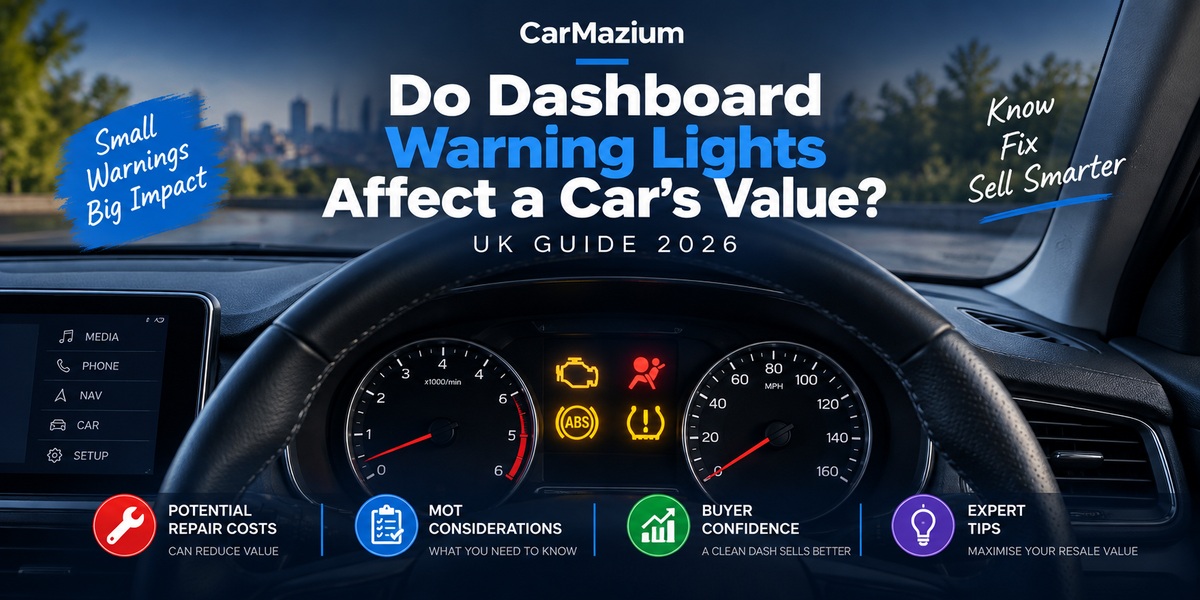
Do Dashboard Warning Lights Affect a Car's Value? UK Guide 2026
Can dashboard warning lights reduce a car's value? Learn what engine, ABS, airbag, ESC and TPMS lights can mean for UK buyers, MOTs and resale negotiations.
In this article
A warning light can change the mood of a car viewing in seconds.
The vehicle may look clean, drive normally and have a strong service history, but an illuminated engine-management, ABS or airbag light immediately creates a new question for the buyer:
How expensive is this going to be to fix?
That uncertainty can affect buyer confidence, dealer offers and the price a seller is able to achieve.
But not every dashboard light means the same thing.
Some lights are normal status indicators. Some simply warn that a system is switched off. Others can indicate a safety or emissions fault that may lead to an MOT failure on an applicable vehicle.
The smartest approach is to understand the warning, diagnose the cause and decide whether fixing it before sale makes commercial sense.
Do Dashboard Warning Lights Really Affect a Car's Value?
Yes, they can.
A warning light affects value mainly because it introduces risk and uncertainty.
A buyer may not know whether an amber engine light means:
- a loose electrical connection,
- a failed sensor,
- an emissions-control fault,
- a misfire,
- a catalytic-converter problem,
- or something more expensive.
Until the fault is diagnosed, the buyer may assume the worst.
That can lead to:
- a lower offer,
- a request for a diagnostic report,
- a buyer walking away,
- a dealer increasing the preparation allowance,
- or the vehicle taking longer to sell.
The light itself is not the value calculation.
The fault behind it is.
Warning Lights Are Not All the Same
Modern cars use dashboard lamps for several purposes.
They can indicate:
- a system check during start-up,
- normal operation,
- a temporary status,
- low fluid or pressure,
- a system that has been switched off,
- a stored malfunction,
- or a serious condition requiring immediate attention.
The colour often gives a broad clue.
RAC's current dashboard-warning guide explains that red warnings generally indicate a more urgent issue, amber or yellow lights normally signal something that needs attention, while green and blue lights are commonly status information.
But symbols and behaviour vary by manufacturer.
Always check the handbook for the exact vehicle.
Why Warning Lights Matter to UK Sellers
For a seller, dashboard warnings matter in three different ways.
1. They Can Affect the MOT
Some malfunction-indicator lamps are specifically included in the DVSA MOT inspection rules.
2. They Can Suggest a Repair Cost
Even when a warning is not itself an MOT failure, it may point to an underlying defect.
3. They Can Reduce Buyer Confidence
A buyer may assume that an illuminated warning light is evidence of deferred maintenance, especially if the seller cannot explain it.
Those three effects can combine.
That is why a £50 diagnosis can sometimes be more valuable than trying to guess how much money to knock off the asking price.
Engine Management Light: Why Buyers Take It Seriously
The engine-management light is usually the warning that creates the most anxiety.
It may also be described as:
- the engine warning light,
- malfunction indicator lamp,
- MIL,
- check-engine light,
- or EML.
The current DVSA MOT inspection manual requires the engine malfunction indicator lamp to be checked on applicable vehicles.
The tester checks that the lamp illuminates as required and then goes out when the system is functioning normally.
An engine-management warning can relate to many different faults.
Possible causes include:
- oxygen sensors,
- air-flow sensors,
- ignition faults,
- fuel-system faults,
- emissions controls,
- exhaust-system issues,
- EGR systems,
- catalytic-converter performance,
- diesel particulate filter issues,
- or wiring and sensor faults.
That wide range is exactly why buyers dislike an unexplained EML.
The repair could be minor.
It could also be expensive.
A Flashing Engine Light Is Different From a Steady One
Do not treat every engine warning as identical.
On many vehicles, a steady amber engine light indicates a detected fault that needs diagnosis.
A flashing engine-management light can indicate a more serious condition, such as an active misfire capable of causing further damage.
The exact meaning depends on the manufacturer.
If the light flashes, the engine runs badly or the car loses power, do not continue driving simply because you plan to sell the vehicle.
Check the handbook and have the fault assessed.
Selling a problem does not stop it from being a problem.
ABS Warning Light and Car Value
ABS is the anti-lock braking system.
An ABS warning light that stays on because the system has detected a malfunction is particularly important because the DVSA MOT manual treats an ABS warning device showing a system malfunction as a major defect.
You can read the current rules in the DVSA brakes section.
Potential ABS-related causes can include:
- wheel-speed sensor faults,
- damaged wiring,
- tone-ring issues,
- control-module faults,
- low voltage,
- or other braking-system problems.
Some are relatively inexpensive.
Others are not.
A buyer will rarely know which category your vehicle falls into just by seeing the light.
That uncertainty can reduce the offer.
Airbag and SRS Warning Lights
An airbag or SRS warning deserves similar attention.
The current DVSA MOT manual states that an SRS malfunction indicator lamp showing a system fault is a major defect.
The SRS can include:
- airbags,
- seat-belt pretensioners,
- crash sensors,
- wiring,
- control modules,
- and occupancy sensors.
A passenger-airbag indicator showing that the passenger airbag has intentionally been switched off is not automatically the same as an SRS system fault.
That distinction matters.
Do not tell a buyer "the airbag light is nothing" until you know what the light is actually indicating.
ESC, ESP, DSC and Stability-Control Warnings
Electronic stability control is known by several names.
Depending on the manufacturer, you may see:
- ESC,
- ESP,
- DSC,
- VDC,
- or another brand-specific acronym.
The DVSA says a stability-control malfunction indicator showing a system fault is a major MOT defect.
Some vehicles allow the driver to switch the system off manually.
An indicator showing that stability control is intentionally disabled is not necessarily the same as a malfunction.
Again, the handbook and a proper diagnosis matter.
TPMS Warning Light: Low Pressure or System Fault?
The tyre-pressure monitoring system can confuse sellers because the warning lamp may indicate more than one thing.
On relevant M1 vehicles first used on or after 1 January 2012, the TPMS is included in the MOT inspection.
The DVSA tyre and TPMS guidance says a malfunctioning or obviously non-working TPMS is a major defect.
But a light showing that one or more tyres simply need pressure correction does not automatically mean the monitoring system itself has failed.
Before assuming you need a sensor, check:
- tyre pressures,
- punctures,
- recent tyre changes,
- whether the system needs recalibration,
- and the handbook procedure.
Our guide to worn tyres and car value also explains why tyre condition can affect buyer negotiation even when the tyres remain legal.
Brake Warning Lights Need Immediate Attention
A red brake warning should not be treated as a resale-value problem first.
It may indicate:
- the parking brake is applied,
- low brake fluid,
- a hydraulic issue,
- a braking-system fault,
- or another manufacturer-specific condition.
If the warning remains on when it should not, especially with poor braking feel or another brake warning, stop treating it as a cosmetic dashboard issue.
The priority is safety and diagnosis.
A buyer will rightly be cautious about a car showing a brake-system warning.
Oil Pressure Warning: Do Not Ignore It for the Sale
An oil-pressure warning can indicate a serious lubrication problem.
Possible causes include:
- low oil level,
- low oil pressure,
- a failed pressure sensor,
- an oil-pump problem,
- blockage,
- or internal engine wear.
The exact cause varies.
What matters is that continuing to run an engine with genuinely low oil pressure can cause severe engine damage.
Do not clear the warning and keep driving purely to make the dashboard look better for an advert.
Find the cause.
A documented sensor replacement is one thing.
An engine with unresolved low oil pressure is something very different.
Coolant and Temperature Warnings
An overheating warning can also signal a potentially serious fault.
Possible causes include:
- low coolant,
- a leak,
- thermostat failure,
- cooling-fan problems,
- water-pump issues,
- or more serious engine problems.
A buyer who sees an overheating warning may immediately worry about cylinder-head or head-gasket damage.
That can have a large effect on confidence.
If the warning has appeared, diagnose it before selling rather than describing the vehicle as mechanically perfect.
Battery and Charging-System Warning
The battery symbol is commonly misunderstood.
It does not always mean the battery itself is the only problem.
It can relate to the charging system and may point to:
- alternator failure,
- belt problems,
- wiring faults,
- poor connections,
- battery condition,
- or voltage-control issues.
A car that cannot maintain electrical charge may eventually stop running.
If the battery warning stays on with the engine running when it should not, investigate it.
DPF Warning on Diesel Cars
A diesel particulate filter warning can affect value because DPF repairs have a reputation for being expensive.
But a DPF light does not automatically mean the filter must be replaced.
Depending on the vehicle and fault, it may involve:
- soot loading,
- interrupted regeneration,
- sensor faults,
- exhaust-temperature issues,
- pressure-sensor problems,
- EGR-related faults,
- or a genuinely blocked or damaged filter.
The DVSA MOT rules also treat evidence of DPF tampering as a major defect.
A seller should therefore avoid "fixes" that simply remove or defeat emissions equipment.
Proper diagnosis protects both the car and the sale.
A Warning Light Can Be Caused by Low Voltage
Modern cars are highly sensitive to battery voltage.
A weak 12V battery or recent flat battery can sometimes produce multiple temporary warning messages.
That does not mean every warning is harmless.
It means voltage condition is part of a competent diagnostic process.
If several unrelated lights appeared after a flat battery, have the charging system and stored fault codes checked.
Do not simply delete the codes and assume the vehicle is fixed.
Why Clearing Fault Codes Is Not a Repair
Many inexpensive diagnostic tools can erase fault codes.
That can switch off a warning light temporarily.
It does not repair the underlying problem.
If the fault is still present, the light may return:
- immediately,
- after a drive cycle,
- after the system runs a self-test,
- or when the same conditions occur again.
Clearing codes before a buyer arrives, without fixing the cause, can create a much worse dispute than being transparent about the fault.
A clean dashboard should be the result of a properly functioning vehicle, not hidden information.
Should You Diagnose the Light Before Selling?
Usually, yes.
Even if you decide not to repair the fault, diagnosis gives you information.
Without diagnosis:
Unknown engine warning — buyer imagines worst case.
With diagnosis:
Rear wheel-speed sensor fault confirmed — estimate available.
Those are very different conversations.
A diagnostic scan can reveal:
- current fault codes,
- stored codes,
- intermittent faults,
- affected systems,
- and sometimes live data that helps locate the problem.
A code is not always a complete diagnosis, but it is a better starting point than guessing.
Should You Repair the Fault Before Selling?
The answer depends on the numbers.
Repairing the issue may make sense when:
- the fault is inexpensive,
- the light creates an MOT failure,
- the vehicle is otherwise in strong retail condition,
- the repair removes a large buyer objection,
- or the cost is small compared with the likely reduction in offers.
It may make less sense when:
- the car is very low value,
- the repair is disproportionately expensive,
- the vehicle has other major faults,
- a trade buyer prefers to repair it themselves,
- or the car is being sold clearly as requiring work.
The important part is knowing the fault and pricing accordingly.
Example: A £100 Sensor Fault Can Cost More Than £100 in Negotiation
Imagine a car worth around £6,000 with an ABS light.
The actual problem turns out to be a relatively straightforward sensor repair.
If the seller does not diagnose it, the buyer may think:
- ABS module,
- wiring loom,
- wheel bearing,
- control unit,
- or unknown braking fault.
They may reduce their offer by far more than the repair cost.
This is why uncertainty is expensive.
A diagnosis can sometimes protect value even before the repair is completed.
Example: A Serious Engine Fault Should Not Be Disguised
Now imagine an engine-management light is caused by low compression and a significant mechanical problem.
The correct strategy is not to erase the code and advertise the car as fault-free.
The car should be described and priced according to its real condition.
A trader may still buy it.
A mechanically experienced private buyer may still be interested.
But the market value will reflect the repair risk.
Does a Warning Light Mean the Car Will Fail Its MOT?
Not every dashboard light means an automatic MOT failure.
The MOT manual is specific about which systems and indicators are tested.
Examples that can be major defects on applicable vehicles include:
- ABS system malfunction,
- SRS/airbag malfunction,
- electronic stability-control malfunction,
- TPMS malfunction on applicable vehicles,
- and engine malfunction indicators where the inspection rules apply.
Other dashboard messages may not be defects in their own right.
The DVSA manual repeatedly notes that warning messages can help the tester determine whether a system malfunction exists.
If you are unsure, use the current DVSA MOT inspection manual rather than relying on an old internet list.
A Fresh MOT Does Not Guarantee No Warning Lights Later
A car can pass an MOT and develop a fault afterwards.
GOV.UK states that you are responsible for keeping a vehicle roadworthy and that it can be unsafe even with a current MOT certificate.
That matters when selling.
Do not respond to a new warning light by saying:
It passed its MOT three months ago, so it must be fine.
The MOT describes the vehicle at the time of the test.
It does not freeze its condition for a year.
For a deeper look at this distinction, see our guide to MOT history and car value.
How Dealers View Dashboard Warnings
A dealer usually sees a warning light as a preparation cost plus a risk allowance.
They may consider:
- diagnostic time,
- parts cost,
- labour,
- MOT implications,
- whether the fault is intermittent,
- whether other systems are affected,
- and whether the car will be difficult to retail.
An unknown fault often produces a larger deduction than a known one.
That is why different dealers may offer very different amounts for the same warning-light vehicle.
One may already know the common failure on that model.
Another may avoid the risk entirely.
CarMazium's dealer auction can expose the vehicle to multiple verified traders rather than relying on a single appraisal. You can start a CarMazium valuation and decide whether auction or retail listing suits the car.
How Private Buyers React
Private buyers often have less certainty about repair costs.
They may respond by:
- searching the warning symbol online,
- asking a mechanic,
- requesting a diagnostic scan,
- assuming a worst-case repair,
- or walking away.
This is why a printed diagnostic report or repair invoice can be useful.
It gives the buyer something more concrete than:
My mechanic said it is probably just a sensor.
Keep Invoices for Warning-Light Repairs
If a warning light has recently been repaired, keep the paperwork.
Useful evidence includes:
- diagnostic reports,
- repair invoices,
- replaced-part details,
- software-update records,
- battery replacement receipts,
- and post-repair test results.
This can be particularly valuable when the MOT history previously showed a related defect or advisory.
Documentation helps show that the issue was resolved rather than temporarily hidden.
The same principle applies to the broader maintenance record. See service history and car value.
Do Not Disconnect or Cover a Warning Lamp
Trying to remove the bulb, disconnect the lamp or physically cover it is not a legitimate repair.
Modern MOT inspection procedures often check that relevant indicators operate correctly, including their start-up sequence where applicable.
A disabled warning system can create its own test problem.
More importantly, it can conceal a safety or emissions defect from the next owner.
Fix the cause.
How to Present a Car After the Fault Is Repaired
If the repair is complete:
- Make sure the warning light now behaves normally.
- Road-test the vehicle appropriately.
- Retain the diagnostic and repair invoice.
- Check whether related MOT advisories remain relevant.
- Describe significant recent work accurately.
Good advert wording might be:
ABS sensor replaced in September 2026 following diagnostic fault; invoice available. No warning lights present.
That is more useful than simply writing:
No faults.
Selling With a Warning Light Still On
Sometimes a seller chooses not to repair the fault.
If so, disclose it clearly.
A useful description might be:
Engine-management light illuminated. Vehicle drives, but fault has not been repaired. Diagnostic code/report available. Priced to reflect condition.
The wording should match what you actually know.
Do not state:
Just a sensor
unless it has been properly confirmed.
Do not promise a repair cost you cannot substantiate.
The more specific and honest you are, the more likely you are to attract the right buyer rather than waste time with people expecting a fault-free car.
Warning Lights and Vehicle Valuation
When valuing a car with an illuminated warning, think in layers.
Start with the market value of an equivalent car without the fault.
Then consider:
- confirmed repair cost,
- diagnostic uncertainty,
- MOT implications,
- inconvenience,
- buyer demand,
- vehicle age,
- overall condition,
- and whether other faults are present.
Do not simply subtract the price of one part.
A £60 sensor may require £150 of diagnosis and labour.
A £500 repair may also reduce confidence beyond £500 if the buyer suspects related problems.
On the other hand, a well-documented minor fault may have less impact than the buyer initially expects.
Warning Lights on Older Cars
On an older low-value vehicle, the repair economics can be different.
A £1,500 car needing a £700 control module is very different from a £20,000 car needing the same repair.
The percentage of vehicle value matters.
That is why some older cars are sold honestly with faults rather than repaired first.
There is still a market for them.
The advert and price simply need to reflect reality.
Warning Lights on Premium and Performance Cars
Buyers of premium or performance vehicles may be even more cautious.
These cars can have:
- more control modules,
- adaptive suspension,
- complex braking systems,
- advanced driver-assistance systems,
- sophisticated emissions equipment,
- and expensive manufacturer-specific parts.
A small warning icon can therefore create a large perceived risk.
On a high-value vehicle, professional diagnosis before sale is often particularly worthwhile.
Warning Lights After a Battery Change
Some vehicles display temporary warnings after:
- battery disconnection,
- low voltage,
- jump starting,
- steering-angle loss,
- tyre-pressure reset,
- or other electrical events.
Some warnings clear after the car completes the required calibration.
Others do not.
Do not assume that every post-battery warning will disappear by itself.
Follow the manufacturer procedure and scan the systems if necessary.
Warning Lights After Repairs
A light appearing after recent work can indicate:
- a disconnected sensor,
- a wiring issue,
- calibration required,
- a stored fault,
- or an unrelated problem.
Return to the repairer if the timing suggests a connection.
Resolving it before advertising can avoid confusion during viewings.
Pre-Sale Dashboard Checklist
Before photographing or showing the car:
- Start the engine from cold.
- Watch the dashboard self-check.
- Confirm relevant warning lamps extinguish as expected.
- Check for warning messages in the information display.
- Drive the vehicle and see whether any lights return.
- Check tyre pressures if TPMS is showing.
- Scan persistent warnings.
- Investigate red or safety-critical warnings immediately.
- Keep invoices for completed repairs.
- Describe unresolved faults honestly.
Do not wait until the buyer is sitting in the driver's seat to discover a warning you have ignored for months.
Frequently Asked Questions
Does an Engine Management Light Reduce Car Value?
It can.
The amount depends on the confirmed fault, the repair cost and the vehicle.
An unexplained engine light can reduce offers more than a diagnosed minor fault because buyers price in uncertainty.
Can I Sell a Car With the Engine Light On?
A car can still be sold with faults, but the condition should be described honestly and the vehicle must not be misrepresented.
If the car is unsafe or not roadworthy, do not treat the warning as simply a pricing issue.
Will an ABS Light Fail an MOT?
On a vehicle where the system is required to be inspected, an ABS warning device showing a system malfunction is classed as a major defect in the current DVSA MOT manual.
Will an Airbag Light Fail an MOT?
An SRS malfunction indicator showing a system malfunction is a major defect under the current DVSA rules.
A passenger-airbag indicator showing that the passenger airbag has intentionally been disabled is not automatically the same thing.
Will a TPMS Light Fail an MOT?
A TPMS system malfunction is a major defect on applicable M1 vehicles first used on or after 1 January 2012.
A warning caused simply by low tyre pressure is not necessarily a system malfunction.
Check the tyres and the handbook.
Should I Clear Fault Codes Before Selling?
Only clearing codes without repairing the fault is not a proper fix.
If the underlying fault remains, the warning may return and the buyer may discover the problem after purchase.
Diagnose the cause instead.
Is It Worth Fixing Warning Lights Before Part Exchange?
Often, but not always.
A low-cost confirmed repair can remove a large deduction.
An expensive repair on a low-value car may not produce a financial return.
Compare the repair cost with the likely difference in dealer offers.
The Bottom Line
Dashboard warning lights can reduce a car's resale value because they create questions about repair cost, MOT status, safety and future reliability.
The most damaging situation is usually not a warning light with a known minor cause.
It is an unexplained warning light.
Before selling:
- identify what the light means,
- diagnose persistent warnings,
- repair safety-critical faults,
- understand any MOT implications,
- keep evidence of completed work,
- and disclose unresolved problems accurately.
A clean dashboard backed by genuine repairs and documentation gives buyers confidence.
A temporarily cleared fault code does not.
When you are ready to test the market, sell your car through CarMazium and compare your options.
Sell your car your way
Ready to turn your research into a real sale?
List in the CarMazium dealer auction for £0, or advertise retail from £1. Qualifying successful auction sales can receive a £100 seller incentive.
Keep reading
Related automotive guides

Do Worn Tyres Affect a Car's Value? UK Guide 2026
Do worn tyres reduce a car's value? Learn the UK tyre rules, what buyers and dealers notice, and when replacing tyres before selling may be worthwhile.

Does ULEZ Compliance Affect a Car's Value? UK Guide 2026
Can ULEZ or Clean Air Zone compliance affect a used car's value? Learn the 2026 rules, which cars normally qualify, and how compliance can influence buyer demand.

Does Car Colour Affect Resale Value? UK Guide 2026
Does car colour affect resale value? See the latest UK used-car colour data, which shades attract the widest demand, and when colour can help or hurt a sale.
From the marketplace