
Does MOT History Affect Your Car's Value? What UK Sellers Should Know
Your MOT history can reveal far more than whether a car passed or failed. Discover what buyers and dealers can learn from it and how it may influence your car's value.
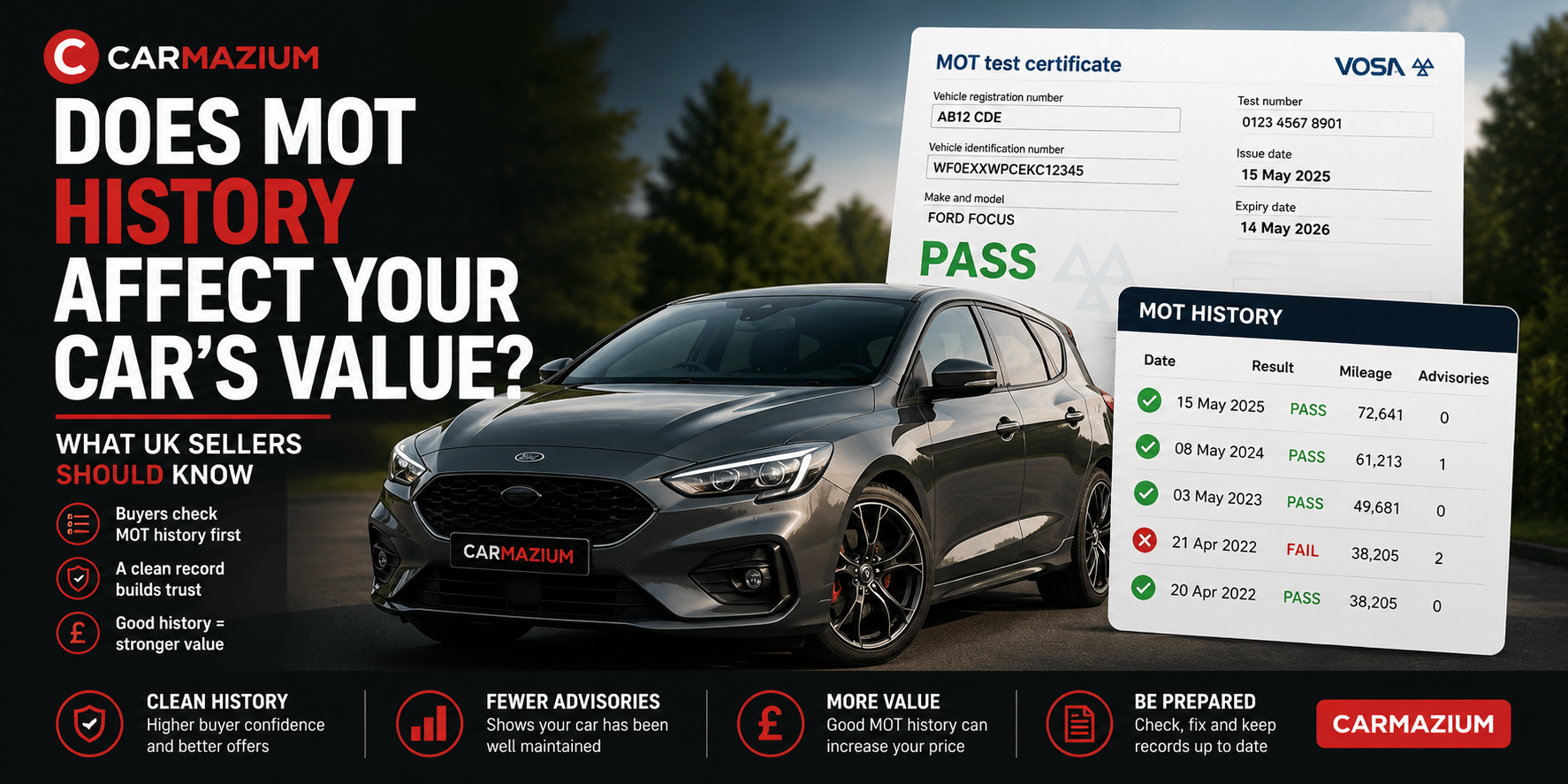
Does MOT History Affect Your Car's Value? What UK Sellers Should Know
When somebody values your used car, they don't necessarily see only the vehicle sitting in front of them.
They can also look backwards.
Years of MOT results can provide a surprisingly detailed picture of a vehicle's past.
Previous failures.
Advisories.
Mileage readings.
Tyre problems.
Brake defects.
Suspension issues.
And whether the same problem appears year after year.
For someone selling a car, this raises an important question:
Can a poor MOT history reduce what buyers are prepared to pay?
Potentially, yes.
But one historic MOT failure doesn't automatically make a vehicle undesirable.
What matters much more is what the history reveals about the car as a whole.
What Does an MOT History Actually Show?
An MOT history is effectively a chronological record of a vehicle's MOT tests.
For most vehicles that require an MOT, historical records can reveal information including:
- Test date
- Recorded mileage
- Pass or fail
- Major defects
- Dangerous defects
- Advisories
- Previous test certificate information
The government has retained computerised MOT testing data going back to 2005, including outcomes, odometer readings and reasons for failure.
That makes MOT history one of the easiest ways for a prospective buyer to investigate an older vehicle.
Buyers Can Check It Before They Even See Your Car
This is important.
A seller may spend hours cleaning and photographing a vehicle.
But before arranging a viewing, a knowledgeable buyer can check its MOT history online.
That means the buyer could already know that the car:
failed on tyres three years ago,
had suspension advisories two years ago,
had corrosion mentioned last year,
or recorded an unusual mileage change.
The RAC describes MOT history as the record of the MOT tests a vehicle has undergone and notes its importance in understanding a vehicle's roadworthiness history.
So there is little benefit in trying to hide an unattractive MOT record.
A better strategy is understanding it and being able to explain what happened.
Is an MOT Failure Bad for Your Car's Value?
Not necessarily.
This distinction is extremely important.
Imagine a car failed an MOT because:
One headlamp wasn't working.
The bulb was replaced.
The vehicle passed its retest.
That tells a very different story from a car repeatedly failing for:
- structural corrosion
- braking problems
- suspension defects
- dangerous tyres
- emissions problems
Buyers shouldn't simply count how many red "FAIL" results appear in a vehicle's history.
They should investigate why it failed.
MOT Failures Are Actually Quite Common
A previous MOT failure doesn't automatically mean a vehicle was badly maintained.
Official DVSA figures demonstrate how frequently vehicles initially fail.
During April–June of the 2025–26 financial year, the initial failure rate for Class 3 and 4 vehicles was approximately:
27.24%
That's more than one in four tests in that dataset.
The average initial failed test also contained around 2.42 defects.
So seeing a failure in a used vehicle's history shouldn't immediately make someone walk away.
The nature and pattern of those defects are much more informative.
What Are Cars Commonly Failing On?
DVSA's latest published defect-category data gives us an interesting picture.
For Class 3 and 4 vehicles during April–June 2025, defects appeared in categories including:
Lamps, reflectors and electrical equipment — 10.36% of tests
Suspension — 8.65%
Tyres — 6.23%
Brakes — 6.10%
Visibility — 4.65%
Body, chassis and structure — 3.18%
Noise, emissions and leaks — 3.03%
These percentages refer to tests recording defects in those categories and shouldn't simply be added together because one vehicle can have multiple defects.
But they show something important:
Many MOT failures involve components that naturally wear as cars age.
Advisories Can Be More Interesting Than the Pass Result
Imagine two cars.
Both have:
MOT: PASS
At first glance they look equal.
Now examine the details.
Car A
Pass.
No advisories.
Car B
Pass.
Advisories for:
- tyre tread approaching legal limit
- brake discs worn
- suspension component showing wear
Both cars technically passed.
But would you value them identically?
Probably not.
An advisory can indicate maintenance that may be required in the future.
A dealer purchasing the vehicle may need to consider those potential preparation costs when deciding how much to offer.
That's why the word PASS alone doesn't tell the whole story.
Repeated Advisories Deserve Particular Attention
One advisory appearing once isn't necessarily significant.
But patterns can be revealing.
Imagine the history shows:
2023 — corrosion advisory
2024 — corrosion advisory
2025 — corrosion advisory
A prospective buyer may reasonably ask:
Has the underlying problem actually been repaired?
The same principle applies to:
- suspension wear
- oil leaks
- tyre deterioration
- brake issues
- damaged components
Repeated advisories can indicate an unresolved problem.
MOT Mileage History Is Extremely Useful
One of the most valuable pieces of information recorded during MOT testing is mileage.
Suppose a car shows:
2022 — 48,500 miles 2023 — 56,300 miles 2024 — 64,900 miles 2025 — 72,100 miles
That looks like a natural progression.
Now consider:
2022 — 78,000 miles 2023 — 85,000 miles 2024 — 62,000 miles
That deserves investigation.
It doesn't automatically prove wrongdoing.
There can be legitimate explanations, including errors during an MOT test or instrument-cluster replacement.
But an unexpected mileage discrepancy is something a buyer will want explained.
This is another reason sellers should check their own MOT history before advertising the vehicle.
Does a Clean MOT History Increase a Car's Value?
It can certainly make a vehicle more attractive.
But we should be careful about claiming:
"Clean MOT history adds £500."
There is no universal figure.
A clean history is simply one positive signal among many.
Vehicle valuation can also depend on:
- Age
- Mileage
- Condition
- Service history
- Specification
- Number of owners
- Fuel type
- Gearbox
- Market demand
- Accident history
- Current supply
MOT history contributes to the overall picture.
It doesn't determine the entire valuation.
MOT History and Service History Are Not the Same Thing
This is another common misunderstanding.
A car can have a perfect MOT record and poor service history.
An MOT is primarily a roadworthiness test against specific requirements.
It isn't a comprehensive mechanical health inspection.
A successful MOT doesn't necessarily prove that:
- the engine has been serviced correctly
- gearbox oil has been changed
- the timing belt has been replaced
- manufacturer maintenance has been followed
- every mechanical component is healthy
Similarly, a comprehensive service history doesn't guarantee an MOT pass.
Ideally, buyers want to see both.
Should You Put a Fresh MOT on a Car Before Selling It?
Sometimes it can help.
Suppose your car has only six weeks of MOT remaining.
A buyer knows they'll soon need to arrange another test.
That creates uncertainty.
A fresh 12-month MOT can remove some of that uncertainty.
But don't assume getting a new MOT automatically increases the selling price by more than the test and any repair costs.
The decision depends on:
- current MOT length
- vehicle age
- condition
- likely repair costs
- expected selling price
- buyer expectations
For some inexpensive vehicles, sellers may prefer to sell honestly with the existing MOT.
For others, a fresh test can improve buyer confidence.
Should You Repair MOT Advisories Before Selling?
Again, there isn't one answer.
Consider an advisory for tyres approaching their limit.
Replacing four tyres might make the vehicle easier to sell.
But if the car is being sold directly into the motor trade, a dealer may prefer to account for those tyres in their own preparation costs.
Before spending hundreds of pounds preparing a vehicle for sale, ask:
Will I actually recover that money in the selling price?
Sometimes yes.
Sometimes no.
Dangerous Defects Are Different
MOT defects are classified according to severity.
A dangerous defect should be treated seriously.
DVSA data for Class 3 and 4 vehicles shows tyres are particularly significant among dangerous defects: tyre-related issues represented a large proportion of dangerous defects recorded in the latest published quarter.
Safety should come before resale value.
If a vehicle has a known dangerous defect, deal with the safety issue appropriately rather than thinking only about how it affects the selling price.
What Should Sellers Check Before Advertising Their Car?
Before listing your vehicle, look at its MOT history yourself.
Don't wait for the buyer to discover something first.
Check:
Current MOT expiry
Know exactly how much MOT remains.
Latest advisories
See whether any unresolved items are recorded.
Previous failures
Understand what caused them.
Repeated problems
Look for the same defect appearing across multiple tests.
Mileage progression
Make sure the recorded mileage history makes sense.
Repairs
If you repaired something that previously appeared as an advisory or failure, find the invoice.
That evidence can be valuable when explaining the vehicle to a buyer.
Documentation Can Change the Conversation
Suppose an MOT history shows:
FAIL — suspension component
That sounds concerning.
But the seller then produces an invoice showing:
Suspension replaced immediately after test.
Now the buyer has additional context.
The failure hasn't disappeared from the historical record.
But there is evidence showing what happened next.
This illustrates an important principle when selling any used car:
History isn't necessarily the problem. Unexplained history is.
How Motor Traders May Look at MOT History
Dealers buy cars differently from many private buyers.
They're trying to estimate not only whether they like the vehicle, but what it will cost to prepare for resale.
Suppose a dealer sees:
- two tyres close to their limit
- brake advisory
- short MOT
- damaged windscreen
They may mentally calculate potential preparation costs.
Those costs can influence their bid.
Another vehicle with a cleaner history and fewer immediate requirements may justify a stronger offer.
This is why accurate vehicle descriptions matter when selling into the trade.
Can You Sell a Car That Previously Failed Its MOT?
Yes, a historical failure doesn't permanently prevent a vehicle from being sold.
Many vehicles fail, are repaired and subsequently pass.
The more relevant questions are:
What caused the failure?
Was it repaired?
What is the vehicle's current condition?
A repaired historic defect and an unresolved current defect are completely different situations.
What About Selling a Car With No Current MOT?
This requires more care.
A vehicle without a valid MOT generally cannot simply be driven on public roads in the normal way.
There are limited exceptions, such as travelling to a pre-arranged MOT test where the legal requirements are met.
For a seller, this can affect:
- buyer confidence
- collection arrangements
- transport requirements
- potential dealer bids
A no-MOT vehicle isn't necessarily worthless.
But its market can be smaller and buyers may factor additional risk and transportation into their offers.
MOT History Is Really a Story About Maintenance
The most useful way to look at MOT history isn't:
Pass = good car
Fail = bad car
Instead, look at the entire sequence.
Does the history suggest the owner dealt with problems?
Did advisories disappear after repairs?
Does the mileage progress logically?
Are serious issues repeatedly appearing?
Has the car consistently been presented for testing?
Those patterns can tell buyers far more than a single MOT result.
How CarMazium Fits Into This
When a vehicle is offered to competing motor traders, its history forms part of the information buyers can consider when determining what they're prepared to pay.
That means sellers benefit from providing accurate information about:
- MOT history
- current advisories
- mileage
- condition
- service records
- known faults
Different traders can value the same vehicle differently.
One dealer may be less concerned about certain preparation work because they can repair it cost-effectively.
Another may particularly want that make or model for stock.
Allowing buyers to compete can therefore provide a clearer indication of the vehicle's real trade-market value.
Frequently Asked Questions
Does a failed MOT lower a car's value?
Not automatically. Buyers will usually be more interested in why the vehicle failed, whether the defect was repaired and its current condition.
Can buyers see old MOT failures?
Yes. Historical MOT information can include previous results, mileage and defects recorded during tests.
Do MOT advisories affect car value?
They can. Advisories indicating upcoming maintenance may influence what a buyer or dealer is prepared to pay.
Is a car worth more with 12 months' MOT?
A long MOT can make a used vehicle more attractive because it reduces immediate uncertainty, but there is no fixed amount that 12 months' MOT adds to every vehicle.
Is MOT history the same as service history?
No. An MOT tests specific roadworthiness requirements. Service history records maintenance carried out on the vehicle. Both provide different information.
Should I fix advisories before selling?
It depends on the cost of repair, vehicle value and how you're selling it. Don't automatically spend money unless the improvement is likely to justify the cost.
Where can I check MOT history?
The UK government provides an official online MOT-history service where vehicle MOT information can be checked.
Final Thoughts
An MOT certificate tells you whether a vehicle met the required standard at the time it was tested.
The MOT history tells a much bigger story.
For sellers, that history can influence buyer confidence and ultimately what somebody is prepared to pay.
One failure shouldn't frighten you.
One advisory shouldn't either.
Instead, pay attention to patterns:
Repeated defects.
Unresolved advisories.
Mileage discrepancies.
Serious safety problems.
And equally importantly:
Evidence that problems were properly repaired.
Before putting your car up for sale, check the history yourself.
Because there's a very good chance your buyer will.
Sell your car your way
Ready to turn your research into a real sale?
List in the CarMazium dealer auction for £0, or advertise retail from £1. Qualifying successful auction sales can receive a £100 seller incentive.
Keep reading
Related automotive guides

WeBuyAnyCar Alternatives UK 2026: Compare Better Ways to Sell Your Car
Looking for an alternative to WeBuyAnyCar? Compare CarMazium, Carwow, Auto Trader, dealer auctions and private selling to find the right way to sell your car.

Selling an Electric Car in the UK: Battery Health, Range & Value Guide 2026
Selling an electric car? Learn how battery health, real-world range, charging speed, warranty, service history and charging cables can affect buyer confidence and your EV's value.

Do Previous Owners Affect a Car's Value? UK Guide 2026
Does a one-owner car really sell for more? Learn how previous keepers can affect used-car value, why ownership history matters and what sellers can do when a car has changed hands several times.
From the marketplace