
Why Isn't My Car Selling? 12 Common Reasons UK Sellers Get No Enquiries
If your car is getting views but no serious buyers, check these 12 common causes including price, photos, advert quality, condition, trust and buyer friction.
In this article
You listed the car.
The advert is live.
Days pass.
You get a few views, maybe a message asking "best price?", but no serious buyer.
This is one of the most frustrating parts of selling a car privately.
The good news is that a slow advert usually has an explanation.
Sometimes the price is wrong.
Sometimes the photos make a good car look average.
Sometimes buyers see a warning sign in the history, description or presentation and move on without asking a question.
Here are 12 of the most common reasons a car does not sell — and what to do about them.
1. The Asking Price Is Too High
This is the first thing to check.
Buyers rarely look at your car in isolation.
They may have 10, 20 or 50 similar cars open in other browser tabs.
If yours is materially more expensive without an obvious reason, it can be eliminated immediately.
Current Auto Trader valuation guidance emphasises current market data, while its pricing guidance warns that overpricing can increase time to sale.
Compare your vehicle with:
- same model,
- same generation,
- similar trim,
- similar mileage,
- similar year,
- same fuel type,
- same transmission,
- and similar condition.
Do not justify a high price simply because you "need" a certain amount.
The market does not know what you need.
2. The Main Photo Is Weak
Buyers often see the main photo before they read a word.
If the first image is:
- dark,
- blurry,
- vertical,
- too far away,
- taken on a cluttered street,
- cropped badly,
- or showing only part of the vehicle,
the buyer may never open the advert.
Auto Trader currently recommends landscape images and a full set of useful angles, including front and rear three-quarter views.
A clean front three-quarter photo in even daylight is usually a strong starting point.
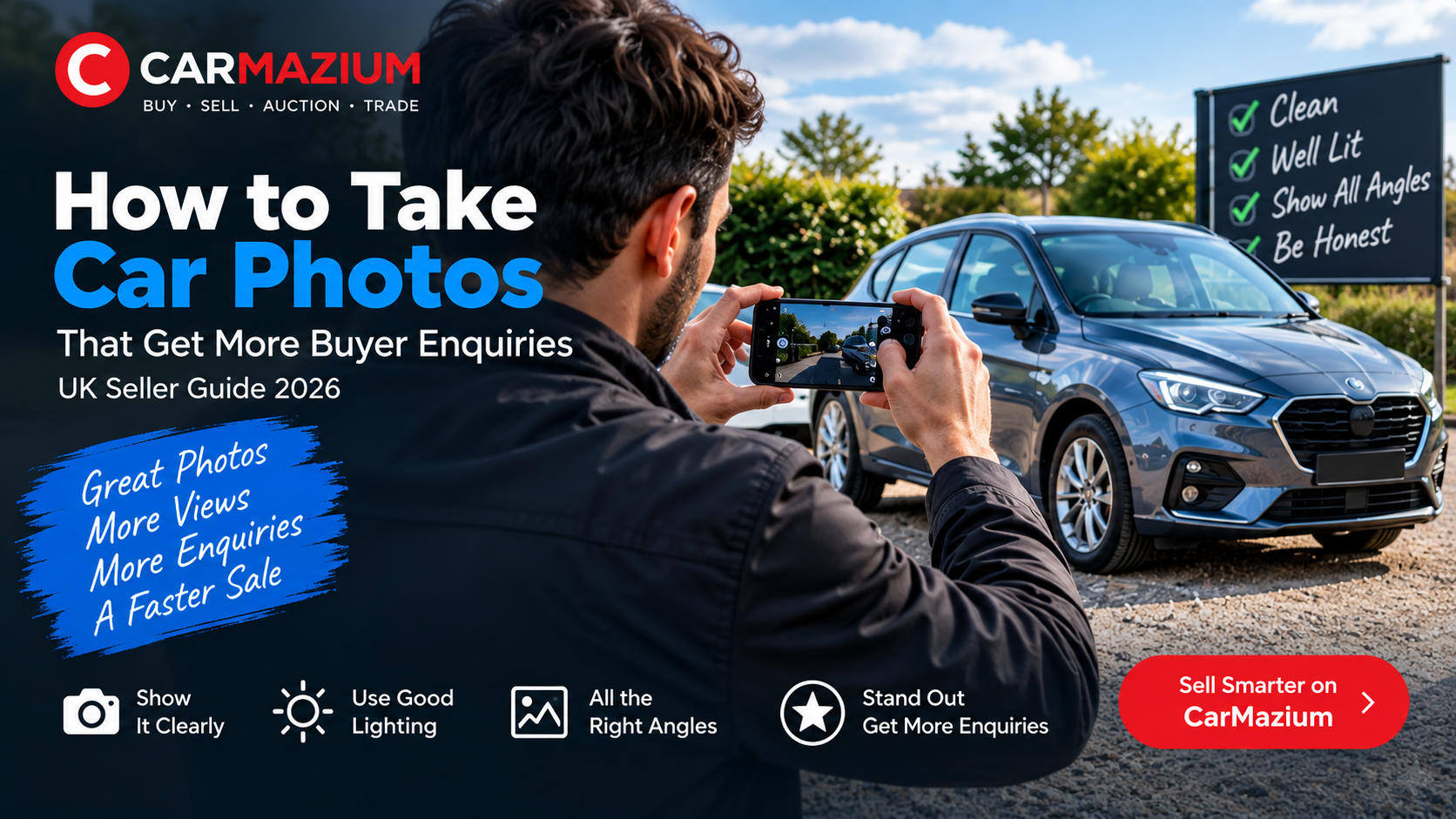
Our separate guide to car photos that get more enquiries explains the full photo sequence.
3. There Are Too Few Photos
One exterior picture and one dashboard picture are not enough for many buyers.
The buyer wants to understand the car before travelling.
Useful photos include:
- front three-quarter,
- rear three-quarter,
- straight front,
- straight rear,
- both side profiles,
- wheels,
- dashboard,
- front seats,
- rear seats,
- boot,
- engine bay,
- service evidence where appropriate,
- and visible damage.
Auto Trader suggests at least 20 photos for a strong advert.
You do not need to copy that number mechanically, but the principle is sound:
reduce buyer uncertainty before the viewing.
4. The Description Says Almost Nothing
A description such as:
Good car. Runs well. First to see will buy.
does not answer the questions a serious buyer has.
Useful information can include:
- ownership length,
- reason for sale,
- service history,
- MOT,
- recent maintenance,
- number of keys,
- tyre condition,
- specification,
- faults,
- cosmetic marks,
- and anything unusual about the car.
The description should make the buyer feel that the seller understands the vehicle.
See our guide to writing a car advert that builds buyer trust.
5. You Are Hiding the Obvious Problem
Buyers are cautious when an advert avoids a major issue.
Examples include:
- Category S or N history not mentioned,
- warning light visible in a photograph,
- obvious body damage photographed from every angle except the damaged side,
- poor MOT history with no explanation,
- missing service history,
- or an unusual mechanical noise described only as "drives mint".
Hiding a problem does not remove it.
It moves the problem to the viewing — where trust can disappear completely.
Describe the car accurately.
A buyer who is comfortable with the fault may still purchase.
A buyer who discovers it unexpectedly often will not.
6. The Car Looks Neglected
Presentation changes perception.
A vehicle with:
- dirty bodywork,
- rubbish in the footwells,
- dusty dashboard,
- stained seats,
- empty bottles,
- muddy boot,
- and grimy wheels
can look mechanically neglected even if it has been serviced properly.
You do not need a £500 detailing package.
A careful wash, interior clean and basic preparation can make the car easier to assess.
Likewise, do not use cleaning to conceal damage.
The aim is presentation, not deception.
7. The Tyres or Warning Lights Create Immediate Cost
A buyer may like the car but calculate:
- four tyres,
- ABS fault,
- engine-management diagnosis,
- brake warning,
- short MOT,
- and wheel refurbishment
before making an offer.
That can turn a £7,000 asking price into a very different mental calculation.
If a low-cost repair can remove a major concern, it may be worth completing before sale.
But do not spend blindly.
Diagnose first.
Read our guides to worn tyres and dashboard warning lights.
8. The Car Is Competing With Better-Specified Alternatives
Sometimes the price is reasonable in isolation but weak against current stock.
Your car may be competing with examples that have:
- lower mileage,
- better trim,
- automatic gearbox,
- panoramic roof,
- heated seats,
- camera,
- upgraded audio,
- newer tyres,
- or stronger history.
If buyers can get meaningfully more for the same money, your advert may stall.
That does not mean every option adds full resale value.
It means the competitive set matters.
9. ULEZ or Emissions-Zone Status Narrows the Audience
For some older vehicles, especially diesels, emissions-zone compliance can change who wants the car.
A non-compliant vehicle may still be a good car.
But a buyer who regularly enters London or another relevant zone may exclude it immediately.
If the car is compliant, state it accurately after checking.
If it is not, price and market it for the audience that can use it comfortably.
See our ULEZ car-value guide.
10. You Are Difficult to Contact
A good advert can still fail if the seller responds slowly or awkwardly.
Common problems include:
- no answer for days,
- one-word replies,
- refusing reasonable questions,
- constantly changing viewing times,
- no clear location,
- or refusing to confirm basic information before the buyer travels.
Serious buyers are often talking to several sellers.
Make the process easy.
You do not have to be available every minute.
But clear, timely communication helps.
11. Viewings Feel Unsafe or Inconvenient
Buyers may hesitate if:
- the location keeps changing,
- the seller insists on a strange meeting place,
- there is no opportunity to inspect the car properly,
- test-drive arrangements are unclear,
- paperwork cannot be shown,
- or the seller pressures them to send money before viewing.
A safe, straightforward viewing builds confidence.
For private sales, agree:
- location,
- time,
- test-drive expectations,
- documents,
- and payment method
before the buyer arrives.
See our guide to safe car viewings and test drives.
12. You Chose the Wrong Selling Route
Some sellers simply do not enjoy managing retail enquiries.
Others are willing to wait for a retail buyer because they want more control over the asking price.
CarMazium gives sellers two different routes:
Dealer Auction
- £0 seller listing fee,
- 24-hour auction,
- verified motor traders bid,
- reserve-price control,
- qualifying £100 reward after approved handover.
Retail Listing
- Basic £1,
- Standard £10 with HPI,
- Premium £25 with HPI + first 28-day Featured Boost.
If the car is struggling in retail, a trade auction may provide a faster market test.
If a trade result is below your objective, a retail listing may suit your strategy better.
See CarMazium Auction vs Retail.
Views but No Messages: What Does That Usually Mean?
If the advert receives plenty of views but almost nobody contacts you, inspect:
- price,
- main photo,
- description,
- vehicle history,
- obvious faults,
- and comparative value.
People are finding the advert.
Something is stopping them from taking the next step.
No Views at All: What Does That Usually Mean?
Low views can indicate:
- weak search visibility,
- poor categorisation,
- uncompetitive price,
- a niche vehicle,
- or insufficient exposure.
Check that the vehicle details are correct.
If the platform offers an optional visibility tool, consider whether it is commercially sensible.
CarMazium Premium includes the first 28-day Featured Boost, while a separate boost is also available under current pricing.
Messages but No Viewings
This often means the advert is generating curiosity but not enough confidence.
Common causes:
- seller replies are vague,
- location is inconvenient,
- faults emerge during chat,
- price expectations are rigid,
- or the buyer finds a stronger alternative before arranging the visit.
Try answering the common questions directly in the advert.
Every unanswered question creates friction.
Viewings but No Offers
If multiple genuine buyers inspect the car and nobody offers, pay attention.
The problem may be:
- condition,
- unexpected damage,
- mechanical noise,
- warning lights,
- poor test drive,
- paperwork,
- or price.
One buyer can be wrong.
Five independent buyers raising the same issue is useful market feedback.
Repeated Offers at the Same Lower Level
Suppose the car is advertised at £9,500.
Three separate serious buyers offer around £8,500.
That does not prove the car is worth exactly £8,500.
But it is data.
You should investigate why the market keeps clustering there.
Maybe comparable cars have fallen.
Maybe your mileage is high.
Maybe a repair is putting buyers off.
Use the feedback rather than dismissing every buyer as a "lowballer".
How Long Should You Wait Before Changing the Advert?
There is no universal number of days.
A rare vehicle may naturally take longer.
A mainstream car priced correctly should usually generate some meaningful activity faster.
Instead of changing the price every 24 hours, watch:
- views,
- saves,
- messages,
- offers,
- and viewing conversion.
Make one evidence-based change at a time.
The 30-Minute Advert Audit
Before reducing the price, check:
Price
Are comparable cars cheaper?
Main Photo
Would you click it?
Photo Set
Can the buyer see the whole car?
Description
Does it answer obvious questions?
Trust
Have you disclosed important history?
Condition
Are visible defects creating immediate cost?
Contact
Are you easy to reach?
Route
Would auction or retail better suit your goal?
This audit often reveals the problem quickly.
Frequently Asked Questions
Why Am I Getting Views but No Enquiries?
Price, presentation or trust are the most common areas to review.
Should I Lower the Price Immediately?
Not necessarily.
First check photos, description and obvious buyer concerns.
Is My Car Unsellable if It Has Faults?
No.
But the condition should be described accurately and reflected in the price.
Can Better Photos Really Matter?
Yes.
Buyers often judge whether to open an advert from the main image, and stronger photo coverage reduces uncertainty.
Should I Switch to Auction?
If you want a fast trade-market test rather than managing retail enquiries, auction may be worth considering.
The Bottom Line
A car that is not selling is usually giving you information.
Maybe the price is too high.
Maybe the photos are weak.
Maybe buyers do not trust the description.
Maybe the condition creates too much immediate cost.
Maybe the selling route does not match your goal.
Do not change everything at once.
Audit the advert logically, fix the biggest weakness first and watch how buyer behaviour changes.
If you want to test the market through either dealer auction or retail listing, start selling on CarMazium.
Sell your car your way
Ready to turn your research into a real sale?
List in the CarMazium dealer auction for £0, or advertise retail from £1. Qualifying successful auction sales can receive a £100 seller incentive.
Keep reading
Related automotive guides
How to Write a Car Advert That Builds Buyer Trust: UK Guide 2026
Write a stronger used-car advert with accurate details, service history, condition, specification, recent maintenance and honest fault disclosure.
How to Handle Viewings and Test Drives Safely When Selling a Car Privately in the UK
A practical UK guide to safer private car viewings and test drives, including buyer identity, insurance, keys, documents, payment and DVLA handover.
How to Take Car Photos That Get More Buyer Enquiries: UK Seller Guide 2026
Learn how to photograph a car for sale in the UK, including the best main image, essential exterior and interior angles, lighting, damage photos and common mistakes.
From the marketplace