
CarMazium Auction vs Retail: Which Route Should Sellers Choose?
Compare CarMazium Auction and Retail selling routes, including seller fees, timing, buyer types, pricing control, HPI options and the £100 auction reward.
In this article
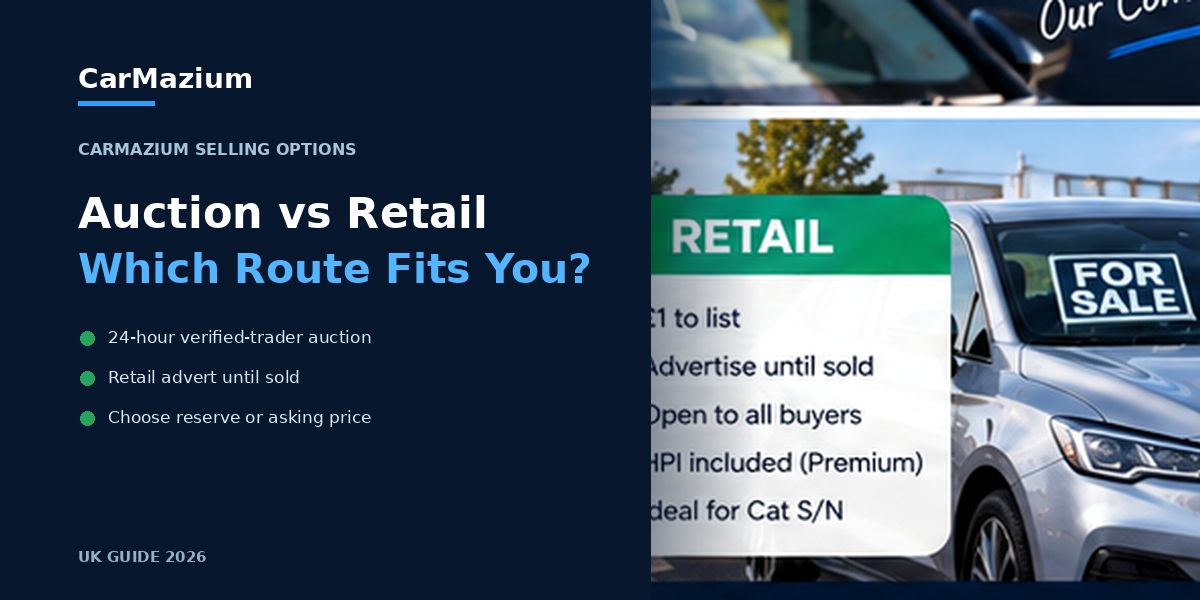
CarMazium gives UK sellers two different ways to bring a car to market.
You can put the vehicle into a free 24-hour dealer auction, or you can create a retail listing starting from £1.
Both routes are designed to help a seller reach buyers, but they work differently.
Auction focuses on competitive bidding from verified motor traders.
Retail focuses on advertising directly to marketplace buyers at a seller-controlled asking price.
The important question is not:
Which CarMazium route is better?
It is:
Which route better matches the way you want to sell this particular car?
CarMazium Auction vs Retail at a Glance
| Feature | Auction | Retail |
|---|---|---|
| Seller listing fee | £0 | From £1 |
| Listing format | 24-hour live auction | Advertised listing |
| Who buys | Verified motor traders | Retail marketplace buyers |
| Seller sets | Reserve price | Asking price |
| Buyer competition | Live bidding | Offers and enquiries |
| Seller reward | £100 on qualifying successful auction handover | No auction reward |
| Retail buyer fee | Not applicable | £0 |
| Vehicle payment | Buyer pays seller directly | Buyer pays seller directly |
| HPI | Optional | Optional on Basic; included Standard/Premium |
That table shows why the two routes should not be treated as substitutes in every situation.
They create different kinds of selling experience.
How the CarMazium Auction Route Works
The auction route is free for the seller to list.
Once the vehicle is prepared and accepted into the auction flow, verified motor traders can bid during the 24-hour auction.
The seller sets a reserve price.
That means the vehicle is not simply sold at any number that appears on screen.
The reserve gives the seller a minimum threshold.
CarMazium also uses anti-snipe protection so last-second bidding does not unfairly close the auction before other active bidders have a chance to respond.
When a bid arrives during the final protected period, the auction timer can extend.
The aim is to behave more like a live auction room than a one-click countdown race.
What Makes Auction Different From a Normal Online Advert?
An ordinary advert waits for somebody to find the car and make contact.
An auction creates a defined competition window.
That changes the seller experience.
Instead of asking:
Will anyone contact me this week?
the seller can see how verified trade buyers respond during the auction.
That gives the seller useful market evidence even before the handover stage.
Who Can Bid in a CarMazium Auction?
Only verified motor traders can bid.
Private retail buyers can view relevant marketplace content but they are not the bidding audience for the dealer auction.
This is a deliberate separation.
The auction is the trade-buying route.
Retail is the direct marketplace route.
For trade-specific fee information, see CarMazium Trader Pricing.
What Does the Winning Trader Pay?
The winning verified motor trader currently pays a £125 one-off CarMazium auction buyer fee.
The seller does not pay this fee.
A trader who does not win does not pay the auction buyer fee for that vehicle.
After the applicable fee is completed, the seller contact and deal details unlock so the parties can coordinate the next stage.
The vehicle purchase price is then paid directly to the seller.
CarMazium does not hold the vehicle purchase funds.
The £100 Auction Seller Reward
A qualifying successful auction sale can receive a £100 seller reward from CarMazium.
This is separate from the amount the trader pays for the vehicle.
The seller completes the transaction and provides the required handover evidence.
Once the handover is approved under the current platform terms, CarMazium releases the reward.
So there are two separate flows:
Vehicle money: buyer → seller
Seller reward: CarMazium → qualifying seller after approved handover
That distinction prevents confusion about who is paying for the vehicle itself.
When Auction Can Make Sense
Auction may suit a seller who wants a simple competitive process.
Examples include sellers who prefer:
- a defined 24-hour selling window,
- no seller auction listing fee,
- verified motor-trade bidders,
- competitive live offers,
- and a reserve price rather than a public retail asking price.
It may also appeal to somebody who does not want to manage repeated retail enquiries over a longer period.
The auction lets the trade market show what it is prepared to pay.
When Auction May Be Less Suitable
Auction may be less attractive to a seller who is determined to achieve a specific retail asking price and is prepared to wait for the right retail buyer.
It may also be less suited to somebody who wants:
- a public retail advert,
- direct retail enquiries,
- long-term listing visibility,
- or a package with an included HPI report and Featured Boost.
That does not make the auction weak.
It simply means the seller's goal is different.
How the CarMazium Retail Route Works
Retail gives the seller more direct control over the advertised price.
Instead of entering a 24-hour bidding process, the vehicle is shown in the public marketplace.
Buyers can view the car and make offers.
The seller chooses whether to accept.
The current retail packages are:
Basic — £1 One-Off
Basic is the lowest-cost retail route.
It includes a public marketplace listing advertised until sold under the current package terms.
HPI remains optional.
Standard — £10 One-Off
Standard includes the Basic features plus an HPI vehicle-history report.
Premium — £25 One-Off
Premium includes the Standard benefits plus a 28-day Featured Boost and Premium presentation.
A separate Featured Boost currently costs £25 for 28 days when purchased outside Premium.
Full current package information is available on CarMazium Pricing.
Retail Buyers Pay No CarMazium Buyer Fee
CarMazium does not charge a retail buyer fee for purchasing a vehicle through the retail marketplace.
That is different from the verified-trader auction model.
The trader auction fee is attached to winning the auction.
The retail buyer fee is £0.
This distinction should be clear in any comparison.
Retail Gives the Seller More Asking-Price Control
Retail may suit somebody who already has a clear price in mind.
You decide the asking price and wait for buyers to respond.
That can be useful when:
- the vehicle has strong retail appeal,
- the specification is easy to explain,
- the seller is prepared to handle enquiries,
- or the seller is willing to wait for a particular price.
The trade-off is time.
A retail advert does not guarantee that the right buyer appears quickly.
Auction Gives the Market More Pricing Control
Auction works differently.
The seller still controls the reserve, but verified traders decide how far they are prepared to compete above the starting level.
That can be useful where the seller wants the trade market to discover the price.
It may also reveal that the market disagrees with the seller's expectation.
That information can be useful.
A valuation is an estimate.
Bids are real buying decisions.
What About Cars With Unusual Specification?
A heavily optioned, rare-colour or enthusiast car can behave differently from an ordinary mainstream model.
Retail may sometimes give the seller more room to explain:
- unusual options,
- provenance,
- modifications,
- rarity,
- specialist history,
- or a distinctive specification.
Auction may still work well if trade buyers recognise the value.
There is no rule that unusual cars must use one route.
The seller should think about which buyer group is most likely to understand the vehicle.
What About Category S or Category N Cars?
Insurance-category cars can require more explanation.
A retail listing gives the seller space to present the repair history, photographs and supporting information to prospective buyers.
Auction can still be used where appropriate, but the category status must be disclosed accurately.
The most important point is transparency.
A seller should never treat category history as a minor detail.
Does HPI Have to Be Included?
No.
HPI is optional for Auction and Basic Retail.
Standard and Premium Retail include the HPI report.
That means the seller can choose the package that matches the level of presentation they want.
HPI should not be confused with an MOT history check or a mechanical inspection.
Each serves a different purpose.
Which Route Gives You More Speed?
Auction has the clearer time structure because it runs for 24 hours.
That does not mean the complete sale and collection always happen within the same 24-hour period.
The auction determines the bidding result.
The winning buyer and seller then arrange inspection, payment and handover.
Retail has no equivalent 24-hour auction deadline.
A buyer could appear quickly or the listing could remain live much longer.
So Auction generally gives faster price discovery, while Retail may offer more patience for a seller targeting a specific retail price.
Which Route Gives You More Control?
Retail gives more control over the public asking price.
Auction gives control through the reserve.
Those are not the same thing.
A reserve answers:
What is the minimum I am willing to accept in this auction?
An asking price answers:
What price do I want to advertise to retail buyers?
The seller should choose the mechanism that feels closer to their actual objective.
Which Route Creates More Competition?
Auction creates direct, visible competition between verified motor traders.
Retail can still create competition if several buyers make offers, but the process is not the same.
There is no single live bidding ladder unless the vehicle is in auction.
This is one of the most important functional differences between the routes.
Do You Get Paid Through CarMazium?
No.
For the vehicle itself, the buyer pays the seller directly.
CarMazium does not hold the vehicle purchase price in either Auction or Retail.
This reduces confusion around the platform's role.
CarMazium provides the marketplace, listing and transaction workflow.
The underlying vehicle money stays between the parties.
What Happens After an Auction Win?
After the auction, the winning verified trader completes the applicable CarMazium fee.
The contact and deal details then become available.
The buyer and seller coordinate:
- inspection,
- collection,
- direct vehicle payment,
- and handover.
After a qualifying successful auction sale, the seller can complete the handover evidence required for the £100 reward.
The How It Works page explains this flow in detail.
What Happens After a Retail Offer Is Accepted?
The seller and buyer proceed directly with the transaction.
The buyer can inspect the vehicle, agree the final terms and pay the seller directly.
Retail buyers are not charged a CarMazium buyer fee.
The seller should still confirm cleared funds before releasing the vehicle.
Auction vs Retail: A Practical Decision Framework
Ask yourself five questions.
1. Do I Want a Fast Market Test?
If yes, Auction may be more suitable.
2. Do I Want to Control the Public Asking Price?
If yes, Retail may be more suitable.
3. Do I Want Trade Buyers or Retail Buyers?
Auction is for verified motor traders.
Retail is for marketplace buyers.
4. Am I Willing to Manage Enquiries?
Retail can involve more direct enquiry management.
Auction concentrates bidding into a defined period.
5. Do I Want the Qualifying £100 Seller Reward?
That reward belongs to the successful Auction route after approved handover.
It is not part of the Retail package.
Example: Everyday Family Hatchback
Imagine a mainstream five-year-old hatchback with:
- normal mileage,
- good service history,
- clean condition,
- and no unusual specification.
If the seller wants a quick trade-market result, Auction may be attractive.
If the seller is willing to wait and wants to target a higher retail asking price, Retail may be more suitable.
The car itself has not changed.
The selling objective has.
Example: Specialist or High-Specification Car
Now imagine a vehicle with:
- rare factory options,
- distinctive colour,
- enthusiast appeal,
- detailed provenance,
- and a carefully chosen asking price.
Retail may give the seller more room to present those details.
But a strong trade audience may still value the vehicle accurately in Auction.
Again, the route depends on the likely buyer.
Example: Seller Who Values Simplicity
Some sellers do not want:
- repeated phone calls,
- multiple viewings,
- extended price negotiation,
- or an open-ended advert.
For that seller, a free 24-hour dealer auction may feel simpler.
The result is based on verified trade demand.
Example: Seller Who Values Maximum Price Control
Another seller may be comfortable waiting.
They may prefer:
- setting their own retail asking price,
- reviewing buyer offers,
- and keeping the listing active until they accept a deal.
That seller may prefer Retail.
Common Mistake: Comparing Auction Bid With Retail Asking Price
A trade auction bid and a retail asking price are not directly equivalent.
A trader buying a vehicle may need to allow for:
- preparation,
- warranty exposure,
- stock holding,
- advertising,
- staff,
- finance costs,
- and a retail margin.
A private retail buyer is purchasing for a different reason.
So do not assume a lower trade auction price automatically means the vehicle was undervalued.
The markets are different.
Common Mistake: Setting the Reserve Too High
A reserve should protect the seller, not make the auction impossible to complete.
If the reserve is far above realistic trade value, genuine bidders may still participate but the vehicle may finish unsold.
Use valuation guidance and current market evidence rather than emotional attachment.
Common Mistake: Pricing Retail Like a Dealer Without Dealer Preparation
Private retail sellers sometimes copy the highest dealer advert they can find.
That comparison may ignore:
- dealer warranty,
- preparation,
- finance availability,
- business overhead,
- consumer protection obligations,
- and professional retail presentation.
A private asking price still needs to make sense to the buyer.
The Bottom Line
CarMazium Auction and Retail are deliberately different.
Choose Auction when you want a free seller listing, a 24-hour competitive trade process and the opportunity for a qualifying £100 reward after successful approved handover.
Choose Retail when you want a public advert, control over the asking price and a choice of Basic, Standard or Premium presentation.
Neither route is universally better.
The better route is the one that matches your car, your timeframe and your preferred buyer.
You can compare the live package details on CarMazium Pricing or start selling here.
Sell your car your way
Ready to turn your research into a real sale?
List in the CarMazium dealer auction for £0, or advertise retail from £1. Qualifying successful auction sales can receive a £100 seller incentive.
Keep reading
Related automotive guides

How to Sell Your Car on CarMazium: Step-by-Step UK Guide 2026
Learn how to sell your car on CarMazium in 2026, from valuation and listing choice to dealer auction, retail offers, direct payment and vehicle handover.
How to Write a Car Advert That Builds Buyer Trust: UK Guide 2026
Write a stronger used-car advert with accurate details, service history, condition, specification, recent maintenance and honest fault disclosure.

How to Handle Viewings and Test Drives Safely When Selling a Car Privately in the UK
A practical UK guide to safer private car viewings and test drives, including buyer identity, insurance, keys, documents, payment and DVLA handover.
From the marketplace