
How to Sell a Non-Runner or Faulty Car in the UK: 2026 Guide
Learn how to sell a non-running or faulty car honestly in the UK, including pricing, fault disclosure, trader vs retail routes, recovery, payment and safe handover.
In this article
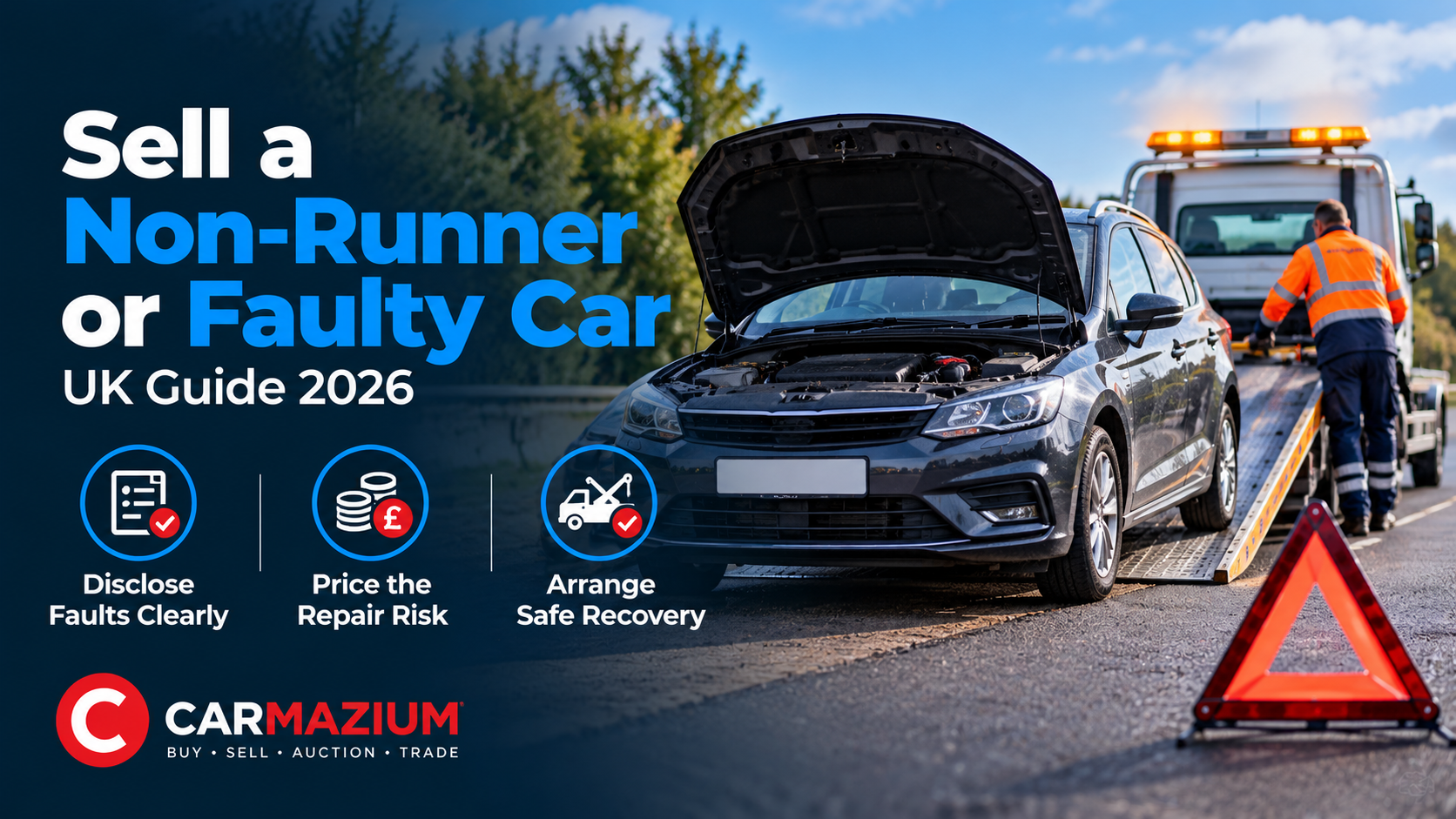
A car does not need to be perfect to have value.
Vehicles with engine faults, gearbox problems, warning lights, accident damage, electrical issues or no MOT can still attract buyers.
The challenge is that a faulty or non-running car needs a different selling strategy from an ordinary road-ready vehicle.
The seller needs to be clear about:
- what is wrong,
- what is known and unknown,
- whether the vehicle can legally and safely be driven,
- how the price reflects the risk,
- and how collection will take place.
Handled properly, a faulty car can still be sold efficiently without pretending it is something it is not.
What Counts as a Non-Runner or Faulty Car?
A non-runner is generally a vehicle that cannot currently be driven away under its own power.
That can include a car that:
- will not start,
- starts but immediately cuts out,
- has no drive,
- has a failed clutch,
- has a severe engine fault,
- has accident damage,
- has locked brakes,
- or is otherwise unsuitable to drive.
A faulty car may still move but has a known problem.
Examples include:
- engine-management light,
- noisy gearbox,
- slipping clutch,
- overheating,
- battery or charging fault,
- ABS or airbag warning,
- DPF issue,
- suspension noise,
- oil leak,
- electrical malfunction,
- or intermittent starting fault.
The important point is not the label.
It is the actual condition of the vehicle.
Can You Sell a Faulty Car Privately in the UK?
Yes, but the description needs to be accurate.
Citizens Advice guidance for private sales makes clear that goods, including cars, should match the description given by the seller.
If you know a fault exists, do not describe the car in a way that contradicts that known condition.
For example, do not advertise:
“Mechanically perfect”
when you know the engine is overheating.
A better description is factual:
“Vehicle starts and drives but overheats after 15–20 minutes. Fault has not been diagnosed. Sold as requiring repair.”
That gives the buyer information they can use.
Roadworthiness Still Matters
A current MOT does not guarantee that a vehicle is safe to drive today.
GOV.UK roadworthiness guidance states that the vehicle keeper is responsible for making sure the vehicle is safe to drive and that a vehicle can be unsafe even with a current MOT.
That matters when selling a faulty car.
If the vehicle is unsafe or unroadworthy, do not let the buyer simply drive it away because they say they are willing to take the risk.
Arrange appropriate recovery or transport instead.
For serious defects, collection by transporter is often the safest route.
The First Question: Repair It or Sell It as It Is?
Before advertising, compare the likely repair cost with the likely increase in sale value.
Repair May Make Sense When
- the fault is inexpensive,
- the diagnosis is certain,
- the repair removes a major buyer objection,
- the vehicle is otherwise in strong condition,
- or the repair is likely to add more value than it costs.
Selling As-Is May Make Sense When
- the repair is expensive,
- the car is low value,
- the diagnosis is uncertain,
- several faults are present,
- the vehicle is already a non-runner,
- or a trader is likely to repair it more cheaply than you can.
Do not spend £2,000 trying to gain £1,000.
The commercial decision should be based on the whole vehicle.
Diagnose Before You Advertise Where Possible
An unknown fault usually scares buyers more than a known one.
Compare these two adverts:
Advert A:
“Engine light on. No idea why.”
Advert B:
“Engine-management light on. Diagnostic scan shows oxygen-sensor fault code. Vehicle drives. Fault not repaired.”
Advert B gives the buyer something concrete to assess.
A diagnostic scan or garage report can help identify:
- fault codes,
- affected systems,
- likely repair area,
- and whether the problem appears minor or serious.
A fault code is not always a complete diagnosis, but it is still better than guessing.
Do Not Clear Fault Codes Just for the Sale
Erasing a warning light without repairing the underlying problem does not fix the car.
The light may return:
- immediately,
- after a few miles,
- after a drive cycle,
- or once the control unit sees the same fault again.
If you have diagnosed the fault but chosen not to repair it, say so.
That is better than creating a false impression that the vehicle is fault-free.
See our guide to dashboard warning lights and car value.
How to Price a Faulty Car
Start with the value of an equivalent car in normal condition.
Then deduct for:
- confirmed repair cost,
- diagnostic uncertainty,
- recovery or transport,
- MOT risk,
- preparation,
- time,
- and buyer margin.
This is especially important when selling to the motor trade.
A trader may need to allow for:
- parts,
- labour,
- VAT where applicable,
- transport,
- workshop time,
- resale warranty exposure,
- and profit margin.
That means the deduction may be larger than the raw price of the broken part.
Example: Known Minor Fault
Imagine the car would normally sell privately for £6,500.
It has a confirmed sensor fault likely to cost around £180 to repair.
If everything else is good, selling at £6,200–£6,300 may still be realistic depending on demand.
The buyer can see the likely cost and risk.
Example: Unknown Engine Fault
Now imagine the same car:
- has low compression,
- misfires badly,
- smokes,
- and the cause is not confirmed.
A buyer may allow for:
- engine rebuild,
- replacement engine,
- towing,
- labour,
- hidden damage,
- and uncertainty.
The price impact may be much larger.
This is why diagnosis often protects value.
Trade Value Can Be More Relevant Than Retail Value
For a genuine non-runner, trade value may be the more useful benchmark.
A private retail buyer often wants a car they can use immediately.
A motor trader, dismantler, specialist or repairer may be more willing to buy a vehicle with faults because they have:
- workshop access,
- trade labour rates,
- parts contacts,
- transport,
- diagnostic equipment,
- and resale experience.
That means a faulty car may attract stronger interest from the trade than from ordinary retail buyers.
CarMazium Auction Can Suit Faulty Vehicles
CarMazium's current seller auction costs £0 to list and gives verified motor traders 24 hours to bid.
That can be useful for a faulty or non-running vehicle because the audience is trade-focused.
The important part is accurate disclosure.
Include:
- whether the car starts,
- whether it drives,
- known warning lights,
- known mechanical faults,
- MOT position,
- tyre condition,
- accident or category history,
- and whether recovery is required.
A trader can then price the vehicle based on the real condition.
You can start a CarMazium auction or valuation.
Retail Listing Can Still Work
A faulty vehicle can also be listed in retail if the seller wants a public asking price.
CarMazium's retail packages currently start from £1.
Retail may suit:
- enthusiast vehicles,
- project cars,
- rare models,
- repairable category cars,
- or vehicles with a known fault that a private buyer may want to fix.
The advert must be clear.
Do not present a project car as normal road-ready transport.
Write the Faults Near the Top of the Advert
Do not hide important defects in the last sentence.
If the vehicle is a non-runner, say so early.
For example:
“2016 diesel hatchback. Non-runner due to suspected timing-chain failure. Engine turns but does not start. Recovery required. Service history and two keys present.”
That immediately filters the audience.
You are less likely to waste time with buyers who expected a normal drive-away car.
Describe What the Car Still Does
Fault disclosure does not mean the advert should be entirely negative.
Useful factual information can include:
- engine cranks,
- engine starts,
- gearbox engages,
- car rolls freely,
- steering works,
- brakes hold,
- battery is flat,
- tyres hold air,
- vehicle can be winched,
- or car must be lifted.
For transporters and traders, these details matter.
A non-runner with free-rolling wheels is a different collection job from a vehicle with seized brakes.
Be Clear About MOT Status
State:
- current MOT expiry,
- failed MOT,
- no MOT,
- or SORN status where relevant.
A vehicle without MOT may still be sold.
But the buyer should not assume they can simply drive it home.
If the car is not legal and safe for the road, arrange transport.
GOV.UK guidance also reminds buyers and sellers that the tax position changes when the vehicle changes keeper.
Include Honest Photos
Show the whole car.
Useful photos include:
- front,
- rear,
- both sides,
- interior,
- dashboard,
- odometer,
- wheels,
- engine bay,
- visible damage,
- and fault evidence where useful.
If the car has:
- accident damage,
- missing bumper,
- broken window,
- oil leak,
- warning lights,
- or damaged wheel,
show it clearly.
Hiding obvious defects usually creates wasted viewings and lower trust.
Category S and Category N Cars
If the faulty vehicle also has insurance-category history, disclose it.
A Category S or N marker is relevant to value and buyer decision-making.
Do not assume a mechanical fault somehow makes the previous write-off history unimportant.
See Cat S vs Cat N.
Service History Still Has Value
Even a broken car can be worth more if the maintenance history is clear.
A buyer may want to know:
- when the timing belt was changed,
- when the gearbox was serviced,
- whether the clutch was replaced,
- whether the battery is recent,
- how regularly the oil was changed,
- and what work led up to the current fault.
Keep invoices.
A non-runner with strong paperwork can be easier to assess than a running car with no history.
Outstanding Finance Still Needs to Be Resolved
A mechanical fault does not change the finance position.
If outstanding finance exists, understand the settlement before sale.
Do not assume you can simply sell the vehicle and deal with the finance later.
See our guide to selling a car with outstanding finance.
Recovery and Collection
A non-runner usually needs professional transport.
TradeXchange allows users to post Delivery & Recovery jobs and compare fixed-price quotes from approved providers.
When posting the job, include:
- collection postcode,
- delivery postcode,
- vehicle size,
- whether it rolls,
- whether it steers,
- whether brakes are locked,
- whether keys are available,
- and whether winching is required.
You can use TradeXchange Delivery & Recovery for suitable vehicle movement jobs.
Do Not Let an Unroadworthy Car Be Test-Driven
A buyer may say:
“I know it has a fault. I will take the risk.”
That does not make an unsafe vehicle safe.
If the fault affects:
- brakes,
- steering,
- tyres,
- major suspension,
- visibility,
- or another critical system,
do not allow an unsafe road test.
If the car cannot legally and safely be driven, use recovery.
What Documents Should You Have?
Even for a faulty car, prepare the normal sale paperwork where available.
Useful items include:
- V5C,
- service records,
- MOT history,
- invoices,
- repair estimates,
- diagnostic report,
- keys,
- handbook,
- and receipts.
GOV.UK advises sellers to protect the V5C document reference number and not share pictures or copies of the log book.
You can show the V5C to a genuine buyer so they can match the details to the car.
See documents needed to sell a car.
Use a Written Receipt
A simple receipt should record:
- date,
- seller,
- buyer,
- vehicle registration,
- VIN where appropriate,
- mileage,
- price,
- payment method,
- and known faults disclosed.
Do not rely on vague wording such as:
“Sold as seen”
as a substitute for accurate description.
The better approach is to list the material known issues.
For example:
“Known faults disclosed before sale: vehicle non-running, engine-management warning previously present, suspected timing-chain fault, no current MOT, recovery required.”
That creates a clearer record.
Payment for a Faulty Vehicle
The same payment precautions apply as with any car sale.
Do not release the vehicle because the buyer shows you a screenshot.
Check the money through your own banking channel.
If the buyer uses bank transfer:
- confirm the agreed amount,
- verify the payment independently,
- and only release the vehicle after you are satisfied.
For CarMazium vehicle sales, the vehicle purchase price is paid directly between buyer and seller.
CarMazium does not hold the car purchase money.
DVLA Handover Still Applies
When the vehicle is sold to a UK buyer, follow the normal DVLA change-of-keeper process.
GOV.UK selling-a-vehicle guidance says the seller must notify DVLA and provide the buyer's full name and address.
Give the green new-keeper slip to the buyer where applicable.
A non-runner is still a vehicle sale.
The keeper record still needs to be updated.
Can You Sell a Car for Spares or Repair?
Yes, but be precise about what that means.
If the vehicle is being sold as a repair project, state:
- current condition,
- whether it runs,
- known faults,
- whether road use is suitable,
- and whether collection by transporter is required.
Do not use "spares or repair" as a way to conceal a roadworthiness problem while still encouraging the buyer to drive it away.
If the car is intended only for dismantling or off-road repair, make that clear.
Non-Runner vs Scrap
A non-running car is not automatically scrap.
Some vehicles are worth repairing because of:
- model demand,
- age,
- specification,
- parts value,
- engine or gearbox availability,
- rarity,
- or overall condition.
Before scrapping, compare:
- trade bids,
- repair quotes,
- parts value,
- and recovery cost.
A trader or specialist may value the car well above scrap-metal value.
When Scrapping May Make More Sense
Scrapping may be sensible where:
- corrosion is severe,
- repair cost exceeds vehicle value,
- several major systems have failed,
- accident damage is extensive,
- parts demand is low,
- or storage and recovery costs are increasing.
Even then, use an authorised treatment facility or legitimate vehicle disposal route.
How to Make the Advert Stronger
A good faulty-car advert answers six questions quickly.
1. Does It Start?
Yes / no / intermittent.
2. Does It Drive?
Fully / limited / no drive.
3. What Is the Known Fault?
State confirmed information only.
4. What Is Unknown?
Say when diagnosis is incomplete.
5. Can It Be Collected Normally?
Explain whether transporter or winch is needed.
6. What Evidence Exists?
Mention scan report, garage estimate, invoices or MOT.
Example Advert
2015 petrol hatchback, 82,000 miles, two keys and service history. Vehicle currently does not start. Garage diagnostic indicates low compression on cylinder 3; no repair has been completed. Body and interior remain in good overall condition for age. MOT expired August 2026. Vehicle rolls and steers but must be collected by transporter. Diagnostic invoice available. Priced as a repair project.
That is much stronger than:
Cheap car, won't start, easy fix.
Common Mistake: Calling Every Fault "Easy"
If you have not repaired it, you usually do not know how easy it is.
Avoid claims such as:
- easy fix,
- £50 sensor,
- quick weekend job,
- just needs a battery,
- probably fuse,
- simple clutch.
unless you have evidence.
If the repair were guaranteed to be cheap, buyers may reasonably ask why you did not fix it.
Common Mistake: Pricing From the Healthy-Car Value
A car worth £8,000 in good condition is not automatically worth £7,500 with a serious gearbox fault.
The buyer is purchasing:
- the car,
- the fault,
- the uncertainty,
- and the recovery problem.
Price the whole package.
Common Mistake: Letting the Buyer Discover the Fault
If the buyer travels two hours and then learns:
- the car does not start,
- there is no MOT,
- the gearbox is broken,
- or collection requires a transporter,
the sale is likely to collapse.
Disclose important facts before the viewing.
That saves everybody time.
Frequently Asked Questions
Can I Sell a Car That Does Not Run?
Yes.
Describe the condition accurately and arrange suitable collection.
Can the Buyer Drive Away a Faulty Car?
Only if the vehicle is legally and safely roadworthy and the buyer has the necessary insurance and other legal requirements.
If the vehicle is unroadworthy, use transport.
Should I Repair a Fault Before Selling?
Only if the repair is commercially sensible.
Compare repair cost with likely increase in sale value.
Is a Non-Runner Worth More Than Scrap?
Often, yes.
Trade or specialist buyers may value the complete vehicle, parts and repair potential above scrap value.
Should I Get a Diagnostic Report?
If practical, yes.
A known fault is easier to price than an unknown fault.
Can I Sell a Faulty Car Through CarMazium?
Yes.
The vehicle should be described accurately. A verified-trader auction can be particularly suitable for repairable or non-running vehicles.
The Bottom Line
A faulty car can still be sold successfully.
The best approach is not to hide the problem.
It is to make the problem understandable.
Diagnose what you can.
Describe the faults clearly.
Price the repair risk honestly.
Do not allow an unsafe vehicle to be driven.
Use recovery where necessary.
Confirm payment before handover.
Then complete the normal DVLA process.
For a fast trade-market test, start with CarMazium, or arrange suitable transport through TradeXchange Delivery & Recovery.
Sell your car your way
Ready to turn your research into a real sale?
List in the CarMazium dealer auction for £0, or advertise retail from £1. Qualifying successful auction sales can receive a £100 seller incentive.
Keep reading
Related automotive guides
Can You Sell a Car Without an MOT? UK Guide 2026
Can you sell a car with no MOT in the UK? Learn how expired or failed MOTs affect pricing, road use, tax, recovery, buyer expectations and safe handover.

Vehicle Delivery & Recovery on TradeXchange: How to Compare Quotes
Learn how to post a vehicle delivery or recovery job on TradeXchange, compare fixed-price quotes from approved transporters and manage payment through completion.
How to Write a Car Advert That Builds Buyer Trust: UK Guide 2026
Write a stronger used-car advert with accurate details, service history, condition, specification, recent maintenance and honest fault disclosure.
From the marketplace