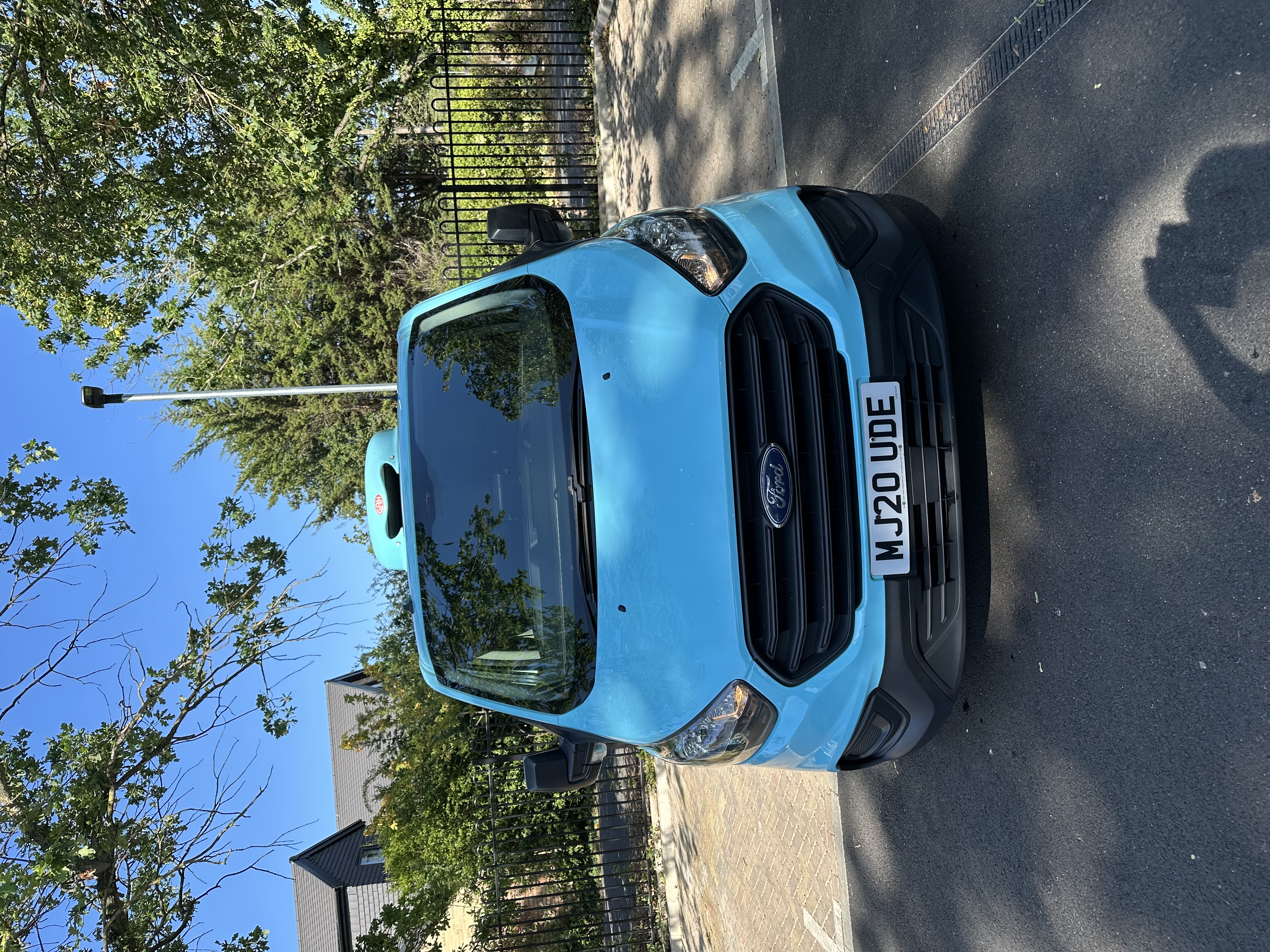

What Documents Do You Need to Sell a Car in the UK? 2026 Checklist
Selling your car? Use our UK checklist covering the V5C log book, MOT, service history, finance settlement, receipts, spare keys and DVLA keeper transfer.
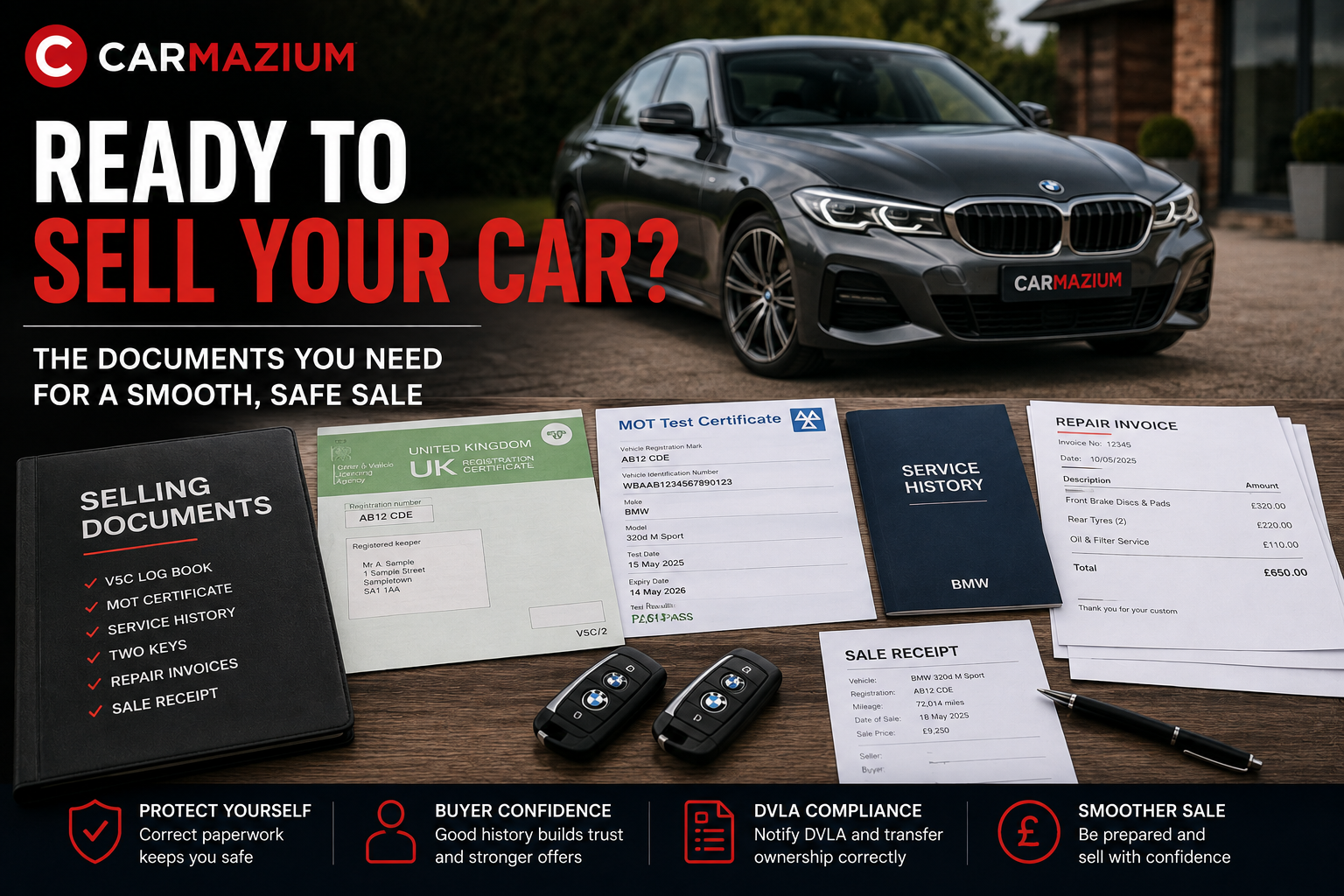
What Documents Do You Need to Sell a Car in the UK? 2026 Checklist
You've found a buyer.
You've agreed a price.
They're ready to collect the car.
Then comes the question:
What paperwork do you actually need to sell it?
Getting the documentation organised before advertising your vehicle can make the entire transaction easier.
It can also give buyers more confidence in what they're purchasing.
Here's what UK sellers should prepare.
- V5C Log Book
The most important document to locate is your V5C registration certificate, commonly called the log book.
The V5C contains information about the vehicle and its registered keeper.
When selling a vehicle that will remain in the UK, you need to notify DVLA of the change of keeper and provide the appropriate new-keeper information.
The buyer receives the green new keeper slip.
One important distinction:
A V5C isn't proof of ownership.
It identifies the vehicle's registered keeper.
But it remains a crucial part of transferring the vehicle correctly.
Check Your V5C Before Advertising
Don't discover a problem with your log book while the buyer is standing on your driveway.
Check that:
- Your name is correct
- Your address is current
- The registration matches the car
- Vehicle details are accurate
- You actually have the latest V5C
If you've changed your name, address or made relevant changes to the vehicle, DVLA may need the record updated.
Protect the V5C Reference Number
This is particularly important when advertising online.
Potential buyers may reasonably want to see that you have the log book.
But that doesn't mean you should upload photographs of the entire document.
DVLA specifically warns sellers not to share photographs or copies of their V5C or its document reference number because the information could potentially be misused.
So:
Show that you have the V5C — but protect the sensitive information on it.
What If You've Lost the V5C?
Don't ignore it.
A missing log book can make buyers uncomfortable and complicate the transaction.
DVLA advises buyers not to purchase a vehicle without a V5C.
If you're preparing to sell and have lost yours, investigate getting a replacement before advertising where possible.
A complete transaction is much easier when the correct documentation is ready.
- MOT Information
For vehicles requiring an MOT, buyers will usually want to know:
Does it have a current MOT?
When does it expire?
Are there advisories?
Has it previously failed?
Much of this information is now available electronically through the government's MOT-history service.
A buyer can check previous:
- Test dates
- Mileage readings
- Passes
- Failures
- Defects
- Advisories
So you don't necessarily need a folder containing every historic paper MOT certificate.
But knowing the current position before selling is important.
A Valid MOT Doesn't Guarantee the Car Is Roadworthy
This is worth understanding.
An MOT reflects the vehicle's condition against the relevant test requirements at the time of testing.
It doesn't guarantee that the vehicle remains safe indefinitely afterwards.
GOV.UK states that a vehicle can still be unsafe even when it has a current MOT.
So don't describe a car as mechanically perfect simply because:
“It passed its MOT.”
Those are two different things.
- Service History
This isn't normally part of the DVLA keeper-transfer process.
But commercially, it can be extremely valuable.
Service history helps demonstrate how the vehicle has been maintained.
Depending on the car, this might include:
- Stamped service book
- Digital service record
- Main-dealer history
- Independent garage invoices
- Oil-change records
- Maintenance receipts
A buyer comparing two otherwise similar cars may feel more confident about the one with clear evidence of maintenance.
What Does “Full Service History” Actually Mean?
Be careful with this phrase.
Don't advertise a vehicle as having full service history simply because you have a few invoices.
Check the records.
If services are missing, describe the history accurately.
For example:
Full service history
Part service history
Some service invoices available
Digital service history
Accuracy is more important than making the advertisement sound better.
- Repair and Maintenance Invoices
Keep your repair receipts.
They can turn an apparent problem into useful evidence.
Imagine the MOT history previously recorded:
Brake discs worn
But you have an invoice showing:
Front brake discs and pads replaced
That's useful information.
Other valuable invoices might show replacement of:
- Timing belt
- Timing chain
- Clutch
- Gearbox
- Battery
- Tyres
- Suspension
- Brakes
- Water pump
- Major engine components
For an older vehicle, a well-organised folder of maintenance receipts can tell an important story.
- Finance Settlement Information
If the car has outstanding PCP, HP or another finance arrangement connected with the vehicle, deal with this carefully.
Don't simply hand the car over and hope the finance sorts itself out afterwards.
Request a current settlement figure from the finance company.
If appropriate, keep evidence confirming when the agreement has been settled.
A prospective buyer or motor trader may perform a vehicle-history check and identify outstanding finance.
Transparency is therefore essential.
- Vehicle History Information
Many professional buyers conduct vehicle-history checks before purchasing.
Depending on the service used, these checks can help identify information relating to areas such as:
- Outstanding finance
- Write-off history
- Theft records
- Vehicle identity
- Mileage information
If you've already obtained a recent vehicle-history report, keep it with your paperwork.
But remember that information can change.
A buyer may still choose to conduct their own fresh check.
- Owner's Manual and Vehicle Pack
These aren't legal transfer documents, but don't underestimate them.
If you still have the original vehicle wallet containing:
- Owner's handbook
- Infotainment instructions
- Service booklet
- Security information
- Other manufacturer documentation
put everything together.
Small details can make a used vehicle feel more complete and better cared for.
- Spare Keys
Technically, a spare key isn't paperwork.
But it belongs on your selling checklist.
Modern replacement keys can be expensive.
If you advertise:
“Two keys”
make sure you actually have both.
Test them as well.
A buyer discovering at collection that the second key doesn't work isn't a good way to finish a transaction.
- Locking Wheel Nut Key
This tiny item is remarkably easy to forget.
If your vehicle has locking wheel nuts, find the locking-wheel-nut key.
Without it, removing a wheel can become unnecessarily difficult.
Check:
- Glovebox
- Boot
- Spare-wheel compartment
- Tool kit
before the buyer arrives.
- Proof of Major Work
Some maintenance jobs matter considerably to buyers.
For example, if your advertisement states:
“Timing belt replaced last year”
a buyer may reasonably ask:
“Do you have the receipt?”
Evidence makes the claim stronger.
The same applies to statements such as:
New clutch
Gearbox rebuilt
Four new tyres
New battery
Major service completed
If you're going to use maintenance as a selling point, have the documentation ready where possible.
- Car Sale Receipt
It's sensible to create a written record of the transaction.
A basic receipt can record:
- Vehicle registration
- Make and model
- Sale price
- Date and time
- Seller
- Buyer
- Mileage
- Payment method
- Any relevant agreed information
Both parties can retain a copy.
For higher-value transactions especially, having a clear record of what happened and when is useful.
Don't Hide Known Problems
Paperwork isn't a substitute for honesty.
If you know the vehicle has a significant fault, don't deliberately misrepresent it.
Similarly, don't describe a car as:
“Never damaged”
if you know it has previously been involved in a substantial accident.
And don't claim:
“Full service history”
when the documentation clearly shows otherwise.
A good vehicle advertisement should describe the car accurately enough that the buyer knows what they're considering.
What Happens to the V5C When You Sell?
For a normal UK keeper change, notify DVLA that you've sold or transferred the vehicle.
The buyer should receive the green new-keeper slip.
DVLA provides an online service for changing the registered keeper.
Once DVLA has been notified, your vehicle tax is cancelled.
If you're entitled to a refund, DVLA refunds any full remaining months of vehicle tax.
Vehicle Tax Does Not Transfer to the Buyer
This catches some people out.
You aren't selling the remaining road tax with the car.
When ownership/keeper details change, the new keeper needs to tax the vehicle before using it on the road, unless the relevant exemption or SORN arrangements apply.
So don't advertise:
“Six months' road tax included.”
Vehicle tax doesn't transfer with the vehicle.
What If You're Selling to a Motor Trader?
The transaction can differ slightly when selling into the motor trade.
You still need to notify DVLA correctly that the vehicle has been sold or transferred to a motor trader.
Make sure you use the appropriate DVLA process rather than treating the transaction exactly like a private keeper-to-keeper sale.
Keep your confirmation.
That evidence can be extremely useful if anything happens with the vehicle after you've handed it over.
Keep DVLA Confirmation
This is one of the most important practical tips in this entire guide.
When you notify DVLA online, keep the confirmation that the transfer was completed.
Don't simply assume everything worked.
You want a clear record showing when you stopped being the vehicle's registered keeper.
Remove Your Personal Belongings
Before collection, check the entire vehicle.
Look in:
- Glovebox
- Door pockets
- Centre console
- Boot
- Under seats
- Sunglasses compartment
- Seat-back pockets
Also remember your digital information.
Modern vehicles can store:
- Home addresses
- Navigation destinations
- Phone contacts
- Bluetooth devices
- Call histories
- App accounts
Consider performing the appropriate infotainment reset before handover.
Don't Leave Important Documents Inside the Car Too Early
Keep your:
V5C, keys and important documentation secure until payment and the transaction are complete.
Don't put the entire paperwork folder in the boot and let a prospective buyer drive away for a test drive.
Documents should only be handed over at the appropriate stage.
Your Pre-Sale Document Checklist
Before listing the vehicle, try to have these ready:
Essential / important
V5C log book Current MOT information where applicable Finance settlement information if financed Correct DVLA details
Useful supporting documentation
Service history Maintenance invoices Repair receipts Vehicle-history report Owner's manuals Spare keys Locking-wheel-nut key Evidence of major repairs Sale receipt
The more organised you are, the easier the handover can be.
Why Documentation Can Affect What Buyers Pay
Paperwork doesn't physically improve a car.
But it reduces uncertainty.
Consider two identical cars.
Same year.
Same model.
Same mileage.
Similar condition.
Car A
One key.
No service records.
Seller can't find invoices.
Unclear maintenance history.
Car B
Two keys.
Organised service history.
Receipts for recent maintenance.
Clear MOT history.
Major repairs documented.
Which would make you more confident?
That's why documentation can influence a buyer's perception of value.
Preparing Your Car for a CarMazium Listing
Before offering your vehicle to buyers through CarMazium, gathering your information in advance helps you describe the vehicle accurately.
Know:
Registration
Current mileage
MOT position
Service history
Number of keys
Finance status
Vehicle condition
Known faults
Accurate information gives motor traders a better opportunity to assess the vehicle properly.
And when dealers understand what they're bidding on, sellers can make better-informed comparisons between offers.
Frequently Asked Questions
Do I need the V5C to sell my car?
The V5C is an important part of the normal vehicle-transfer process. DVLA advises buyers not to purchase vehicles without one, so sellers should ideally obtain the correct V5C before advertising.
Do I need paper MOT certificates?
MOT history is available electronically for tests recorded in the government database. Having old paper certificates can still be useful, but buyers can check the official history online.
Do I need service history to sell a car?
You can sell vehicles without complete service history, but missing records can affect buyer confidence. Describe the history accurately.
Do I give the buyer the whole V5C?
Follow the current DVLA process for the type of buyer. For a normal UK keeper change, the buyer receives the green new-keeper slip while DVLA is notified of the transfer.
Does road tax transfer when I sell my car?
No. Vehicle tax is cancelled when DVLA is notified of the keeper change. The seller may receive a refund for full remaining months, and the new keeper must arrange their own vehicle tax before using the vehicle on the road.
Should I give the buyer my repair invoices?
They can be useful evidence of maintenance. Before handing over documents, check that invoices don't contain personal information you don't want to disclose unnecessarily.
Should I give the buyer a receipt?
Keeping a written record of the transaction is sensible and provides both parties with evidence of the sale.
Final Thoughts
Selling a car isn't just about finding somebody willing to pay the right price.
It's about completing the transaction correctly.
The best time to organise your paperwork isn't after you've accepted an offer.
It's before you advertise the car.
Find your V5C.
Check your MOT history.
Organise your service records.
Locate both keys.
Find your repair invoices.
Check your finance position.
And make sure your DVLA information is correct.
When the right buyer arrives, you'll be ready to complete the sale rather than searching through drawers for a log book you last saw three years ago.
Sell your car your way
Ready to turn your research into a real sale?
List in the CarMazium dealer auction for £0, or advertise retail from £1. Qualifying successful auction sales can receive a £100 seller incentive.
Keep reading
Related automotive guides

Selling an Electric Car in the UK: Battery Health, Range & Value Guide 2026
Selling an electric car? Learn how battery health, real-world range, charging speed, warranty, service history and charging cables can affect buyer confidence and your EV's value.
Do Previous Owners Affect a Car's Value? UK Guide 2026
Does a one-owner car really sell for more? Learn how previous keepers can affect used-car value, why ownership history matters and what sellers can do when a car has changed hands several times.

Do Optional Extras Increase Your Car's Value? UK Guide 2026
Panoramic roofs, heated seats, upgraded wheels and technology packs can make a used car more desirable. Find out which optional extras can add value and which may add very little when you sell.
From the marketplace