
Vehicle Inspection on TradeXchange: How to Check a Used Car Before You Buy
Learn how TradeXchange vehicle inspections work, from posting the car and comparing fixed-price quotes to choosing an approved inspector and confirming completion.
In this article
Buying a used car always involves some uncertainty.
An advert can show the mileage, specification, photographs and MOT history, but it cannot always tell you how the car feels, whether warning lights are present, whether the bodywork has been repaired well or whether the vehicle is mechanically consistent with the description.
That is where an independent vehicle inspection can help.
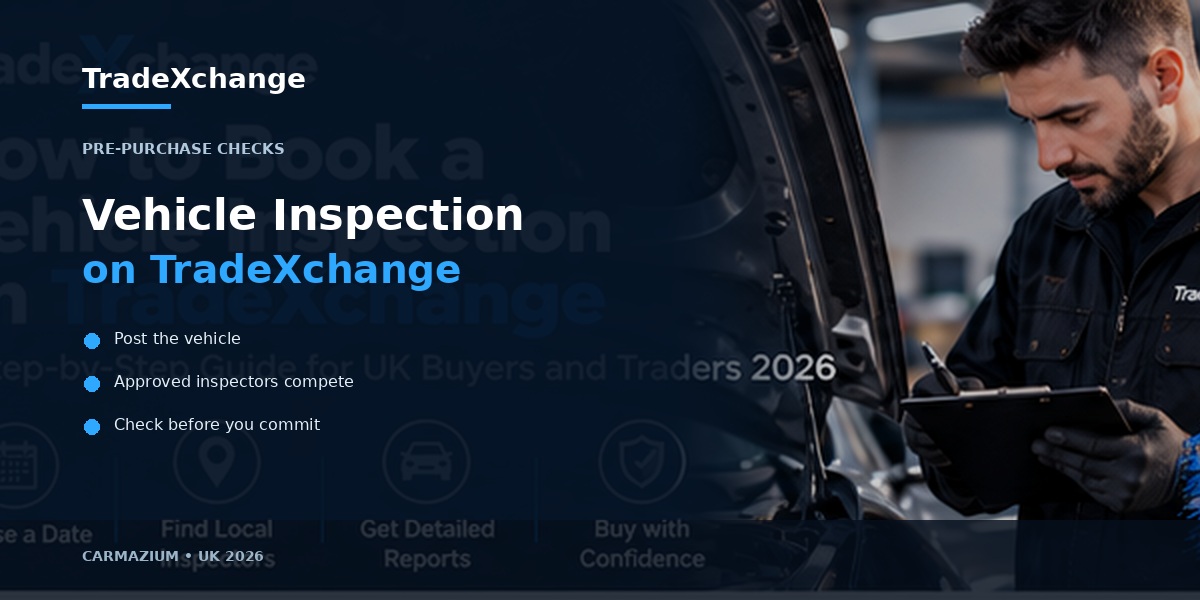
TradeXchange allows a signed-in CarMazium user to post a vehicle inspection request and receive fixed-price quotes from approved inspection providers.
The customer chooses the provider, pays the accepted service quote through CarMazium and confirms completion before the provider payout is released.
This guide explains the process and what buyers should think about before requesting an inspection.
What Is a TradeXchange Vehicle Inspection?
The TradeXchange inspection service is a paid job marketplace.
You post the vehicle and the inspection requirement.
Businesses approved specifically for Vehicle Inspection can see suitable open jobs and send fixed-price quotes.
You compare those quotes and choose the provider you want.
The current service is available on the TradeXchange Vehicle Inspection page.
Why Inspect a Used Car Before You Commit?
A pre-purchase inspection can help answer questions that are difficult to resolve from an advert alone.
Depending on the provider and agreed scope, an inspection may help you understand areas such as:
- visible body condition,
- tyres,
- warning lights,
- fluid leaks,
- engine behaviour,
- gearbox behaviour,
- suspension noises,
- brakes,
- interior condition,
- evidence of repair,
- and whether the vehicle generally matches the listing.
The exact scope belongs to the provider and the accepted job.
Do not assume every inspection includes the same tests.
Compare the provider's quote and service description before choosing.
An Inspection Is Not the Same as an MOT
This is one of the most important distinctions.
An MOT checks whether a vehicle meets the required roadworthiness and environmental standards at the time of the test.
A pre-purchase inspection is a separate service intended to help a buyer assess the vehicle before committing.
A car can have a valid MOT and still have:
- developing mechanical faults,
- worn components,
- cosmetic damage,
- poor repairs,
- warning messages that appeared later,
- or maintenance requirements that were not MOT failures.
For this reason, an MOT certificate should not automatically replace a buyer's own inspection or due diligence.
CarMazium's guide to MOT history and car value explains why MOT history is useful but not a complete mechanical assessment.
Step 1: Post the Vehicle
Start by entering the vehicle information.
Useful details include:
- registration,
- make and model,
- year,
- mileage,
- vehicle location,
- requested inspection date,
- and anything specific you want the inspector to know.
If there is already a concern, mention it.
For example:
- engine-management light present,
- noise from front suspension,
- seller says clutch was recently replaced,
- Category N history,
- suspected paint repair,
- or no service history.
This helps the provider understand the job before quoting.
Step 2: Approved Inspection Providers Quote
Only businesses approved by CarMazium for the Vehicle Inspection capability can quote on inspection jobs.
That approval is separate from other TradeXchange services.
A transporter is not automatically an inspection provider.
A dealer is not automatically an inspection provider.
The business must have the relevant capability enabled.
This helps keep the customer response tied to the service being requested.
Step 3: Compare the Fixed-Price Quotes
When providers respond, compare more than price.
Look at:
- what the inspection includes,
- how quickly the provider can attend,
- whether a written report is included,
- whether photographs are included,
- whether a road test is possible where appropriate,
- what happens if the vehicle cannot be inspected fully,
- and any limitations stated by the provider.
The lowest price can be attractive, but the scope matters.
A £60 visual check and a £180 detailed inspection are not necessarily equivalent services.
Step 4: Choose the Provider and Pay
Once you accept the quote, you pay the service amount through CarMazium.
Provider private contact details then unlock.
The accepted job uses the same paid-service workflow as Delivery & Recovery.
The service payment is held through CarMazium while the job is active.
After the inspection is completed and the customer confirms completion, the provider payout is released.
How the 9% Inspection Fee Works
Vehicle Inspection is one of the TradeXchange paid job categories.
The current provider economics are:
- 91% provider share
- 9% CarMazium platform fee
If the accepted inspection quote is £150:
- Customer pays £150
- CarMazium fee is £13.50
- Provider share is £136.50
This fee is deducted from the accepted job price.
It is not charged under the Finance or Warranty matched-enquiry model.
Step 5: Coordinate Access to the Vehicle
After payment and contact unlock, make sure the inspector can access the car.
If the vehicle is at:
- a private seller's home,
- a dealership,
- an auction site,
- storage,
- or another business,
confirm that the owner or site contact knows the inspection has been arranged.
The inspector may need:
- keys,
- permission to start the vehicle,
- access to documents,
- enough space to inspect,
- and consent for any road test that forms part of the agreed service.
Do not assume access is automatic.
Step 6: The Inspection Takes Place
The provider completes the inspection according to the agreed scope.
The customer should not assume the inspector can dismantle the car or perform workshop-level diagnosis unless that is specifically included.
An inspection is usually about reducing uncertainty, not guaranteeing that no future fault can occur.
Mechanical systems can fail after inspection.
The value comes from having an independent professional look at the vehicle before the purchase decision.
What Should a Good Inspection Request Ask?
If you have specific concerns, include them in the job.
Useful questions might include:
- Are there any dashboard warning lights?
- Does the engine start cleanly from cold?
- Is there visible smoke?
- Are there fluid leaks?
- Does the clutch engage normally?
- Does the automatic gearbox shift correctly?
- Are there suspension noises?
- Are the tyres worn evenly?
- Is there evidence of accident repair?
- Are the panel gaps consistent?
- Does the interior condition match the mileage?
- Are both keys present?
- Does the VIN match the vehicle details?
Not every provider will offer every check.
The point is to make your priorities clear before accepting a quote.
Bodywork and Paint Inspection
Photographs can hide a lot.
A physical inspection may help identify:
- mismatched paint,
- overspray,
- inconsistent panel gaps,
- filler,
- lacquer damage,
- poor smart repairs,
- corrosion,
- scratches,
- dents,
- and previous accident repairs.
This is particularly relevant when a car has insurance-category history or where the seller has described previous damage.
Our guide to Category S and Category N cars explains why category history should be understood before purchase.
Dashboard Warning Lights
Warning lights are another reason buyers request inspections.
A vehicle may display:
- engine-management light,
- ABS light,
- airbag/SRS warning,
- TPMS warning,
- stability-control warning,
- DPF warning,
- or another fault message.
A basic inspection may identify the light.
A diagnostic inspection may go further if the provider includes fault-code scanning.
Do not assume a warning light is minor because the seller says:
It is probably just a sensor.
Ask for evidence or diagnosis.
Our guide to dashboard warning lights and car value explains why unresolved warning lights can change buyer confidence.
Tyres and Wheels
An inspector can also look at visible tyre condition.
Important points include:
- tread,
- cuts,
- bulges,
- uneven wear,
- mismatched tyres,
- damaged wheels,
- and signs that alignment or suspension may need attention.
A legal tyre is not automatically a tyre with a long remaining life.
Buyers should consider likely replacement cost.
See our guide to worn tyres and car value.
Service History and Documents
An inspector may be able to confirm whether the documents presented with the vehicle appear consistent with the seller's description.
Useful documents can include:
- service book,
- digital service evidence,
- invoices,
- MOT paperwork,
- repair receipts,
- timing-belt evidence,
- battery replacement,
- tyre invoices,
- and manufacturer recall work.
The inspection should not be confused with a legal title check or HPI-style vehicle-history product.
Those services answer different questions.
Should You Inspect a Cheap Car?
The economics depend on the car and the buyer.
A £200 inspection on a £1,000 car may feel expensive.
But if the inspection prevents a £1,000 mistake, it can still be valuable.
On the other hand, some buyers of very low-value vehicles are comfortable accepting more risk.
There is no universal price threshold where inspection suddenly becomes worthwhile.
Think about:
- purchase price,
- repair risk,
- distance,
- complexity,
- your own mechanical knowledge,
- and whether you can inspect the vehicle personally.
Should You Inspect an Expensive Car?
The case can be stronger on high-value vehicles.
A premium, performance or complex vehicle can have expensive systems such as:
- adaptive suspension,
- advanced driver assistance,
- air suspension,
- high-performance brakes,
- hybrid systems,
- complex emissions equipment,
- and expensive electronics.
A relatively small inspection cost can represent a low percentage of the total purchase price.
Inspection Before Travelling Long Distance
TradeXchange can be particularly useful when the car is far away.
Instead of driving several hours only to discover a major issue, a buyer can arrange an inspection at the vehicle's location.
That can help decide whether the journey is worth making.
It does not replace the buyer's own final decision, but it can reduce unnecessary travel.
Inspection After Winning an Auction
A trader or buyer may also want an inspection after an auction result and before final vehicle handover where the transaction process permits.
The inspection can help confirm that the vehicle materially matches the listing.
For CarMazium auction buyers, the post-win process is separate from the TradeXchange inspection service.
The inspection has its own quote and payment workflow.
What If the Inspector Finds Faults?
The report or inspection outcome gives the customer information.
What happens next depends on the underlying vehicle transaction.
Possible outcomes include:
- proceed at the agreed price,
- negotiate where appropriate,
- ask the seller to address an issue,
- seek more specialist diagnosis,
- or decide not to continue where the transaction terms allow.
TradeXchange itself does not decide the vehicle purchase for you.
The inspection gives you information to support your own decision.
What If the Vehicle Cannot Be Fully Inspected?
Sometimes access or condition prevents the provider from completing every planned check.
Examples include:
- seller unavailable,
- no keys,
- flat battery,
- vehicle blocked in,
- road test not permitted,
- severe weather,
- or the car being unsafe to drive.
The provider and customer should communicate clearly through the job workflow.
If a limitation is known before attendance, include it when posting the job.
For Inspection Providers: Why Join TradeXchange?
Approved inspection businesses can use TradeXchange as a source of paid work.
Benefits include:
- access to relevant inspection jobs,
- ability to quote selectively,
- one provider dashboard,
- clear job economics,
- and customers already involved in vehicle buying or selling.
The provider chooses which open jobs suit their availability and operating area.
Provider Payout
The provider sends a fixed-price quote.
If the customer accepts and pays, the job becomes active.
Once the inspection is completed and the customer confirms completion, the provider receives the 91% provider share under the current TradeXchange paid-job model.
CarMazium retains the 9% service fee.
Frequently Asked Questions
Who Can Request an Inspection?
Signed-in CarMazium users can post eligible inspection jobs.
Who Can Quote?
Only businesses approved for Vehicle Inspection capability.
Does the Customer Pay the Inspector Directly?
The accepted inspection job is paid through CarMazium.
The provider payout is released after completion is confirmed.
How Much Does the Provider Keep?
The current provider share is 91% of the accepted job price, with a 9% CarMazium platform fee.
Is an Inspection the Same as an MOT?
No.
An MOT and a pre-purchase inspection answer different questions.
Does an Inspection Guarantee the Car Will Never Develop a Fault?
No.
An inspection reduces uncertainty based on the condition observed and the agreed scope at that time.
Can I Use Inspection for a Car Far Away?
Yes.
That is one of the practical use cases for remote buyers.
The Bottom Line
TradeXchange Vehicle Inspection gives buyers a structured way to get an independent look at a car before committing.
You post the vehicle and inspection requirement.
Approved inspection businesses send fixed-price quotes.
You choose the provider, pay through CarMazium and coordinate access.
The provider completes the agreed inspection.
You confirm completion, and the provider payout is released.
For buyers, the value is better information.
For providers, it is access to relevant paid inspection work through the TradeXchange marketplace.
Start with TradeXchange Vehicle Inspection.
Sell your car your way
Ready to turn your research into a real sale?
List in the CarMazium dealer auction for £0, or advertise retail from £1. Qualifying successful auction sales can receive a £100 seller incentive.
Keep reading
Related automotive guides
How to Write a Car Advert That Builds Buyer Trust: UK Guide 2026
Write a stronger used-car advert with accurate details, service history, condition, specification, recent maintenance and honest fault disclosure.
How to Handle Viewings and Test Drives Safely When Selling a Car Privately in the UK
A practical UK guide to safer private car viewings and test drives, including buyer identity, insurance, keys, documents, payment and DVLA handover.
How to Take Car Photos That Get More Buyer Enquiries: UK Seller Guide 2026
Learn how to photograph a car for sale in the UK, including the best main image, essential exterior and interior angles, lighting, damage photos and common mistakes.
From the marketplace