

Selling a Car With an Oil Leak in the UK: MOT, Repairs & Value (2026)
An oil leak can affect safety, MOT results and resale value. Learn how UK sellers assess faults, compare repairs and describe them honestly.
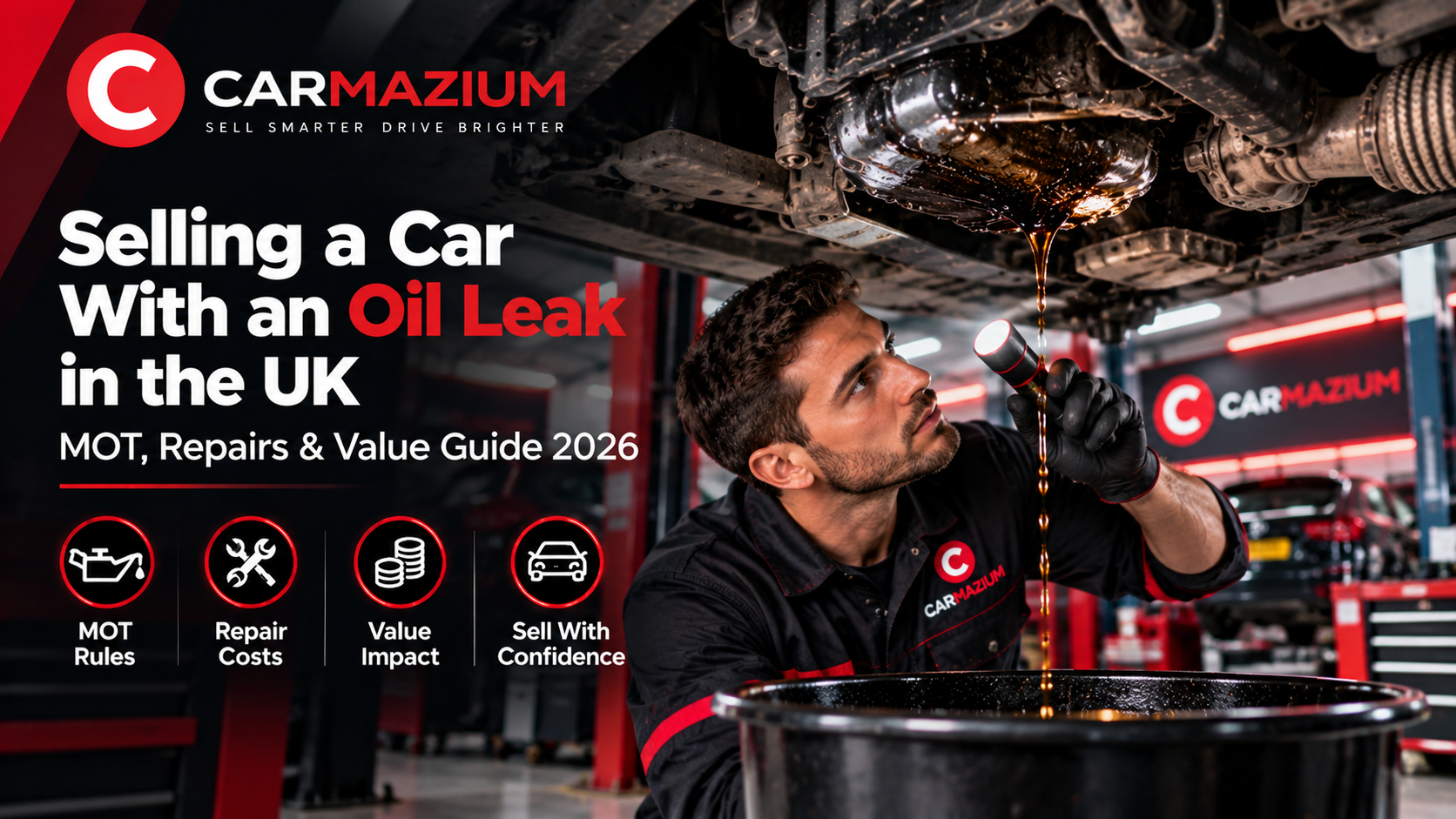
In this article
An oil stain beneath a parked car can complicate an otherwise straightforward sale. Is it residue from a recent service, a slow leak from a gasket, or a problem that makes the vehicle unsafe? The answer affects the asking price, buyer confidence and whether the car should be driven.
This guide explains how to sell a car with an oil leak in Great Britain in 2026. It covers current MOT rules, diagnosis, repair-versus-sell decisions, accurate adverts and safe handover. Northern Ireland has a separate vehicle-testing system, so check local requirements if selling there. You can also explore CarMazium's selling options once the car's condition is established.
The short answer: a car with a properly assessed minor leak may still be saleable. But never assume a leaking vehicle is roadworthy. Identify the fluid, seek competent advice, disclose known defects and do not offer unsafe vehicles as normal drive-away transport.
Can you sell a car with an oil leak in the UK?
An oil leak does not automatically make a vehicle unsellable. Cars of different ages and mileages can develop seepage, and buyers may accept a specific repair requirement. The distinction is between a roadworthy car with a known defect and one presenting a serious mechanical, fire, environmental or road-safety risk.
Private sellers must describe vehicles truthfully and avoid misrepresenting known faults. Motor traders have additional consumer-law duties concerning satisfactory quality, fitness for purpose and fair commercial practices. The phrase “sold as seen” is not an automatic exemption from those duties.
Running is not the same as roadworthy
A car may start and drive around a yard while a leak makes public-road use unsafe. Oil may escape more rapidly when the engine is hot, reach an exhaust, contaminate components or create a hazard on the road. Do not offer a test drive merely because the dashboard has no warning lights. If a garage advises against driving, arrange repair or recovery.
Old oil stain, seepage or active leak?
A historic stain may remain after an oil change or earlier repair. Seepage describes a damp or oily component without obvious dripping. An active leak releases fluid and may leave fresh drops or a growing patch. These are useful descriptions, not official MOT defect categories.
Where might oil come from?
Possible engine-oil sources include a cam-cover gasket, sump, drain plug, filter housing, oil cooler, turbo pipe or crankshaft seal. Other dark fluids may originate from the gearbox, differential or power-steering system. Fuel and brake-fluid leaks need particularly careful assessment. Air-conditioning condensation is different, but do not identify a puddle by colour alone. Fluid can travel along undertrays, so the drip location may not reveal its source.
What the 2026 MOT rules say about fluid leaks
The DVSA's MOT inspection manual, section 8.4.1, updated on 1 June 2026, applies to cars tested in England, Scotland and Wales. Testers check fluid leaks with the engine idling. A leak producing a pool more than 75 mm in diameter within five minutes, or several leaks at an equivalent combined rate, meets the manual's stated failure threshold.
Excessive leakage likely to harm the environment or other road users is classified as a major defect. Continuous leakage likely to create a serious road-safety risk is dangerous. A tester may refuse to test a vehicle with excessive leakage. The manual treats certain fluids, including coolant and screen wash, differently under this specific inspection item; that does not mean every such leak is harmless.
Does a small oil leak automatically fail an MOT?
No. A light trace or old stain is not necessarily an MOT failure. The examiner considers the applicable defect criteria, severity and risk. Conversely, an MOT pass is not an engine-health certificate. As GOV.UK explains, an MOT is not a service or a full check of general mechanical condition.
What if the vehicle has already failed?
You can transfer ownership of a car that has failed an MOT, but must not present it as safe to drive away. The official MOT results guidance explains how major and dangerous defects affect road use. Even a previously valid certificate does not make an actually dangerous vehicle roadworthy. Arrange suitable transport when a garage or test result indicates it should not be driven.
Get a written diagnosis before setting the price
Ask an independent garage or appropriate marque specialist to identify the fluid, suspected source, severity and likely repair. A useful written report explains what was inspected, whether the leak is active, whether the engine can safely run, and whether further dismantling is needed. A quotation should separate parts and labour and make any uncertainty clear.
Checks worth requesting
The technician may examine the sump, drain plug, oil-filter housing, accessible seals, oil cooler and turbo connections. Cleaning the area and inspecting it again under controlled conditions can help locate a leak. Some leaks are visible only when the engine is warm; others are hidden by undertrays. A suspected gearbox or transmission leak requires a different repair plan from a simple engine-oil seep.
Never work beneath a car supported only by a jack or touch hot components. If an oil-pressure warning appears, stop safely and seek advice rather than running the engine to demonstrate that it starts. A drip tray can protect a workshop floor but is not a road-use repair.
Common causes and why repair costs differ
An oil leak is a symptom, not a single standard job. A loose filter or damaged sealing washer might be relatively straightforward, while a crankshaft seal can involve substantial dismantling. The part price alone rarely tells the whole story. Oil may also escape from several places at once, especially on an older engine.
Gaskets, seals and housings
Cam-cover gaskets, sump seals, filter housings and oil-cooler assemblies are common inspection points. Ask whether the garage has confirmed the failed component or merely identified the general area. A low quotation based on a guess is less useful than a realistic quotation backed by inspection.
Transmission oil or engine oil?
Dark fluid beneath the car may come from an automatic gearbox, differential or power-steering system. The consequences differ considerably. Some transmission leaks can lead to poor operation or rapid component damage. Do not advertise an undiagnosed leak as a cheap engine-gasket repair simply because it looks oily.
Repeated leaks and underlying wear
High crankcase pressure, damaged mating surfaces or previous poor-quality repairs can cause leaks to return. If the technician cannot rule out underlying problems, that uncertainty belongs in your selling decision and advert. Keep the inspection report, even if you choose not to repair.
Should you repair the leak or sell as-is?
Compare two realistic outcomes: the likely sale price after a verified repair and the likely sale price with the known fault. Subtract the repair cost, diagnostic charges, transport, time and risk of additional problems. Use comparable cars with the same model, engine, transmission, age, mileage and condition. Advertised prices are not guaranteed sale prices.
For example only, a car might sell for £5,500 after a confirmed £350 repair, versus £4,600 with the leak disclosed. Repair could make financial sense in that scenario. If the likely repair is £1,400 with substantial uncertainty, selling honestly as-is may be more practical. These figures illustrate the calculation; they are not valuations for any specific car.
When repair usually makes sense
Repair is worth considering when the source is confirmed, the cost is proportionate, the garage can complete it promptly and a documented result will reassure buyers. Keep invoices and, where appropriate, obtain a follow-up inspection. A receipt for work performed is helpful but does not guarantee that every possible leak has been eliminated.
When an as-is sale may be sensible
An older, lower-value or non-running car may attract trade buyers willing to arrange repairs. Be specific about what is known, what is suspected and what remains untested. An as-is price should reflect uncertainty; it should not be used to encourage someone to drive a car that may be unsafe.
How an oil leak affects used-car value
Buyers often deduct more than the quoted cost of a gasket. They consider diagnostic uncertainty, lost use, transport, the possibility of additional faults and the effort involved in repairs. A small, documented leak may be easier to value than an unexplained puddle accompanied by warning lights and no maintenance history.
Consider the wider picture: mileage, MOT history, service records, tyres, brakes and bodywork all affect buyer confidence. Read CarMazium's guides to MOT history and value and service history and value for additional context.
Use valuations carefully
A general valuation may assume ordinary mechanical condition. Record the fault separately and adjust your asking price using repair evidence and relevant comparables. CarMazium's valuation tools can provide a starting point, but no automated estimate should be presented as a guaranteed sale price for a faulty car.
How to describe an oil leak in a car advert
Name the issue early and explain it accurately. State whether a garage has confirmed the source, whether a repair has been completed, whether warning lights are present and whether the vehicle is suitable for driving or requires recovery. Include the MOT status and relevant service records. If diagnosis remains uncertain, say so.
Example of responsible advert wording
“Oil leak noted during inspection. Garage report dated [date] identifies a suspected [component]. Repair has not been completed. The fault is reflected in the asking price. Buyer should review the report and agree safe collection arrangements before purchase.”
Replace the placeholders with verified facts. Avoid phrases such as “easy fix”, “minor leak”, “MOT guaranteed” or “drives perfectly” unless there is solid evidence to support them. Clear photographs and a credible inspection report are more persuasive than vague assurances. See CarMazium's advert-writing guide.
Private sellers and motor traders: different legal duties
A genuine private seller must not misdescribe a vehicle. A buyer may have a remedy where a vehicle was materially misrepresented. Private-sale rights differ from consumer purchases from businesses, so do not treat the two situations as legally identical.
Traders selling to consumers have duties under the Consumer Rights Act 2015, including satisfactory quality, fitness for purpose and accurate description. The Digital Markets, Competition and Consumers Act 2024 regulates misleading commercial practices, with the relevant provisions applying from April 2025. A trader cannot automatically remove statutory rights by writing “sold as seen”, “spares or repair” or “no warranty”. For more detail, consult Citizens Advice on used-car problems and the CMA's unfair-commercial-practices guidance.
Choosing retail or auction on CarMazium
Once the vehicle's condition is established, decide whether a retail listing or a motor-trade auction better suits the sale. The CarMazium pricing page currently lists a free auction seller listing and a £1 one-off Basic retail listing, alongside optional higher packages. Retail buyers pay no CarMazium buyer fee; verified motor traders bid in auctions.
Retail: for a well-documented vehicle
A retail listing may suit a roadworthy car with a clearly diagnosed, proportionately priced defect. Buyers can review the advert and supporting evidence before making an offer. Read how to sell on CarMazium to prepare the listing.
Trade auction: for specialist assessment or repair
A motor-trade auction may suit a vehicle requiring specialist work, subject to eligibility and truthful listing information. CarMazium advertises a £100 incentive for qualifying completed auction sales following approved handover evidence; this is not an automatic reward for listing. The buyer pays the seller directly for the vehicle, rather than CarMazium holding the purchase money.
Safe viewing, payment and DVLA handover
Give the buyer the inspection findings before they travel. Do not offer a test drive where roadworthiness is in doubt. If a garage advises against driving, agree professional recovery and who will pay for it. Use a written receipt recording the vehicle, mileage, price, date, time, known disclosed defects and included documents. Confirm cleared payment through your own bank before releasing keys.
Follow the GOV.UK vehicle-selling procedure: provide the appropriate new-keeper slip and notify DVLA when the vehicle changes hands. Do not share photographs of the V5C or its document reference number in a public advert. The buyer must arrange appropriate tax and insurance before using the vehicle on public roads.
Practical checklist before listing
- Identify the fluid and obtain a competent diagnosis.
- Confirm roadworthiness and safe transport requirements.
- Get a written repair estimate and keep relevant invoices.
- Check MOT history and recorded defects.
- Compare repaired and as-is values without assuming a guaranteed price.
- Describe known faults clearly, including uncertainty and warning lights.
- Choose retail or auction based on condition and likely buyer needs.
- Agree payment, a written receipt, collection and DVLA notification.
Frequently asked questions
Is it legal to sell a car with an oil leak?
A car with a disclosed defect can be sold, but the seller must not misdescribe it or arrange unsafe road use. Traders have additional consumer-law duties. Severity and roadworthiness matter more than the mere presence of an oily mark.
Will an oil leak fail the MOT in 2026?
Not every stain fails. The DVSA manual sets specific thresholds for excessive leakage and classifies serious defects as major or dangerous. A pool over 75 mm in diameter within five minutes is an explicit threshold under the Great Britain manual.
Can I drive a car with a small oil leak?
Only if it remains roadworthy and safe. A small-looking leak may worsen when the engine is hot or pressurised. Seek professional advice and never ignore an oil-pressure warning.
Should I repair the leak before selling?
Compare a reliable repair quotation with the likely difference between repaired and as-is sale prices. A modest confirmed repair may be worthwhile; an uncertain expensive repair may not recover its cost.
Does “sold as seen” protect a seller?
It does not excuse a false description, and it cannot automatically override applicable consumer rights. Traders and private sellers have different obligations, so use accurate factual disclosure instead of relying on a phrase.
Can I auction a car needing repairs?
Potentially, subject to platform rules and accurate condition information. On CarMazium, verified motor traders can bid in auctions. Disclose the leak and any transport restrictions, and do not assume a particular price will be achieved.
Does a valid MOT prove the leak is harmless?
No. An MOT is a check of specified items at the time of testing, not a complete mechanical inspection. The driver remains responsible for roadworthiness between tests.
Bottom line: diagnose first, describe accurately, price realistically and put safety ahead of a quick sale.
Guidance reviewed against UK official and consumer sources in October 2026. This article is general information, not a substitute for professional mechanical inspection or legal advice.
Relevant CarMazium guides and next steps
Continue with the guides and tools most relevant to this article.
Sell your car your way
Ready to turn your research into a real sale?
List in the CarMazium dealer auction for £0, or advertise retail from £1. Qualifying successful auction sales can receive a £100 seller incentive.
Keep reading
Related automotive guides
Selling a Car With a Faulty Turbocharger in the UK: MOT, Repairs & Value (2026)
Selling a car with a faulty turbocharger? Learn UK MOT rules, diagnosis, repair-versus-sale decisions, honest pricing and safe handover.
Selling a Car With an Overheating Engine in the UK: MOT, Repairs & Value (2026)
Selling a car with an overheating engine? Understand UK MOT rules, coolant faults, repair decisions, honest pricing and safe collection before you sell.
Selling a Car With an Exhaust Leak in the UK: MOT, Repairs & Value (2026)
Selling a car with an exhaust leak? Understand UK MOT rules, fumes and safety risks, repair decisions, honest pricing and secure collection before you sell.
From the marketplace