

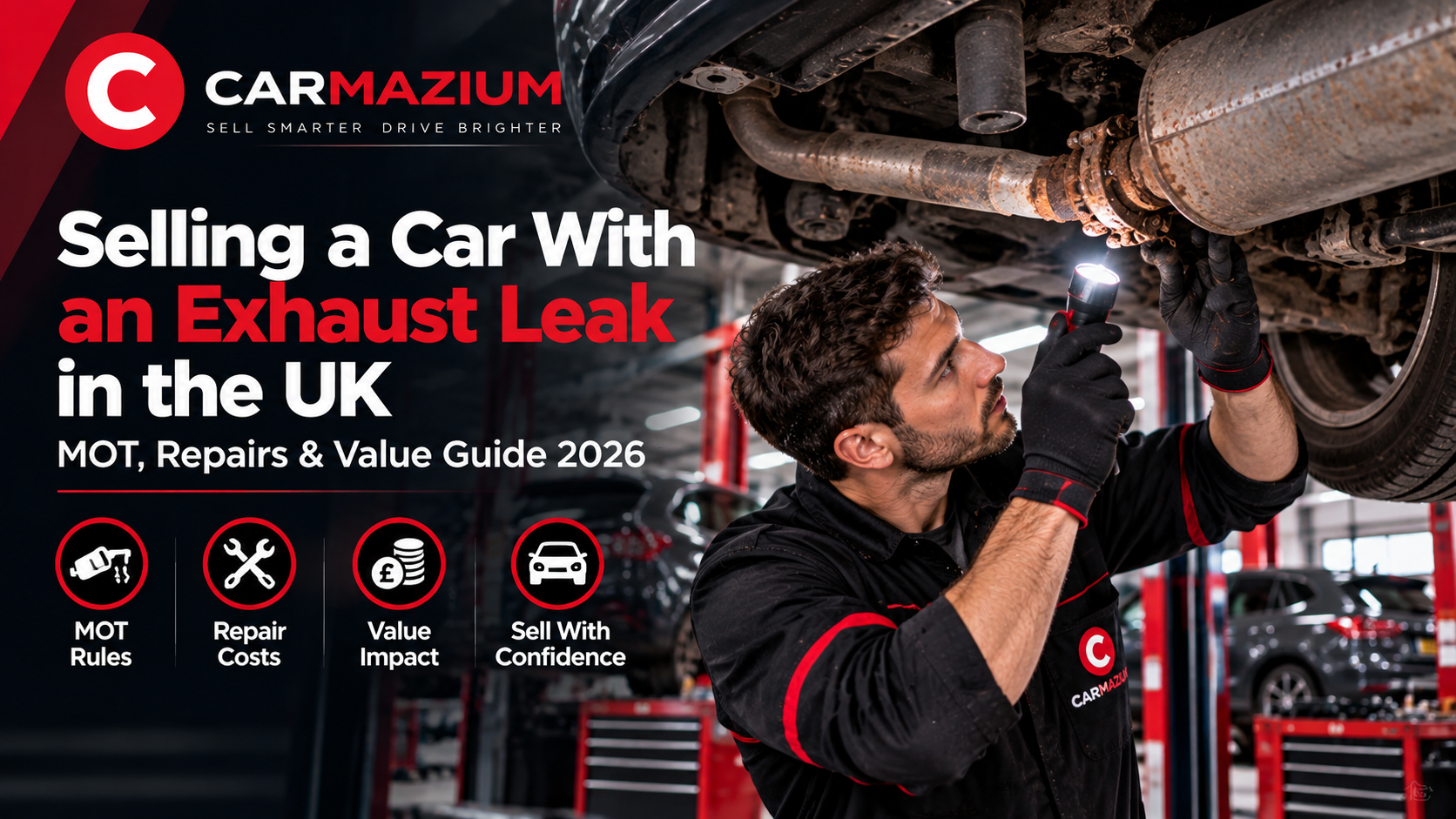
Selling a Car With an Exhaust Leak in the UK: MOT, Repairs & Value (2026)
Selling a car with an exhaust leak? Understand UK MOT rules, fumes and safety risks, repair decisions, honest pricing and secure collection before you sell.
In this article
Selling a car with an exhaust leak in the UK is possible, but the right decision depends on where the leak is, whether the exhaust is secure and whether fumes could reach the passenger cabin. A corroded rear silencer is not the same as a leaking manifold or damaged emissions equipment. Buyers need an honest description, evidence and a realistic price rather than an assurance that the problem is “just a cheap fix”.
This 2026 guide explains symptoms, MOT rules, repair-versus-sale decisions, valuation, CarMazium selling routes and safe handover. It is general guidance, not a diagnosis of an individual car. If you suspect exhaust fumes are entering the cabin, stop using the vehicle and arrange professional assessment.
Can you sell a car with an exhaust leak?
Yes. A private seller can sell a vehicle with a known defect, provided the condition is accurately represented and the buyer is not misled about roadworthiness. Selling a faulty vehicle does not make it safe to drive. If the defect may make the car dangerous, arrange suitable collection rather than encouraging a test drive.
Three questions before advertising
Find out whether a garage has identified the leaking section, whether there is a relevant MOT failure or advisory, and whether the car can be moved safely. Record what you know and what remains untested. Those details influence the asking price and the type of buyer likely to be interested.
Why accurate wording helps
“Centre exhaust section blowing; garage quote available” is more useful than “small exhaust problem, easy repair”. If a diagnosis is uncertain, state the symptoms and avoid presenting a guess as a confirmed repair.
What causes an exhaust leak?
Exhaust systems carry combustion gases away from the engine, reduce noise and incorporate emissions-control components. Heat, vibration, road salt and moisture can damage pipes, joints and mountings.
Rust, holes and failed joints
Corrosion can perforate a rear silencer, centre pipe or connecting flange. A loose clamp or damaged gasket may let gases escape without a large visible hole. Repair complexity depends on the vehicle and access to the defective section.
Flexi-pipe and manifold faults
A flexible joint accommodates engine movement; it can crack or split. A leaking exhaust manifold or gasket may cause ticking near the engine, especially on a cold start. Noise alone cannot reliably identify the component, so avoid ordering parts on speculation.
Loose hangers and emissions equipment
Broken supports can let the exhaust rattle, hang low or strike the body. Catalytic converters, oxygen sensors and diesel emissions equipment may also be involved. An exhaust leak is not automatically a blocked DPF; read our guide to DPF problems and car value for that separate issue.
What are the symptoms of an exhaust leak?
Different faults can sound similar, and some significant leaks are not especially loud. Describe what you observed rather than diagnosing a component from a video or online checklist.
Rumbling, hissing or ticking
A deep rumble may suggest a rear or centre-section fault. Hissing or ticking near the engine can point towards a front joint or manifold. Note whether the noise is worse when cold, accelerating or idling.
Fumes, rattling and warning lights
Exhaust smells in the cabin require immediate attention. Rattling may come from a heat shield or loose mounting. Engine-management lights, poor performance or unusual fuel consumption can have several causes; an exhaust leak should not be assumed to explain them all.
Useful evidence to record
Write down when the symptoms began, the mileage, recent repairs, any dashboard messages and whether the noise changes with engine speed. Keep any diagnostic codes, but remember that a code reader cannot locate every physical leak.
Is a leaking exhaust safe to drive?
There is no universal answer. Risk depends on leak position, gas direction, exhaust security, possible heat damage and the overall vehicle condition. A current MOT is not a guarantee of roadworthiness today.
Fumes inside the passenger compartment
Exhaust gases may contain carbon monoxide, which cannot reliably be detected by smell. If fumes may be entering the car, do not continue driving or rely on open windows as a solution. Arrange a professional inspection or recovery.
An insecure or dragging exhaust
A loose component may detach, contact the road or strike another part of the car. Do not inspect underneath a vehicle supported only by a jack. A workshop should use proper lifting equipment and assess both leakage and mounting security.
The legal responsibility
GOV.UK roadworthiness guidance confirms that drivers must keep vehicles safe to use even with a valid MOT. If safety is uncertain, agree on transporter collection instead of a road test.
Will an exhaust leak fail the MOT in 2026?
It can. The DVSA car MOT manual, updated 14 October 2026, distinguishes major leaks, insecure systems, fumes entering the cabin, excessive noise and emissions-related defects. The result depends on the actual inspection.
Major exhaust leaks and fumes
Section 6.1.2 classifies an exhaust system with a major leak or insecure mounting as a Major defect. Fumes entering the passenger compartment are also Major; fumes that create a danger to occupants' health are Dangerous. These are not merely cosmetic issues.
Noise and emissions failures
Section 8.1 treats excessive exhaust noise as a Major defect. Under the relevant section 8.2 emissions checks, an induction or exhaust leak that could affect emissions is also Major. An exhaust problem can therefore affect more than one part of the MOT inspection.
What about a small pinhole?
Not every minor imperfection is automatically a major leak, but only a proper inspection can establish the result. A holed exhaust can also distort emissions readings, requiring retesting after repair. Do not promise an MOT pass based on a brief visual check.
What does a previous pass prove?
It records the vehicle's condition at the time of the test, not today. Compare the current symptoms with any advisories and failures. Our guide to MOT history and resale value explains why buyers look beyond the certificate date.
How should you diagnose an exhaust leak?
A proportionate garage assessment can reduce buyer uncertainty without committing you to an expensive repair. Ask the mechanic to distinguish a confirmed defect from possible related faults.
Request an itemised quotation
A useful report identifies the leaking section, mounting condition, any emissions or warning-light concerns, the recommended parts and a total including VAT. Ask whether clamps, gaskets, diagnostics and a possible emissions retest are included.
Do not rely on fault codes alone
An engine-management code may suggest a sensor or mixture issue but cannot identify every hole or joint leak. Likewise, finding a damaged pipe does not prove that a separate warning light has been resolved. Physical inspection and appropriate testing are complementary.
Keep documents for the buyer
Retain the quotation, invoice, MOT history and safely obtained photographs. State whether the repair was completed, quoted only or not attempted. That distinction is more credible than promising the car needs only one part.
How much does an exhaust leak cost to fix?
There is no reliable single UK repair price. Costs vary by make, model, part location, corrosion, labour rate and whether a catalytic converter or other emissions component is involved.
Small repair versus replacement
A sound joint might need a gasket or clamp, while a corroded pipe or silencer may require replacement. A manifold, front flexi-section or catalytic converter can be more involved. Temporary patches are not equivalent to documented permanent repairs.
Compare complete quotations
Check parts quality, labour, VAT, seized-fastener risk, warranty and any retest. A quote marked “subject to inspection” is not a guaranteed bill. Generic internet ranges should not be presented as a verified price for your vehicle.
Avoid paying for the wrong fault
Before approving major work, ask what evidence supports the diagnosis and whether another defect could explain the symptoms. A written estimate may itself improve the confidence of an as-is buyer.
How does an exhaust leak affect car value?
A buyer may deduct the expected repair cost, a contingency for hidden issues and the inconvenience of inspection or collection. The discount is not necessarily equal to a single parts invoice.
Known repair versus uncertain fault
A verified rear-section replacement with a firm quote is easier to value than unexplained cabin fumes, an emissions failure or multiple warning lights. Clear evidence reduces uncertainty but does not guarantee a particular offer.
Compare equivalent cars
Start with similar vehicles in sound condition, matching age, mileage, trim, history and location. Adjust for the fault and the buyer audience. Asking prices are not proof of achieved prices. Use our UK used-car pricing guide to build a realistic comparison.
MOT status and demand
A current MOT may help a listing attract interest, but a known new defect still matters. Traders may assess repair costs differently from private retail buyers. Obtain real offers rather than assuming one fixed percentage reduction.
Should you repair the exhaust before selling?
Repairing can make financial sense when the fault is isolated, the quotation is credible and the expected improvement in sale proceeds exceeds the full cost and effort. Selling as-is can be sensible when costs are uncertain or disproportionate.
An illustrative calculation
Suppose a sound comparable car might achieve £3,000 and credible as-is interest is £2,350. A fully quoted £350 repair could improve the net result, assuming no other problems. If the estimate is £900 with further investigation possible, selling as-is may be preferable. These numbers are examples, not actual valuations or repair estimates.
When repair is worthwhile
A straightforward replacement with a proper invoice may make an otherwise desirable car easier to sell privately. Retain the paperwork and avoid claiming that the repair eliminates every future emissions concern.
When an as-is sale may work better
An older vehicle with extensive corrosion, repeated failures or uncertain engine faults may appeal more to a repair specialist. Compare genuine bids before spending heavily. See our guide to selling a faulty or non-running car.
How to describe the defect in your advert
When selling a car with an exhaust leak, separate confirmed facts, suspected causes and untested systems. An accurate advert protects buyer trust and helps avoid wasted viewings.
A clear example description
“Exhaust blowing noise under acceleration. Garage inspected and advised replacing the centre section; written estimate available. No repair carried out and no post-repair MOT or emissions test. Buyer to assess and arrange suitable collection.” Adapt this only to the actual facts of your car.
Photographs and supporting evidence
Show the vehicle, odometer, dashboard, MOT record and any visible damage that can be photographed safely. Do not crawl under an unsupported car for a listing photo. Provide a copy of the garage findings when appropriate.
Claims to avoid
Do not say “guaranteed MOT pass”, “easy cheap fix” or “perfect condition” when those claims are unverified. “Sold as seen” does not make an inaccurate description acceptable. Explain known faults plainly.
Selling through CarMazium: auction or retail
CarMazium offers two different selling routes. Neither guarantees a sale or a particular price, especially for a vehicle with unresolved mechanical problems. Check CarMazium's current pricing before listing.
Free 24-hour dealer auction
Sellers currently list for £0 in a 24-hour auction for verified motor traders. A reserve can protect a minimum acceptable price. The winning trader currently pays a separate £125 auction buyer fee; the seller does not pay it. A qualifying successful auction may earn a £100 seller reward after approved handover evidence, subject to the rules. Read how CarMazium auctions work.
Retail packages
Basic Retail is currently £1 one-off. Standard is £10 with an HPI vehicle-history report. Premium is £25, adding a 28-day Featured Boost. Retail buyers pay no CarMazium buyer fee. An unresolved exhaust fault may limit private-buyer interest, so describe it fully and price realistically.
Vehicle payment is direct
The buyer pays the seller directly; CarMazium does not hold the vehicle purchase price. Platform fees and any qualifying reward are separate. Agree inspection, payment and collection terms with the buyer.
Safe collection, payment and DVLA paperwork
Before agreeing a sale, explain whether the vehicle can be driven safely. If fumes, insecure components or other dangerous defects are suspected, arrange a transporter or professional recovery rather than a test drive.
Verify cleared payment
Check funds through your own banking service, not a screenshot. Provide a dated receipt with the vehicle details, mileage, agreed price, both parties and the known faults. Keep appropriate records of the transaction.
Notify DVLA
Follow GOV.UK's vehicle-selling guidance: give the correct new-keeper slip and notify DVLA of the change. Protect your V5C document reference number and do not assume the buyer will handle the seller's notification. Vehicle tax does not transfer to the buyer.
Frequently asked questions
Is it legal to sell a car with a leaking exhaust?
Yes, provided you describe the known condition honestly and do not represent a dangerous vehicle as roadworthy. Agree suitable collection arrangements and document the disclosed defect.
Will a small exhaust hole always fail an MOT?
No automatic rule covers every small hole. DVSA testers assess the actual leakage, security, noise, fumes and emissions implications. A major leak or relevant emissions issue can cause failure.
Are exhaust fumes inside the car dangerous?
Potentially, yes. Stop using the vehicle and arrange professional assessment. Exhaust gases can contain harmful carbon monoxide; ventilation is not a substitute for repairing the cause.
Is an exhaust leak the same as a failed catalytic converter?
No. A pipe or joint can leak while the converter works, and a converter can fail without an obvious external leak. Obtain a diagnosis before naming the faulty part.
Should I clear an engine warning light before sale?
No. Clearing a code without addressing the underlying fault may hide useful information. Record the warning and disclose what was diagnosed or remains unresolved.
Can I sell without a current MOT?
Yes, but a sale does not make an unsafe vehicle legal to drive. Arrange appropriate collection and read selling a car without an MOT in the UK.
Can a dealer auction work for an exhaust-fault car?
It may. Verified traders can assess repair risk and bid accordingly, but no sale is guaranteed. Supply accurate condition details and a written garage quote if available.
Will repairing the exhaust restore full resale value?
Not necessarily. Buyers also consider mileage, history, overall condition and demand. A repair invoice reduces uncertainty but does not guarantee recovery of the full expense.
Final checklist
Record symptoms, review MOT history, seek a proportionate written diagnosis and compare repair cost with genuine as-is offers. Describe known defects accurately, choose a realistic price or reserve, arrange safe collection, verify payment and notify DVLA.
Selling a car with an exhaust leak is easier when buyers can distinguish a confirmed repair from unresolved safety or emissions concerns. Evidence, transparency and sensible handover arrangements matter more than optimistic promises.
Sources checked for this 2026 guide
- DVSA MOT manual, section 6: exhaust security and fumes — updated 14 October 2026.
- DVSA MOT manual, section 8: noise and emissions — updated 14 October 2026.
- GOV.UK: Check your vehicle is safe to drive.
- GOV.UK: Selling a vehicle.
- RAC: Common exhaust problems.
- CarMazium: Current pricing.
Relevant CarMazium guides and next steps
Continue with the guides and tools most relevant to this article.
Sell your car your way
Ready to turn your research into a real sale?
List in the CarMazium dealer auction for £0, or advertise retail from £1. Qualifying successful auction sales can receive a £100 seller incentive.
Keep reading
Related automotive guides
Selling a Car With Steering Problems in the UK: MOT, Repairs & Value (2026)
Selling a car with steering problems? Understand UK MOT rules, warning signs, professional diagnosis, repair decisions, honest disclosure, valuation and safe collection.
Selling a Car With Faulty Air Conditioning in the UK: MOT, Repairs & Value Guide 2026
A practical UK guide to selling a car when the air conditioning does not cool: what the MOT checks, how to diagnose the fault, whether repairs pay, how to disclose it and how to choose auction or retail.
Selling a Car With Suspension Problems in the UK: MOT, Repairs & Value (2026)
Selling a car with suspension problems? Understand UK MOT rules, safety checks, professional diagnosis, repair decisions, honest disclosure and realistic pricing.
From the marketplace