

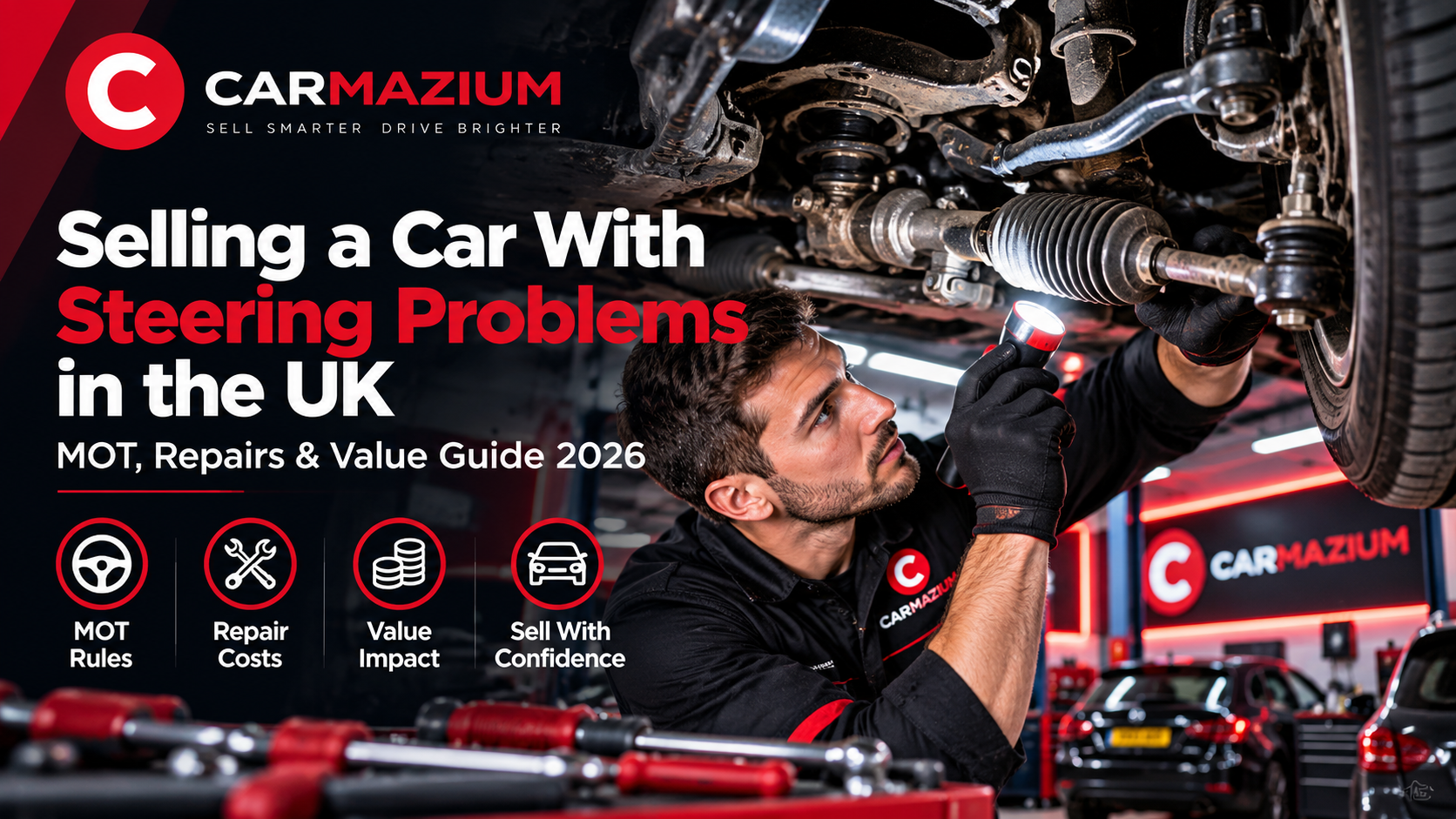
Selling a Car With Steering Problems in the UK: MOT, Repairs & Value (2026)
Selling a car with steering problems? Understand UK MOT rules, warning signs, professional diagnosis, repair decisions, honest disclosure, valuation and safe collection.
In this article
Car steering problems can turn an attractive used car into a difficult sale. Heavy steering, a knock while turning, a power-steering warning or unexplained wandering may have several causes, ranging from a straightforward repair to a serious defect affecting control. UK sellers should establish what is wrong, keep the vehicle safe, document the evidence and price it accordingly.
Quick answer: You can generally sell a car with steering problems in the UK, but you must describe known faults accurately and must not allow an unsafe vehicle to be driven on the road. A current MOT does not guarantee that the steering is safe today. Obtain a professional assessment, decide whether repair makes financial sense, and arrange recovery if roadworthiness is uncertain.
This guide focuses on Great Britain’s MOT steering requirements as updated by the Driver and Vehicle Standards Agency (DVSA) on 14 October 2026. Northern Ireland operates a separate vehicle-testing system. It also explains how to present a faulty vehicle honestly on CarMazium.
What counts as car steering problems?
The steering system converts movement at the steering wheel into controlled movement of the road wheels. Components can include a steering rack or box, column, tie rods, track-rod ends, joints, hydraulic assistance, an electric motor, sensors and control modules. A symptom does not identify a failed component.
Warning signs to record
Common signs include heavy steering, excessive free play, knocking while turning, intermittent assistance, a steering warning lamp, vibration, uneven return to centre, fluid leaks or wandering. Note whether the symptom occurs at parking speed, after a cold start, on uneven roads or following a pothole impact.
Steering, suspension and tyres can overlap
A car that pulls to one side might have incorrect tyre pressures, uneven tyres, wheel alignment issues, braking drag or suspension damage rather than a defective rack. Avoid telling a buyer “it only needs tracking” unless a workshop has confirmed that diagnosis.
Why a written diagnosis matters
A dated inspection identifying the component, severity and repair estimate is more useful than an advert saying “steering feels funny”. It gives buyers evidence to assess and can prevent you paying for unnecessary parts.
Can you legally sell a car with steering problems?
A vehicle needing repairs can generally be sold to a private buyer, motor trader or repair specialist. But selling a vehicle and driving it on a public road are different questions. The GOV.UK roadworthiness guidance says drivers must ensure vehicles are safe even when they hold valid MOT certificates.
If steering control is compromised, do not arrange a demonstration drive or invite the purchaser to drive home. Organise suitable transport and explain the condition before handover.
Private sales and accurate descriptions
Private sellers should be truthful about known faults, condition, mileage and history. Do not advertise “excellent drive”, “no faults” or “safe to drive” when you know there is a steering concern. Describe what you observed and what a technician confirmed.
Motor traders have additional obligations
Traders selling to consumers have additional statutory responsibilities. Trading Standards guidance on selling used vehicles emphasises truthful descriptions and roadworthiness. Wording such as “sold as seen” does not automatically remove a consumer’s legal rights.
Selling for repair or parts
Where a vehicle is not roadworthy, make that explicit: “steering fault diagnosed; not to be driven; recovery required”. The legal and practical suitability of a sale depends on the actual condition and circumstances, not a label alone.
Will steering problems fail an MOT in 2026?
The DVSA’s MOT inspection manual, section 2: Steering, updated 14 October 2026, covers steering gear condition, linkages, power steering, the steering wheel and column, excessive play and electronic power steering.
A minor defect differs from a major failure, while a dangerous defect represents a direct and immediate road-safety risk. A tester must assess the vehicle before assigning a category.
Excessive play or roughness
Excessive steering free play is a major defect, becoming dangerous when safe steering is affected. Excessive roughness can also be major. Permitted free-play measurements depend on steering design; do not judge compliance from a casual video.
Leaks and worn linkages
A steering-box oil leak may be minor, while leakage severe enough to drip is major under the relevant inspection item. Loose, worn or damaged components can be major or dangerous depending on severity and their effect on control. Not every damp part requires a new rack.
Electric power steering warnings
For electronic power steering (EPS), the DVSA lists an EPS malfunction indicator lamp as a major defect. Inoperative electronic assistance is also major under the specified criteria. Steering-angle inconsistencies can be dangerous when they adversely affect control.
A valid MOT is not a guarantee of safety today
A steering defect may develop after an MOT pass. Check recorded results through the official MOT history service, but obtain a current diagnosis for a new symptom.
How to identify the fault before advertising
Start with safe observations: record dashboard messages, when steering becomes heavy, and whether recent tyre, suspension or accident work occurred. Check tyre pressures against manufacturer guidance when safe. Never work beneath an unsupported vehicle or dismantle steering components without suitable expertise.
Ask for a structured workshop report
Request the exact component or system affected, the vehicle side where relevant, diagnostic codes if applicable, photographs, whether roadworthiness is affected, an itemised repair estimate and any further tests required. Tyres, alignment and suspension may need checking before a cause is confirmed.
Hydraulic versus electric assistance
Hydraulic systems can have pumps, belts, hoses and fluid reservoirs. Many newer cars use electric motors, sensors and modules. A fluid leak and an EPS warning require different approaches; topping up fluid cannot repair a failed electric motor.
Do not clear warnings to disguise faults
Clearing diagnostic codes without addressing the cause is not a repair. It can erase evidence needed for diagnosis and create a misleading impression. Keep the report and disclose intermittent symptoms.
How serious are common steering faults?
Severity depends on the actual defect, not simply the noise or warning. A car that feels normal at one speed may become difficult to control at another. If steering binds, assistance suddenly disappears or significant play develops, stop using the vehicle and seek professional advice.
Heavy steering at parking speed
Possible causes include assistance failure, electrical supply, a pump, belt or mechanical resistance. The symptom alone cannot distinguish a simple repair from a safety-critical issue. Ask whether the car is safe even to move.
Knocking while turning
A knock can arise from steering linkage, suspension joints or top mounts. Ask the garage to locate it before replacing parts. A new steering rack is an expensive guess when the cause has not been confirmed.
Pulling or wandering
Tyres, brakes, wheel geometry, suspension and steering can contribute. If the car cannot be kept safely in lane, arrange recovery instead of a test drive. An alignment printout is not proof that every underlying defect has been fixed.
Should you repair steering problems before selling?
Compare a realistic repaired selling price with the price in its present condition. Deduct diagnosis, parts, labour, transport and time. A repair makes financial sense only if it improves your net result or substantially improves the prospects of a safe, straightforward sale.
Worked example: repair versus as-is
Suppose a repaired car might sell for £6,000, while the same car with a fully disclosed fault might sell for £4,900. A firm £650 diagnosis-and-repair quote suggests a £450 advantage to repairing. But additional faults, delays or an optimistic £6,000 asking price could reverse the calculation.
These are illustrative numbers, not UK repair-price averages or guaranteed valuations. Use actual local quotations and comparable vehicles.
When repair may be worthwhile
A well-defined defect with available parts, a credible quote and no wider damage may be worth addressing. Keep an itemised invoice and any relevant repair warranty. Evidence of competent work can reassure a buyer.
When selling as-is may be sensible
For an older vehicle with several defects, an expensive electronic module or an uncertain diagnosis, a transparent sale to a repair-capable buyer may be preferable. Do not suggest the final cost is known when further investigation is needed.
How do car steering problems affect resale value?
Car steering problems reduce value through expected repair expense, uncertainty about hidden damage and fewer buyers willing to accept risk. A documented minor issue may produce a limited adjustment; an unsafe or undiagnosed defect can deter ordinary retail buyers altogether.
The whole vehicle still matters
Age, mileage, make, model, service history, accident history, tyres, MOT results and presentation remain relevant. The same repair can represent a small proportion of one car’s value and most of another’s.
Evidence narrows uncertainty
An independent report and itemised quote let a buyer assess a known repair more confidently than “might need a rack”. Do not claim a component is definitely faulty or repaired without supporting evidence.
Compare the right market examples
Start with CarMazium’s free car valuation, then account for confirmed condition. An automated guide is not a binding offer and may not capture an unusual steering defect. Compare repaired and faulty vehicles separately; advertised prices are not necessarily achieved prices.
How to write an honest steering-fault advert
State the observed symptom, confirmed diagnosis, whether professional advice says the vehicle is roadworthy, and the collection plan. Avoid exaggerating a minor issue or offering reassurance that you cannot support.
Example disclosure
“Steering assistance intermittently becomes heavy and a dashboard warning appears. Garage inspection dated 22 October 2026 identifies an EPS fault; report available. No repair completed. Offered for repair; recovery required. Price reflects condition.”
Use this example only if it matches the facts. If no diagnosis has been completed, state that the cause remains unknown.
Photographs and documents
Include clear photos of the car, warning displays, tyre condition and relevant paperwork. Remove personal details from documents before sharing. Never stage a dangerous driving demonstration to make the fault visible.
Keep records consistent
The advert, messages, inspection notes and receipt should agree. Record the buyer’s acknowledgement of disclosed faults, but never treat a signed receipt as permission to mislead or arrange unsafe road use.
Should you choose CarMazium auction or retail?
CarMazium’s UK pricing page currently lists a £0 auction listing fee for sellers and Basic retail advertising at £1 one-off until sold. Optional packages and extras have separate charges.
Free dealer auction
Verified motor traders can bid in a seller’s free auction. This may suit a vehicle needing specialist assessment, although bids and sale prices are not guaranteed. CarMazium also advertises a separate £100 seller incentive after a qualifying successful auction sale and approved handover evidence.
£1 retail listing
Basic retail lets you set an asking price for retail buyers. Retail buyers pay no CarMazium buyer fee. A steering-defective car requires an especially clear description and suitable collection plan; paying for an advert does not change legal obligations.
Payment and handover
The buyer pays the seller directly for the vehicle; CarMazium does not hold the purchase price. Follow the agreed inspection and handover process, and use recovery if safety is uncertain. Read how to sell on CarMazium for the broader journey.
Complete the sale and keep the evidence
Agree the price, buyer identity, payment method, known defects and transport before handover. Do not release the keys until agreed funds are securely received. If finance remains outstanding, document a lawful settlement arrangement before transferring the vehicle.
DVLA notification and V5C
The GOV.UK selling guidance explains the V5C process. Give the appropriate new-keeper slip and tell DVLA about the sale. Vehicle tax does not transfer to the buyer, who must tax or SORN the car as appropriate.
Collection without an unsafe test drive
An MOT certificate, insurance policy or buyer waiver does not make dangerous steering roadworthy. If a workshop says the car is unsafe, or serious symptoms remain unexplained, arrange suitable professional recovery.
Retain a simple paper trail
Keep the advert, dated photographs, inspection report, agreed price, payment confirmation, receipt, DVLA transfer confirmation and collection record. This protects clarity for both parties.
Frequently asked questions about car steering problems
Can I sell a car with a power-steering fault?
Generally yes, provided the description is accurate and the sale is lawful. Driving is a separate safety question. If assistance is lost or control is compromised, arrange assessment and recovery rather than road use.
Is an EPS warning light an MOT failure?
Under the DVSA’s Great Britain steering rules updated 14 October 2026, an EPS malfunction indicator lamp is a major defect. The actual MOT result depends on the vehicle and tester’s findings.
Does a steering rack leak always fail an MOT?
Not necessarily. The DVSA distinguishes severity and components. A steering-box leak can be minor, while oil dripping from it is major under the relevant item. Have the actual leak assessed.
Can wheel alignment fix a car that pulls sideways?
Sometimes, but tyres, brakes, suspension and steering faults may also contribute. Alignment alone does not prove the vehicle is safe. Diagnose the cause before describing it as fixed.
Should I replace the steering rack before selling?
Only after competent diagnosis and a realistic repair-versus-sale comparison. Some symptoms attributed to a rack have other causes. Ask for an itemised quote.
Can a buyer test-drive a car with a steering fault?
Only where the car is demonstrably roadworthy and all normal legal requirements for road use are met. Do not offer a road test if a serious steering defect is known or suspected.
How much does a steering fault reduce resale value?
There is no universal percentage. The effect depends on the confirmed fault, repair cost, overall car value and buyer appetite. A professional report helps establish a realistic adjustment.
Is CarMazium auction free for sellers of faulty cars?
CarMazium currently advertises a £0 auction seller listing fee, with no guarantee of a bid or sale. Its Basic retail alternative costs £1 one-off until sold. Accurately disclose all known faults.
Final checklist: safe, honest and realistic
Before advertising, record the steering symptoms, obtain a professional diagnosis, check MOT history and decide whether repair is worthwhile. Describe the fault truthfully, retain evidence, plan safe collection and complete the DVLA transfer. For related guidance, read selling a car with suspension problems and selling a non-runner or faulty car.
Ready to compare your options? Get a free CarMazium valuation, review auction and retail pricing, and list only after describing the vehicle’s condition accurately.
Relevant CarMazium guides and next steps
Continue with the guides and tools most relevant to this article.
Sell your car your way
Ready to turn your research into a real sale?
List in the CarMazium dealer auction for £0, or advertise retail from £1. Qualifying successful auction sales can receive a £100 seller incentive.
Keep reading
Related automotive guides
Selling a Car With an Exhaust Leak in the UK: MOT, Repairs & Value (2026)
Selling a car with an exhaust leak? Understand UK MOT rules, fumes and safety risks, repair decisions, honest pricing and secure collection before you sell.
Selling a Car With Faulty Air Conditioning in the UK: MOT, Repairs & Value Guide 2026
A practical UK guide to selling a car when the air conditioning does not cool: what the MOT checks, how to diagnose the fault, whether repairs pay, how to disclose it and how to choose auction or retail.
Selling a Car With Suspension Problems in the UK: MOT, Repairs & Value (2026)
Selling a car with suspension problems? Understand UK MOT rules, safety checks, professional diagnosis, repair decisions, honest disclosure and realistic pricing.
From the marketplace