

Selling a Car With a Faulty Turbocharger in the UK: MOT, Repairs & Value (2026)
Selling a car with a faulty turbocharger? Learn UK MOT rules, diagnosis, repair-versus-sale decisions, honest pricing and safe handover.
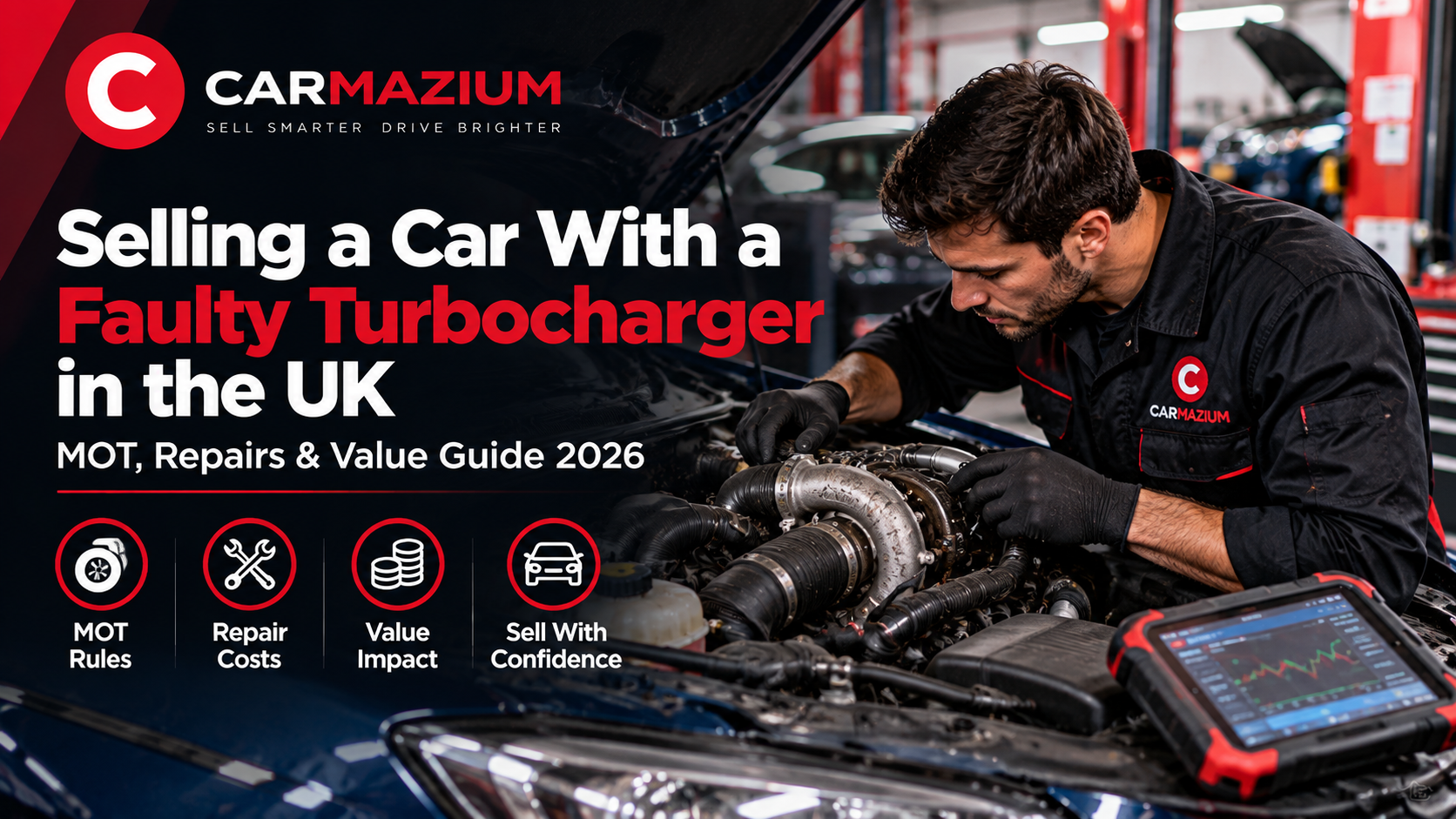
In this article
A suspected turbocharger fault can turn an otherwise desirable used car into a difficult sale. Perhaps the engine has lost power, a warning light appears under acceleration, or a garage has mentioned a replacement turbo. Before you accept a low offer or pay for an expensive repair, establish what is actually wrong. Selling a car with a faulty turbocharger in the UK is possible, but the safest and fairest approach is to diagnose the symptoms, describe the condition accurately and choose a sale route suited to the risk.
This 2026 guide explains the practical difference between a failed turbo and a cheaper boost-system fault, how UK MOT and roadworthiness rules apply, what evidence buyers will expect, and how to compare repair costs with a realistic as-is selling price. It also explains how CarMazium's free dealer auction and £1 Basic retail listing work. It is general guidance, not a diagnosis or a substitute for a qualified mechanic.
What does a turbocharger do?
A turbocharger uses energy from exhaust gases to compress air entering the engine. With more air available, the engine can produce useful power from a relatively small capacity. Turbochargers are common on UK diesel cars and many modern petrol engines. The system includes more than the turbo unit: hoses, an intercooler, sensors, valves, actuators, lubrication pipes and engine-management controls can all affect performance.
Why the distinction matters when selling
A split boost hose can make a car feel dramatically underpowered without requiring a replacement turbocharger. Conversely, a badly worn turbo bearing or oil-seal problem may need urgent mechanical attention and could affect other components. A seller who advertises “needs a new turbo” based only on a warning light may unnecessarily reduce the car's value; a seller who says “drives perfectly” despite persistent power loss risks misleading a buyer. Describe observed symptoms first and distinguish them from confirmed findings.
Seven signs that deserve investigation
1. Loss of power or poor acceleration
A car that struggles on hills or accelerates weakly may not be generating the expected boost pressure. That can result from turbo wear, but also from a leaking intake pipe, faulty sensor, EGR problem or exhaust restriction. Note whether the loss is constant, intermittent or linked to engine temperature.
2. Limp mode or an engine warning light
Modern engine-management systems can limit power when a boost-related fault is detected. A fault code helps narrow the search but is not a final diagnosis. Ask a garage for the actual code, freeze-frame information where available, and the tests that support its conclusion.
3. A new whining, siren or grinding noise
A modest turbo whistle can be normal for some cars. A noticeably louder noise, especially combined with smoke or reduced power, warrants professional inspection. A hissing sound under load may instead be escaping pressurised air from a hose or intercooler connection.
4. Blue or grey exhaust smoke
Persistent blue-grey smoke can indicate engine oil burning. A turbocharger may be responsible, but worn engine components or ventilation problems can produce similar symptoms. Do not promise a buyer that a turbo replacement will cure smoke without diagnostic evidence.
5. Unusual oil consumption
Frequent top-ups without an obvious external leak may indicate oil entering the intake or exhaust system. Record the oil level and mileage accurately. If the oil-pressure warning illuminates, stop the engine safely and arrange professional advice rather than continuing a test drive.
6. Black smoke on acceleration
Visible black smoke may indicate an air-fuel imbalance, boost loss or another diesel-engine fault. It is not proof of a failed turbo. Emissions equipment, air filters, injectors and intake leaks may need checking.
7. A mechanic's report of turbo damage
This is stronger evidence when it identifies the tests performed: boost-pressure readings, actuator checks, intake inspection, oil-feed condition and any confirmed shaft or wheel damage. Keep the written report rather than relying on a verbal description.
For further mechanical context, see Car.co.uk's turbocharger failure guide and UK specialist guidance on distinguishing boost leaks from turbo failure.
Is it legal to sell a car with a faulty turbo in the UK?
Yes, a vehicle with a known mechanical defect can be sold, provided the transaction and description are lawful and the buyer is not misled. The distinction between selling a vehicle and driving it is important. A sale does not make an unsafe car roadworthy.
Private sales versus motor-trader sales
Private buyers generally have fewer statutory quality protections than customers buying from a trader, but a private seller must still describe the vehicle truthfully. A motor trader has additional consumer-law obligations that cannot simply be removed by writing “sold as seen”. If the car is unsafe or intended only for repair, explain this clearly and arrange appropriate collection. The Trading Standards used-vehicle guidance provides useful background.
Keep your claims precise
A fair description might read: “Engine management light comes on during acceleration; noticeable loss of power; garage recorded an underboost fault; exact cause not confirmed. Vehicle offered with this disclosed defect, inspection welcome, collection by transporter recommended.” If a garage has positively diagnosed a failed turbo, say so and retain the invoice or report. Avoid presenting an unverified suspicion as certainty.
Will a faulty turbocharger cause an MOT failure?
The MOT does not automatically fail a car merely because somebody believes its turbocharger is worn. The outcome depends on the defects found during the test and the vehicle's applicable standards. Under the DVSA's MOT inspection manual, section 8: Nuisance, excessive exhaust smoke, emissions above the relevant limits and an applicable engine malfunction indicator lamp showing a fault can lead to failure.
Smoke, emissions and warning lights
For diesel vehicles, smoke opacity and visible smoke rules depend on the vehicle and test procedure. For petrol vehicles, relevant exhaust-emission standards and warning-lamp checks apply. Do not assume every turbo fault will fail or every car with a current MOT has a healthy turbo. A car can pass one inspection and develop a fault later.
A valid MOT is not permission to drive dangerously
The government says a vehicle must remain roadworthy whenever it is used on the road, even with a current MOT certificate. See GOV.UK: Check your vehicle is safe to drive. If the engine is making severe noises, producing heavy smoke, losing oil pressure or behaving unpredictably, do not take it on a demonstration drive. Arrange recovery or a qualified inspection. For more background, read Can You Sell a Car Without an MOT?.
Diagnose before paying for a replacement turbo
A sensible diagnostic process starts with symptoms and a visual inspection, not a parts order. Ask the garage to inspect boost hoses and clamps, the intercooler, air-filter restrictions, fault codes, commanded versus actual boost, actuator operation, oil supply and return, and the exhaust system as appropriate.
Ask for a written estimate with alternatives
Request an itemised quotation stating whether the turbo itself is confirmed faulty, whether a repair or reconditioned unit is suitable, what supporting parts and fluids are included, and whether the garage provides a parts-and-labour warranty. Some jobs require additional cleaning or replacement of contaminated intake components. A replacement turbo fitted without correcting the original oil-supply or contamination problem may fail again.
Avoid speculative repairs
Paying for a new turbo because the car “feels flat” can be a costly mistake. Equally, clearing a warning light immediately before sale without fixing the underlying problem is not an acceptable substitute for disclosure. If diagnosis is inconclusive, say “fault not yet diagnosed” and price the car accordingly.
How much does a turbo fault reduce resale value?
There is no universal deduction. A minor hose or actuator problem on a desirable, otherwise well-maintained car has a different market impact from a confirmed internal turbo failure accompanied by heavy smoke and possible engine damage. Buyers consider repair uncertainty as well as the quoted bill.
Calculate three values rather than guessing
Start with a realistic value for an equivalent healthy car of the same model, year, mileage, specification, service history and condition. Then obtain an itemised repair estimate and an independent as-is trade or buyer offer. Compare the likely repaired sale proceeds against the repair bill, time, transport and risk of further faults.
For example, imagine a healthy comparable car might sell for £6,000, a confirmed repair would cost £1,200, and an informed as-is buyer offers £4,300. The apparent difference is £1,700, not £1,200: repair may be worthwhile only if the extra proceeds cover the work, time, potential additional costs and uncertainty. These numbers are illustrative, not a current market valuation or a quoted turbo repair price.
Service history and evidence influence confidence
An organised folder of oil-service invoices, MOT records, diagnostics and photographs can help a buyer judge risk. A recently replaced turbo with a credible invoice may be reassuring, but the quality of the work and underlying cause still matter. See Does Service History Affect Your Car's Value? and How to Price a Used Car for Sale in the UK.
Repair it first or sell it as it is?
There is no single answer for every seller. Repair first when the diagnosis is credible, the price is proportionate, the vehicle is otherwise attractive and the net return is likely to improve. Selling as-is may make more sense when the fault is expensive, the vehicle has high mileage, there are other known issues, or you need a quicker, simpler transaction.
When repair can make sense
A relatively inexpensive confirmed boost leak may be worth fixing, particularly when it restores normal performance and allows a fresh inspection. Keep the final invoice and do not describe the car as fault-free until the repair has been properly tested.
When selling as-is can be reasonable
A car with a failed turbo, uncertain engine condition or multiple warning lights may attract specialist traders who can assess repair risk. Be transparent about what is known and what remains unknown. For related options, read How to Sell a Non-Runner or Faulty Car in the UK.
Preparing a truthful advert
A useful advert saves both sides time. State the registration year, mileage, transmission, fuel type, MOT expiry, service history and major known faults. Then describe how the turbo-related issue affects driving, when it began and what tests have been completed.
Include evidence, not vague assurances
Photograph the car in daylight and retain the diagnostic printout, repair quotation, MOT history and relevant service invoices. If a warning light is present, disclose it. If the car is in limp mode or cannot safely be driven, state that clearly. Do not imply a cheap repair is guaranteed when a garage has not confirmed it.
Example disclosure wording
“Turbo/boost-system fault suspected. Engine warning light and reduced power under acceleration. Diagnostic code and garage estimate available. Exact repair requirement has not been independently confirmed. Priced to reflect the fault; buyer inspection encouraged. Collection arrangements to be agreed according to roadworthiness.” Adapt this wording to the actual vehicle and do not copy statements that are untrue.
Selling through CarMazium: auction or retail?
CarMazium offers two distinct routes. A dealer auction listing is free for the seller, with verified motor traders able to bid. A qualifying successful auction sale can earn a £100 seller reward after the required approved handover and confirmation steps; the incentive is conditional, not an automatic payment merely for listing. Vehicle purchase money is paid directly between buyer and seller rather than being held by CarMazium.
Free dealer auction
An auction can be useful when you want professional traders to assess a known defect. Enter the symptoms and evidence accurately, follow the listing rules, and expect buyers to account for inspection, collection and repair risk. A winning auction buyer may be subject to the platform's applicable fee; that is distinct from the seller's free listing.
£1 Basic retail listing
The Basic retail option costs £1 once and remains advertised until sold, subject to the platform's terms. Retail buyers pay no CarMazium buyer fee. This route lets you describe the car directly to potential buyers, answer questions and agree an appropriate inspection and collection. Other optional retail packages exist; check the live CarMazium pricing page before choosing.
For a comparison, read CarMazium Auction vs Retail: Which Route Should Sellers Choose? or start from CarMazium's home page.
Viewing, payment and safe handover
A buyer should have a reasonable opportunity to inspect the car and the disclosed fault. A mechanical inspection is especially valuable when turbo damage could affect the engine, exhaust aftertreatment or lubrication system. Do not arrange an unsafe road test just to complete a sale.
Choose collection based on condition
If the vehicle is not roadworthy, organise suitable transport or recovery. Do not assume that a short journey, trade plates or a valid MOT removes safety concerns. Agree who pays for collection before accepting the final offer and record the arrangement in writing.
Transfer the keeper record correctly
Confirm the buyer's identity and receipt of cleared funds through your chosen payment method before releasing the vehicle. Give the appropriate V5C new-keeper slip and notify DVLA of the sale or transfer using the correct procedure. Vehicle tax does not transfer to the buyer. See GOV.UK: Selling a vehicle and Tell DVLA you've sold or transferred a vehicle. Keep a dated receipt recording registration, price, parties, mileage, known faults and handover time.
Frequently asked questions
Can I sell a car if the turbo has completely failed?
Yes, subject to honest disclosure and the normal legal requirements of a vehicle sale. A confirmed failure may make specialist trade buyers more appropriate. Do not allow it to be driven if its condition makes that unsafe.
Does a turbo warning light mean the turbo must be replaced?
No. A boost-related code can arise from hoses, sensors, actuators, exhaust restrictions or other faults. Ask for tests and a written diagnosis rather than relying on the warning light alone.
Can a car with a bad turbo pass an MOT?
Possibly, depending on the actual testable defects and the applicable emissions and warning-lamp requirements. A pass is not a guarantee of mechanical condition or future roadworthiness.
Should I clear the fault code before selling?
Only as part of a legitimate diagnosis or completed repair, with the underlying problem addressed. Do not hide a recurring warning or describe a faulty vehicle as fully repaired when it is not.
Will a replacement turbo increase the selling price?
It may restore buyer confidence and remove a discount for the fault, but it does not necessarily add the full repair cost to the car's market value. Compare genuine net proceeds before authorising work.
Do I have to provide a diagnostic report?
Not every private sale requires one, but a written report is useful evidence and can reduce misunderstandings. If you have one, describe its findings accurately and let serious buyers review it.
Can a faulty turbo cause smoke or damage other components?
Yes, depending on the failure. Oil burning, abnormal boost or contamination can create wider problems, but smoke is not conclusive proof of turbo failure. A qualified mechanic should investigate serious symptoms.
Which CarMazium selling route is better for a turbo-fault car?
A free dealer auction may suit a car requiring specialist repair, while a £1 Basic retail listing may suit a seller prepared to manage enquiries and inspections. Eligibility, condition and the buyer's assessment determine the actual outcome.
Final checklist before listing
Get the symptoms documented; check the MOT and roadworthiness position; obtain a realistic diagnosis or state clearly that it is unconfirmed; compare repair cost against as-is offers; assemble service and ownership paperwork; write an accurate description; and agree safe inspection, payment and collection. The objective is not to disguise a fault or promise a particular price. It is to help the next owner understand the car and complete a fair transaction.
Ready to compare your options? Review CarMazium's current selling routes and fees, then choose the listing method appropriate to the vehicle's actual condition.
Relevant CarMazium guides and next steps
Continue with the guides and tools most relevant to this article.
Sell your car your way
Ready to turn your research into a real sale?
List in the CarMazium dealer auction for £0, or advertise retail from £1. Qualifying successful auction sales can receive a £100 seller incentive.
Keep reading
Related automotive guides
Selling a Car With an Overheating Engine in the UK: MOT, Repairs & Value (2026)
Selling a car with an overheating engine? Understand UK MOT rules, coolant faults, repair decisions, honest pricing and safe collection before you sell.
Selling a Car With an Exhaust Leak in the UK: MOT, Repairs & Value (2026)
Selling a car with an exhaust leak? Understand UK MOT rules, fumes and safety risks, repair decisions, honest pricing and secure collection before you sell.

Selling a Car With Steering Problems in the UK: MOT, Repairs & Value (2026)
Selling a car with steering problems? Understand UK MOT rules, warning signs, professional diagnosis, repair decisions, honest disclosure, valuation and safe collection.
From the marketplace