
How to Sell a High-Mileage Car in the UK: Pricing & Buyer Trust Guide 2026
Selling a high-mileage car does not mean accepting a poor price. Learn how UK sellers can price fairly, prove maintenance, explain mileage and build buyer confidence.
In this article
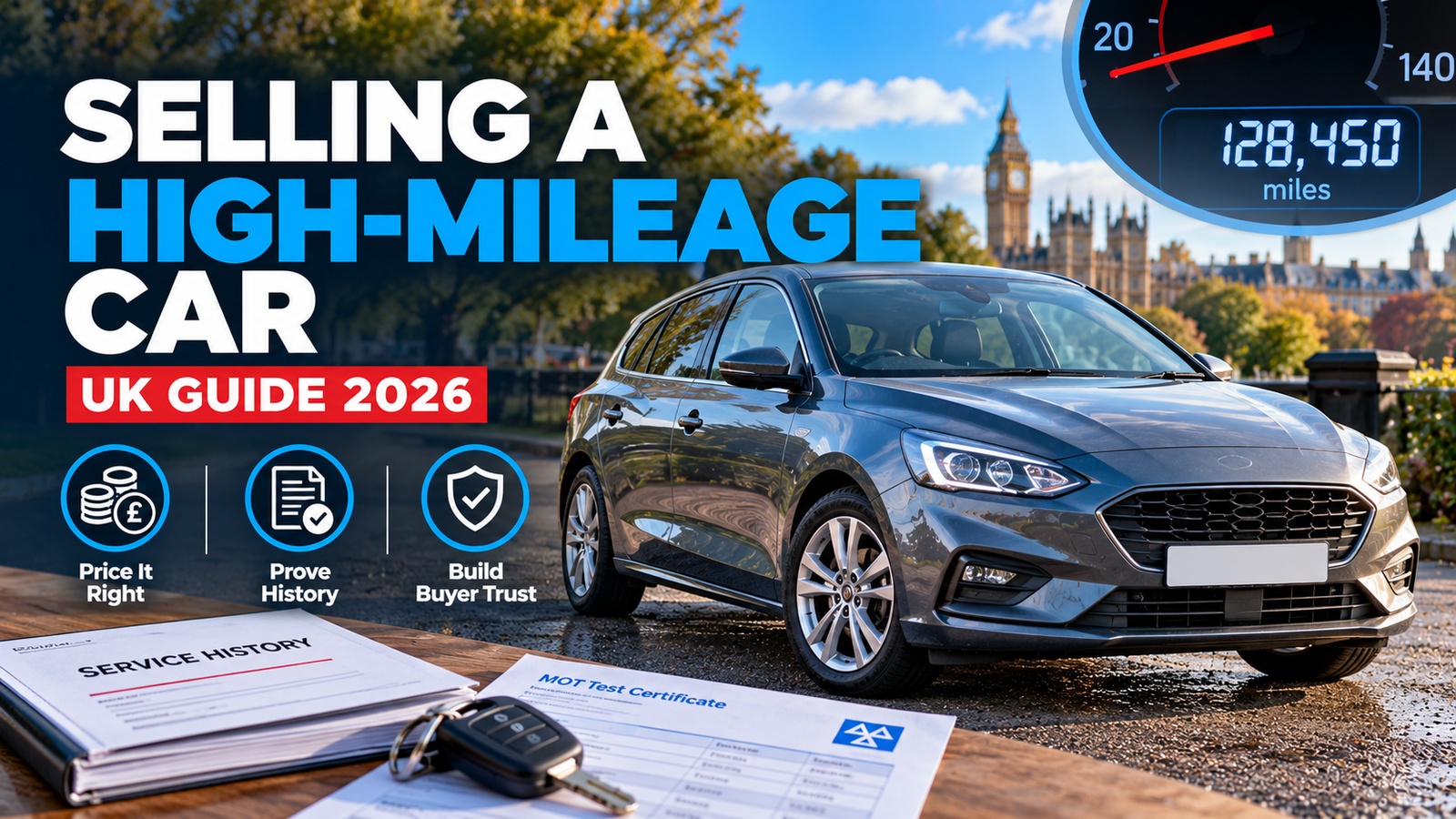
A six-figure odometer reading does not make a car unsellable. In fact, high-mileage cars are a normal part of the UK used-car market. RAC reported in May 2026, using DVSA MOT-mileage data for 2025, that more than 4.3 million cars had recorded 100,000–149,999 miles, with a further 1.2 million between 150,000 and 199,999 miles.
The challenge is not simply the number on the dashboard. Buyers want to understand how those miles were accumulated, how the car has been maintained, what major work has already been done, and whether the asking price reflects the remaining risk.
A well-maintained 120,000-mile car with consistent history can be easier to trust than a lower-mileage example with gaps, repeated MOT problems or unclear provenance.
This guide explains how to prepare, price and present a high-mileage car for sale in the UK without hiding the mileage or automatically undervaluing the vehicle.
What Counts as High Mileage?
There is no single legal or industry threshold that turns a car into a “high-mileage” vehicle.
A useful starting point is to compare the odometer with the car's age and expected use. A three-year-old car showing 90,000 miles tells a different story from a 12-year-old car showing the same figure.
For many buyers, 100,000 miles remains a psychological milestone, but it is not a mechanical expiry date. Modern vehicles can cover considerably more when they have been maintained correctly.
What matters is the complete picture:
- age;
- mileage;
- engine and gearbox type;
- service history;
- MOT record;
- ownership and use;
- condition;
- major maintenance already completed;
- and current market demand.
High Mileage Is Increasingly Normal
UK motorists are keeping vehicles for longer, and the national fleet contains millions of six-figure-mileage cars.
That means sellers should not treat 100,000 miles as if the vehicle suddenly has no retail value.
Mileage still affects price because it is one indicator of wear. But buyers increasingly distinguish between a car that has simply travelled a long distance and a car that has been neglected.
A high-mileage vehicle can still have strong value when its history supports its condition.
Mileage vs Condition: Which Matters More?
Neither should be considered alone.
Mileage can indicate how much use components have experienced. Condition shows how the car has actually responded to that use.
A buyer looking at a 130,000-mile car may check:
- cold-start behaviour;
- clutch operation;
- gearbox smoothness;
- suspension noise;
- steering;
- brakes;
- oil or coolant leaks;
- warning lights;
- tyre wear;
- interior wear;
- and evidence of regular servicing.
A car that performs well in those areas can challenge the assumption that the odometer number tells the whole story.
Service History Becomes More Important as Mileage Rises
Maintenance evidence is one of the strongest ways to build confidence in a high-mileage vehicle.
RAC notes that many cars are serviced around every 12 months or 12,000 miles, although the correct interval is always the manufacturer's own schedule.
For a high-mileage car, buyers may want to see evidence of:
- regular oil and filter changes;
- timing-belt replacement where applicable;
- timing-chain work where required;
- gearbox servicing;
- clutch or flywheel replacement;
- brake work;
- suspension replacement;
- coolant changes;
- battery replacement;
- DPF-related maintenance on diesels;
- and manufacturer-specific scheduled work.
Invoices are particularly useful because they can show what was actually replaced, when it was done and at what mileage.
See our guide to service history and car value for a deeper explanation.
Check the MOT Mileage Trail Before Advertising
The official GOV.UK MOT-history service shows the mileage recorded at previous MOT tests as well as pass/fail results, defects and advisories.
Before listing your car, check the record yourself.
You are looking for a mileage progression that makes sense, for example:
- 2023: 82,140 miles;
- 2024: 94,870 miles;
- 2025: 106,330 miles;
- 2026: 118,520 miles.
A consistent progression helps support the odometer reading.
If a previous MOT mileage entry is genuinely wrong, do not ignore it. GOV.UK provides a process for correcting mileage mistakes, and evidence may be required depending on when the error occurred.
An unexplained mileage discrepancy can create more concern than high mileage itself.
Do Not Try to Hide the Mileage
Put the correct mileage clearly in the advert.
Trying to bury a six-figure figure deep in the description wastes time because buyers can check MOT records and will see the odometer during a viewing.
Instead, make the mileage part of a credible story:
“128,000 miles, supported by MOT history and extensive service invoices. Timing belt replaced at 104,000 miles and clutch replaced at 116,000 miles.”
That is much stronger than simply writing:
“128k, drives fine.”
Explain How the Mileage Was Accumulated — If You Know
Mileage type can help provide context, but avoid making claims you cannot prove.
If you personally used the car for a long motorway commute, saying so can be useful.
For example:
“Owned for four years and used primarily for a 90-mile daily motorway commute.”
Do not invent a “motorway miles” story simply because the mileage is high.
A buyer may compare your explanation with:
- MOT mileage increases;
- service intervals;
- ownership dates;
- tyre and brake history;
- and general condition.
Facts build trust. Unsupported sales phrases do not.
Price Against Comparable High-Mileage Cars
One of the biggest mistakes is comparing your 135,000-mile car with the cheapest 55,000-mile example of the same model and expecting the same price.
Start with genuinely comparable vehicles:
- same model and generation;
- similar age;
- similar engine;
- similar gearbox;
- similar trim;
- similar mileage band;
- similar history;
- and similar condition.
Then adjust for your car's strengths and weaknesses.
CarMazium's valuation and listing journey can help establish a market starting point before you decide between auction and retail. Start with CarMazium.
Do Not Discount Twice for the Same Mileage
Suppose the market value you are using already reflects a 125,000-mile odometer reading.
Do not then make another arbitrary £2,000 deduction simply because the car is “high mileage.”
The mileage should already be part of the comparison.
Further deductions should relate to additional factors such as:
- overdue servicing;
- worn tyres;
- body damage;
- warning lights;
- short MOT;
- missing keys;
- or known mechanical faults.
This prevents panic-pricing.
Major Maintenance Can Protect Value
At higher mileages, expensive work already completed can matter significantly.
Depending on the vehicle, useful evidence may include:
- timing belt and water pump;
- timing chain;
- clutch and dual-mass flywheel;
- automatic gearbox service;
- turbocharger;
- injectors;
- DPF work;
- suspension arms and dampers;
- wheel bearings;
- brake discs and pads;
- or hybrid/EV battery health information.
Do not assume the repair cost adds pound-for-pound to the car's value. A £1,000 repair does not automatically make the car worth £1,000 more.
But it can remove a major buyer objection and make your vehicle easier to choose over another high-mileage example.
Fresh MOT: Useful but Not a Substitute for Condition
A fresh MOT can reduce uncertainty, particularly when the existing certificate is close to expiry.
But an MOT is not a full mechanical inspection.
GOV.UK states that a vehicle can be unsafe even with a current MOT certificate, and the MOT record reflects testable items at the time of the test rather than guaranteeing general mechanical condition for the future.
Use a fresh MOT as supporting evidence, not as a claim that the car is mechanically perfect.
Deal With Advisories Before the Sale Where Sensible
Repeated advisories can make buyers think maintenance has been deferred.
Check the MOT history for recurring items such as:
- worn tyres;
- brake wear;
- suspension play;
- corrosion;
- damaged lamps;
- or fluid leaks.
If an inexpensive repair removes an obvious concern, completing it before sale may improve buyer confidence.
For expensive advisories, you may instead decide to price the vehicle accordingly and disclose them clearly.
Presentation Still Matters
High mileage is not an excuse for a poor advert.
Clean the car properly and photograph:
- front three-quarter view;
- rear three-quarter view;
- both sides;
- wheels;
- interior;
- dashboard;
- odometer;
- boot;
- engine bay;
- service documents;
- and any relevant damage.
See how to take car photos that get more enquiries.
A clean, transparent advert signals that the seller has nothing to hide.
Photograph the Odometer
For a high-mileage car, an odometer photograph is useful.
It confirms the current advertised figure and helps buyers compare it with the MOT history.
Make sure the image is clear and current.
If warning lights are illuminated because the ignition is on but the engine is not running, avoid creating confusion. Photograph the dashboard in a state that accurately represents the vehicle and explain any genuine warning lights.
Write a History-Led Description
A strong high-mileage advert should answer the questions buyers are already thinking about.
For example:
2016 diesel estate, 126,400 miles. Extensive service history with invoices. Serviced at 121,000 miles. Timing belt and water pump replaced at 103,000 miles. Clutch and flywheel replaced at 114,000 miles. MOT until August 2027. Two keys. Used mainly for long-distance commuting during current ownership. Body has age-related marks shown in photos. No dashboard warning lights currently present.
That description gives buyers useful information instead of trying to distract from the mileage.
Be Precise About Service History
Avoid calling a car “full service history” unless you can support that description.
If records are incomplete, say what you actually have:
- seven service stamps;
- invoices from 2021 onward;
- digital manufacturer history;
- partial history;
- or recent service invoice only.
A precise description is more credible than an exaggerated one.
High Mileage and Diesel Cars
Diesel vehicles often accumulate higher annual mileage because they have historically been popular for long-distance driving.
For a high-mileage diesel, buyers may pay particular attention to:
- DPF condition;
- EGR system;
- turbocharger;
- injectors;
- AdBlue system where fitted;
- timing system;
- and clutch/flywheel condition.
If relevant work has already been completed, include the evidence.
High Mileage and Automatic Gearboxes
Automatic gearbox history can become increasingly important as mileage rises.
Some manufacturers specify fluid or filter changes; others use different maintenance regimes.
Check the correct schedule for the exact transmission rather than relying on generic advice.
If the gearbox has been serviced, include the invoice and mileage.
High Mileage EVs and Hybrids
For an electric or hybrid vehicle, odometer mileage is only part of the picture.
Battery condition, charging behaviour, warranty status and service records can matter significantly.
Where battery state-of-health information is available from a credible source, it can help buyers assess a higher-mileage electrified vehicle.
See our electric-car selling guide.
Auction or Retail for a High-Mileage Car?
The right route depends on the vehicle and your priorities.
Dealer Auction
A dealer auction can suit sellers who want the motor trade to compete for the car.
Trade buyers are used to assessing mileage, preparation cost and resale margin. A high-mileage car may still attract interest if it is correctly described and commercially priced.
CarMazium currently allows sellers to list in auction free, with the platform's buyer-side fee applying to the winning dealer. Check the current CarMazium pricing page before listing for the latest package details.
Retail Listing
Retail may suit a clean, well-maintained high-mileage vehicle with strong history and an attractive asking price.
Private buyers may pay more than trade value, but the seller usually needs to spend more time answering questions, arranging viewings and explaining the history.
CarMazium offers retail listing options alongside auction. Compare the two routes before deciding.
Do Not Promise a High-Mileage Car Is “Bulletproof”
No used car is risk-free.
Avoid phrases such as:
- “will do another 200k easily”;
- “bulletproof engine”;
- “nothing will go wrong”;
- or “mileage means nothing.”
Mileage does matter. It simply does not matter in isolation.
Describe what you know and provide evidence.
What Buyers Can Check Themselves
GOV.UK recommends that used-car buyers check vehicle details, MOT status and MOT history, and compare the V5C and vehicle identification details when inspecting a car.
Expect an informed buyer to check:
- registration details;
- MOT mileage history;
- MOT failures and advisories;
- recall information;
- V5C details;
- VIN;
- service records;
- and potentially a paid provenance/history check.
A transparent advert should make those checks reinforce your story rather than contradict it.
Correct Mileage Errors Before the Sale
If the MOT history contains an incorrect mileage entry, deal with it before advertising where possible.
GOV.UK explains that the correction process depends on whether the MOT was within the last 28 days or earlier, and older corrections require supporting evidence.
A corrected official record is much stronger than telling every buyer, “the garage typed it wrong.”
High-Mileage Pricing Example
Imagine two otherwise similar 2017 estates.
Car A
- 78,000 miles;
- patchy history;
- four previous MOT advisories still recurring;
- one key;
- tyres near replacement.
Car B
- 124,000 miles;
- documented servicing;
- timing belt completed;
- recent clutch;
- two keys;
- good tyres;
- clean MOT history.
Car A will usually retain a mileage advantage, but Car B may still be the more convincing purchase for a buyer who values maintenance evidence and known recent expenditure.
That is why pricing should never be based on mileage alone.
Should You Service the Car Before Selling?
If the service is due or overdue, completing it may help.
A recent service can show that the car has not simply been run to the point of sale and abandoned.
But do the maths.
A major service on a low-value car may not return its full cost in the sale price. In that situation, clear disclosure and realistic pricing may be more sensible.
Should You Repair Cosmetic Damage?
Minor cosmetic work can improve presentation, but again, compare cost with likely return.
A high-mileage car does not need to look neglected.
Clean wheels, a tidy interior and good photographs can improve first impressions without pretending the car is new.
For larger dents and scratches, see our guide on whether to repair body damage before selling.
What Documents Build the Most Trust?
Prepare a simple folder containing, where available:
- V5C;
- service book or digital service printout;
- maintenance invoices;
- MOT information;
- timing-belt/chain evidence;
- gearbox service invoice;
- tyre/brake invoices;
- warranty paperwork;
- and both keys.
Do not publish sensitive V5C reference numbers or personal data in advert photographs.
The goal is to prove maintenance, not expose private information.
Frequently Asked Questions
Is 100,000 miles too high to sell a car?
No. Millions of UK cars have recorded more than 100,000 miles. Price, maintenance, age, model, condition and history all influence saleability.
Does a car lose value when it reaches 100,000 miles?
Mileage generally influences value, and 100,000 miles can be a psychological threshold for some buyers. But there is no automatic fixed deduction at exactly 100,000 miles.
Is service history more important on a high-mileage car?
It becomes particularly valuable because it helps explain how the vehicle has been maintained over a longer period of use.
Should I get an MOT before selling a high-mileage car?
A fresh MOT may reduce uncertainty if the existing MOT is short, but it is not a guarantee of overall mechanical condition.
Should I hide the mileage from the advert headline?
No. State it accurately. Buyers can verify MOT mileage history and will see the odometer during inspection.
Is motorway mileage better than town mileage?
Different driving patterns create different kinds of wear. If you genuinely know the car was used mainly for long motorway journeys, explain that fact, but do not make unsupported claims.
Can I auction a high-mileage car on CarMazium?
Yes, subject to the current listing requirements. Accurate mileage, condition and history information helps motor traders bid more confidently.
The Bottom Line
High mileage changes a car's value, but it does not erase it.
The strongest high-mileage sale combines realistic pricing, verifiable mileage, maintenance evidence, honest condition reporting and a clear advert.
Check the MOT mileage trail. Correct genuine errors. Gather service invoices. Highlight major work already completed. Photograph the odometer and condition clearly. Compare the car with vehicles in the same mileage band rather than low-mileage examples.
Most importantly, do not apologise for the mileage or try to hide it. Explain it.
When buyers can see where the miles came from and how the vehicle was looked after, they can assess the car on evidence rather than assumptions.
Ready to test the market? Start your CarMazium valuation or listing and choose the selling route that fits your vehicle.
Sell your car your way
Ready to turn your research into a real sale?
List in the CarMazium dealer auction for £0, or advertise retail from £1. Qualifying successful auction sales can receive a £100 seller incentive.
Keep reading
Related automotive guides
Does Having Only One Car Key Affect Resale Value? UK Guide 2026
Selling a used car with only one key? Learn how a missing spare key can affect buyer confidence, dealer bids and resale value, plus when replacing it before sale may make sense.
Does ULEZ Compliance Affect a Car's Value? UK Guide 2026
Can ULEZ or Clean Air Zone compliance affect a used car's value? Learn the 2026 rules, which cars normally qualify, and how compliance can influence buyer demand.
Can You Sell a Car Without an MOT? UK Guide 2026
Can you sell a car with no MOT in the UK? Learn how expired or failed MOTs affect pricing, road use, tax, recovery, buyer expectations and safe handover.
From the marketplace