
Do Alloy Wheel Damage and Kerbing Affect Car Value? UK Guide 2026
Kerbed or damaged alloy wheels can affect buyer confidence and resale value. Learn when refurbishment is worth it, when damage becomes a safety issue and how UK sellers should price it.
In this article
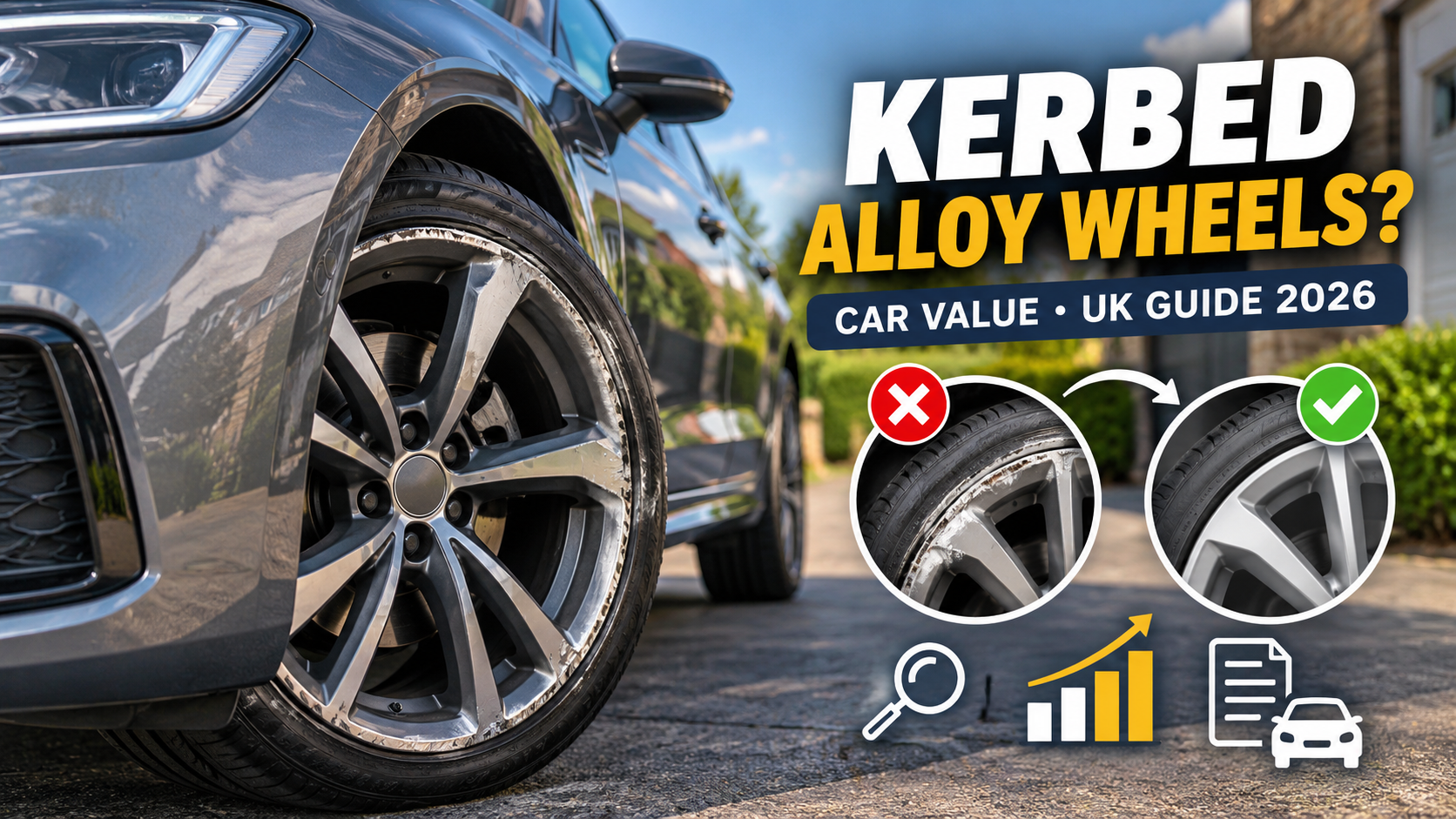
Kerbed alloy wheels are one of the most common cosmetic defects on used cars. A light scrape from a kerb may look minor, but buyers often notice wheel damage quickly because the wheels sit at eye level during a walk-around and can influence the first impression of how a car has been cared for.
So does alloy-wheel damage reduce a car's value? Usually, yes — but the size of the deduction depends on the type of damage, the car, the wheel design and whether the issue is cosmetic or structural.
A few superficial marks are very different from a cracked, buckled or badly distorted wheel. The first is mainly a presentation issue. The second can become a roadworthiness and safety issue.
This guide explains how UK sellers should assess kerbing, decide whether refurbishment is worthwhile, describe damage honestly and avoid spending more on repairs than they are likely to recover in the sale price.
Why Buyers Notice Alloy Wheels
Alloy wheels are a prominent part of a car's appearance. On many modern cars they also contribute significantly to the specification.
A buyer viewing two otherwise similar cars may prefer the one with cleaner wheels because it can suggest:
- more careful ownership,
- less parking damage,
- lower immediate preparation cost,
- and a car that looks closer to retail-ready condition.
That does not mean a small scrape destroys the value of a car. It means visible damage becomes one of the items a buyer may use when negotiating.
This is especially relevant when the rest of the vehicle is in excellent cosmetic condition. A clean body with heavily kerbed wheels makes the wheel damage stand out more.
Cosmetic Kerbing vs Structural Wheel Damage
The first step is to separate cosmetic damage from safety-related damage.
Typical cosmetic damage
Cosmetic issues can include:
- light kerb rash around the rim,
- small paint chips,
- lacquer peeling,
- surface scratches,
- mild oxidation,
- and minor discolouration.
These issues can make a wheel look tired without necessarily affecting its structural integrity.
More serious damage
A wheel deserves closer inspection if it has:
- a visible crack,
- significant distortion,
- a buckle,
- severe impact damage,
- repeated loss of tyre pressure,
- vibration through the steering wheel,
- evidence of an unsafe repair,
- or damage around wheel fixings.
The official DVSA MOT inspection manual treats wheel condition as a safety matter where damage becomes excessive or affects wheel security. A wheel that is excessively damaged or distorted can receive a major defect, while more severe conditions affecting safety can be classified as dangerous.
That distinction matters when selling.
Roadworthiness Comes Before Resale Value
Do not treat every wheel defect as a cosmetic pricing question.
GOV.UK states that the person using a vehicle is responsible for making sure it is safe to drive. A vehicle can be unsafe even when it has a current MOT certificate.
If you suspect a wheel is cracked, badly buckled or structurally damaged, have it assessed before allowing normal road use or a buyer test drive.
The same principle applies to the tyre fitted to the damaged wheel. An impact strong enough to damage a rim can also damage a tyre.
Check for:
- cuts,
- bulges,
- exposed cords,
- abnormal pressure loss,
- sidewall damage,
- and unusual vibration.
For cars and light vans, GOV.UK says tyre tread must meet the legal minimum and tyres must be free from relevant defects.
How Much Does Kerbing Reduce Car Value?
There is no universal deduction.
A buyer normally thinks about the cost and inconvenience of putting the car into the condition they want.
The effect depends on several factors.
Number of damaged wheels
One lightly marked wheel is usually less significant than all four wheels being heavily kerbed.
Four visibly damaged wheels can make the whole car appear neglected even when each mark is individually cosmetic.
Wheel size
Large wheels can be more expensive to refurbish or replace. They are also visually prominent.
Wheel finish
A simple painted alloy may be relatively straightforward to refurbish.
More complex finishes can require specialist work. Examples include:
- diamond-cut faces,
- polished sections,
- two-tone finishes,
- unusual textures,
- and intricate designs.
Vehicle value
A £2,000 older car is judged differently from a nearly-new premium vehicle.
On an inexpensive older car, buyers may accept some cosmetic wear as normal.
On a high-value car presented as immaculate, even moderate wheel damage can become a stronger negotiation point.
Replacement cost
If the wheel cannot be safely refurbished and requires replacement, the cost equation changes considerably.
Original-equipment wheels can be expensive, and a used replacement must be the correct size and specification.
Does Kerbing Automatically Mean You Should Refurbish the Wheels?
No.
The commercial question is:
Will the refurbishment improve the likely selling result by more than it costs?
If four wheels cost a meaningful amount to refurbish but the likely sale price only increases slightly, doing the work purely for resale may not make sense.
Refurbishment becomes more attractive when:
- the car is otherwise very clean,
- the wheels are a major visual feature,
- the asking price is at the stronger end of the market,
- buyers in that segment expect high cosmetic standards,
- or the damage is likely to dominate the advert photographs.
Selling as-is may make more sense when:
- the car is low value,
- the damage is light,
- the vehicle already has other age-related cosmetic marks,
- the likely buyer is a motor trader who will prepare it themselves,
- or the refurbishment cost cannot reasonably be recovered.
Think in Terms of Net Return
Imagine two possible routes.
Route A: Sell as-is
You advertise the car honestly and allow for the wheel condition in the price.
There is no repair bill and no delay.
Route B: Refurbish first
You pay for refurbishment, wait for the work to be completed and then advertise the car in improved condition.
The correct comparison is not simply whether Route B produces a higher sale price.
It is:
extra sale proceeds minus refurbishment cost, time and risk.
If you spend £400 and only gain £250 in the final sale, the refurbishment has not improved your net return.
Dealer Bids May Already Include Preparation Cost
When a motor trader buys a used car, they often calculate what the vehicle will cost to prepare for resale.
That may include:
- mechanical repairs,
- servicing,
- tyres,
- bodywork,
- alloy-wheel refurbishment,
- valeting,
- transport,
- and warranty preparation.
So if all four wheels need work, a dealer may reduce their bid to allow for that preparation.
This is not necessarily the same as saying the car has permanently lost that amount of market value. It means the buyer has a cost to absorb before resale.
CarMazium's auction route can help sellers test the trade market by putting a vehicle in front of verified motor traders. The auction is currently free for sellers to list.
Start a CarMazium valuation or auction.
Retail Buyers May React Differently
A private retail buyer may not calculate refurbishment with the same precision as a trader.
Instead, cosmetic damage can affect their emotional impression of the car.
They may think:
- "What else has been neglected?"
- "I'll need to fix those."
- "The other car I viewed looked cleaner."
- "I should negotiate."
Good presentation therefore matters.
If you choose not to refurbish, clean the wheels thoroughly before taking photographs. Brake dust and dirt can make existing damage look worse.
Should You Repair One Wheel or All Four?
It depends on consistency.
If one wheel is badly marked and the other three are clean, repairing that single wheel may give a noticeable improvement.
If all four have similar light age-related marks, refurbishing only one can sometimes make the remaining wheels look worse by comparison.
Ask the refurbisher whether they can match the existing finish accurately.
Colour and sheen can vary between:
- original finish,
- previously refurbished wheels,
- powder-coated wheels,
- and diamond-cut surfaces.
Diamond-Cut Alloy Wheels Need Special Attention
Diamond-cut wheels have a machined face, usually protected by lacquer.
They can look excellent when new, but kerbing and lacquer deterioration can be particularly visible.
Not every damaged diamond-cut wheel should automatically be machined again. The wheel must remain suitable for the process, and repeated cutting removes material.
Use a reputable specialist and ask whether refurbishment is appropriate for the specific wheel.
If a specialist advises replacement rather than repair, treat that as a different cost decision.
Cracked or Buckled Wheels Are Not Just Cosmetic
A crack or buckle changes the conversation.
Do not advertise serious structural wheel damage merely as "a bit of kerbing."
If you know a wheel is cracked or significantly distorted:
- stop treating it as a cosmetic defect;
- have the wheel and tyre professionally assessed;
- repair or replace it appropriately where necessary;
- keep the invoice or report;
- disclose relevant unresolved defects to the buyer.
The DVSA MOT manual includes specific wheel-condition failure criteria. Wheel security and excessive damage are part of the inspection.
Check the Tyres at the Same Time
Wheel refurbishment is a good opportunity to inspect tyre condition.
Look at:
- tread depth,
- inner-edge wear,
- outer-edge wear,
- cuts,
- bulges,
- cracking,
- and matching sizes.
Uneven wear can sometimes indicate alignment, suspension or pressure issues.
A freshly refurbished wheel with a damaged tyre does not solve the bigger presentation or safety problem.
CarMazium also has a dedicated guide on how worn tyres affect car value.
Will Kerbed Wheels Fail an MOT?
Light cosmetic kerbing alone is not automatically an MOT failure.
The concern is whether the wheel has a defect that meets the MOT rejection criteria.
The DVSA inspection manual covers issues including:
- loose or missing wheel fixings,
- damaged hubs,
- excessive wheel damage,
- distortion,
- and conditions affecting wheel security.
So do not assume that every scratch is an MOT issue.
Equally, do not assume that a wheel is safe simply because the damage started with a kerb impact.
If in doubt, get it checked.
A Current MOT Does Not Guarantee Perfect Wheels
An MOT is a minimum roadworthiness inspection at a point in time.
It is not a cosmetic-condition certificate and it is not the same as a full mechanical inspection.
GOV.UK specifically warns that a vehicle can become unsafe even when it has a current MOT.
A buyer may therefore inspect wheel and tyre condition separately from the MOT history.
Photograph Wheel Damage Honestly
If you sell the car without refurbishing the wheels, photograph them properly.
Useful advert photos include:
- each complete wheel,
- a close-up of significant kerbing,
- tyre tread where practical,
- and any particularly clean or recently refurbished wheel.
Avoid deliberately framing photographs to hide damage.
Accurate photographs reduce wasted viewings and help buyers price the vehicle before travelling.
For better listing presentation, see how to take car photos that get more buyer enquiries.
Describe the Damage Precisely
Avoid vague phrases such as:
"Wheels could do with TLC."
A more useful description is:
"All four alloy wheels have cosmetic kerb marks around the outer edges. No known cracks or pressure loss. Priced in current condition."
If you do not know whether the wheel is structurally sound, do not make a guarantee.
Say what you know.
If a professional has inspected it, keep the evidence.
Keep Refurbishment Receipts
If you refurbish the wheels before sale, retain the invoice.
A receipt can show:
- what work was done,
- when it was completed,
- which wheels were treated,
- and who carried out the work.
This is particularly useful for more expensive wheel finishes.
Documentation supports buyer confidence and prevents the refurbishment from becoming an unsupported claim.
Do Aftermarket Wheels Change the Calculation?
Yes.
Aftermarket wheels can appeal strongly to one buyer and discourage another.
Before valuing them, consider:
- whether the original wheels are available,
- wheel quality,
- correct fitment,
- tyre specification,
- insurance implications,
- and whether the modifications suit the likely buyer.
If the car is modified more broadly, see our guide to selling a modified car in the UK.
Can a Full-Size Spare Add Value?
A clean matching spare can be useful, particularly if the road wheels are expensive or unusual.
But do not assume a spare offsets damage to wheels currently fitted to the car.
The buyer is evaluating the car as presented.
If you have an undamaged matching wheel in storage, it may be worth fitting it before sale if the tyre and wheel are appropriate and safe.
When Refurbishment Is Most Likely to Pay
Refurbishment tends to make the strongest commercial sense when:
- the vehicle is relatively high value,
- bodywork is already excellent,
- wheel damage is the main visible flaw,
- the wheels are central to the car's appearance,
- and you are targeting a retail buyer.
It can also help photography.
Clean wheels give the entire car a more finished appearance in an online advert.
When Selling As-Is Can Be Smarter
Do not refurbish automatically.
Selling as-is can be the better route when:
- the car has several other cosmetic defects,
- it is being sold into the motor trade,
- the buyer is likely to refurbish at trade rates,
- the wheel damage is very minor,
- the vehicle is a low-value part-exchange type car,
- or you need a quick sale.
The aim is not to make every used car perfect.
The aim is to spend money where it improves the net result.
How CarMazium Sellers Should Present Wheel Condition
Whether you choose auction or retail, make the wheel condition easy to understand.
Include:
- clear photos,
- number of affected wheels,
- whether damage is cosmetic,
- any known cracks or buckles,
- tyre condition,
- recent refurbishment evidence,
- and whether original wheels are included if aftermarket wheels are fitted.
For a trade auction, accurate condition information helps bidders calculate preparation costs.
For a retail listing, it reduces surprises at the viewing.
Should You Reduce the Asking Price?
If you decide not to repair the wheels, compare your car with similar examples.
Do not simply deduct a random amount.
Consider:
- overall condition,
- mileage,
- service history,
- MOT history,
- tyre condition,
- number of damaged wheels,
- wheel type,
- and likely repair cost.
A car with light kerbing but excellent mechanical history may still deserve a strong price.
A car with four damaged wheels, worn tyres and bodywork defects needs a broader condition adjustment.
See how to price a used car for sale in the UK.
Frequently Asked Questions
Do kerbed alloy wheels reduce car value?
Usually to some extent. The effect depends on severity, number of affected wheels, vehicle value, wheel finish and buyer expectations.
Should I refurbish alloys before selling?
Only when the likely improvement in saleability or sale price justifies the cost. On a high-value, otherwise clean car it can make sense. On a low-value trade sale it may not.
Will kerbed alloys fail an MOT?
Light cosmetic marks do not automatically cause an MOT failure. Excessive damage, distortion, wheel-security issues or other defects meeting DVSA criteria can result in a failure.
Is a cracked alloy wheel safe?
A suspected cracked wheel should be professionally assessed. Structural wheel damage is a safety issue, not merely a cosmetic one.
Should I disclose wheel damage?
Yes. Clear photos and an accurate description help the buyer understand the condition and reduce disputes or wasted viewings.
Do diamond-cut wheels cost more to put right?
They often require a more specialised process than a basic painted wheel. Suitability also depends on the condition of the wheel and its previous refurbishment history.
Can damaged wheels affect dealer auction bids?
Yes. Traders may allow for refurbishment, tyres, replacement or other preparation costs when calculating a maximum bid.
The Bottom Line
Kerbed alloy wheels can reduce a car's value, but not every mark deserves an expensive repair.
Start by identifying whether the damage is cosmetic or structural.
For light kerbing, compare the refurbishment cost with the likely improvement in sale price and buyer appeal.
For cracks, buckles or serious damage, prioritise roadworthiness and professional assessment.
Whichever route you choose, clean the wheels, photograph them clearly, describe the condition accurately and keep evidence of any work completed.
If you want the trade market to price the vehicle in its current condition, start a CarMazium valuation or auction.
Sell your car your way
Ready to turn your research into a real sale?
List in the CarMazium dealer auction for £0, or advertise retail from £1. Qualifying successful auction sales can receive a £100 seller incentive.
Keep reading
Related automotive guides
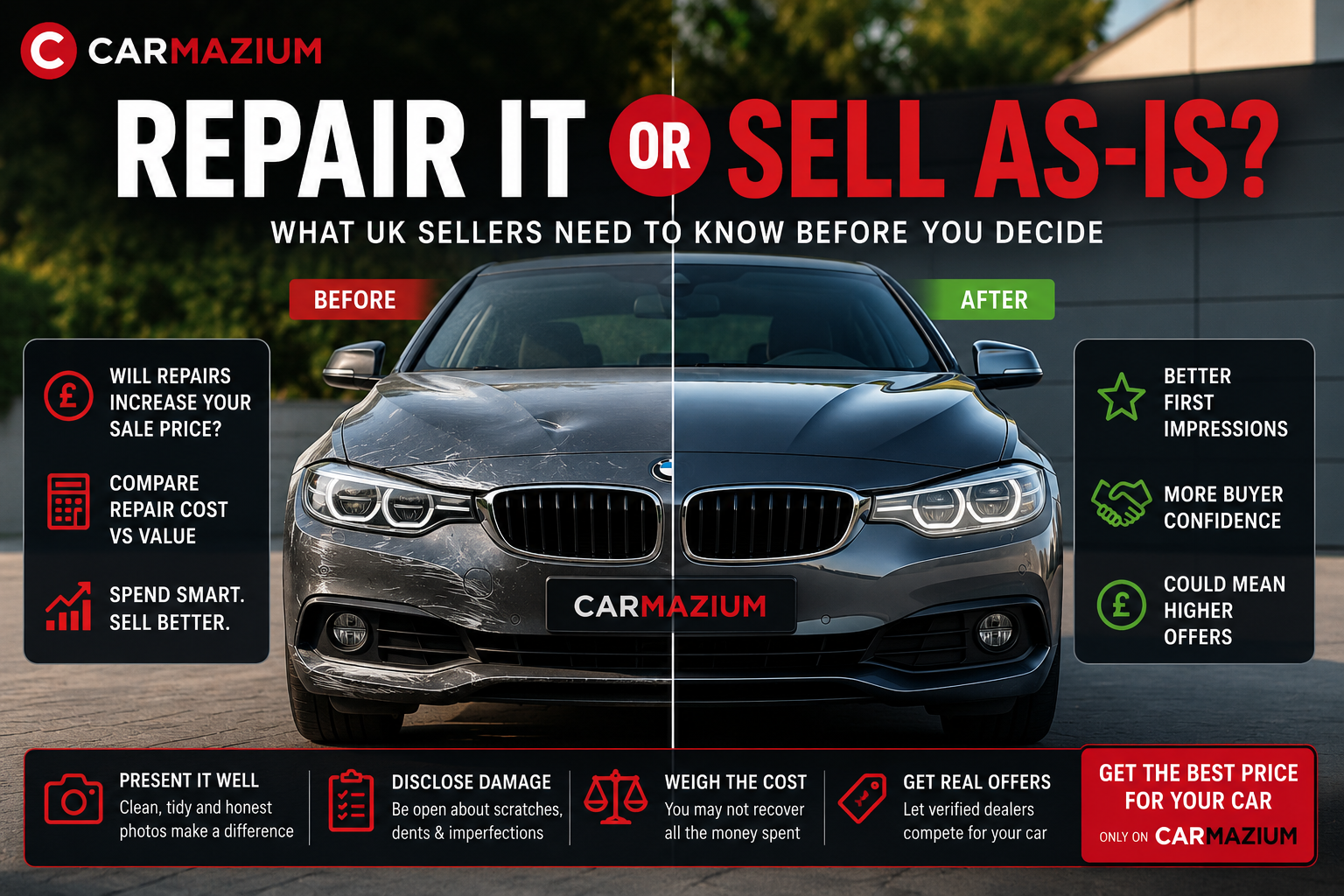
Should You Repair Scratches and Dents Before Selling Your Car?
Should you spend money repairing scratches, dents and damaged alloys before selling your car? Learn which repairs may be worthwhile and when you're better off selling as-is.

How to Sell a Modified Car in the UK Without Undervaluing It: 2026 Guide
Selling a modified car in the UK? Learn how to document upgrades, handle V5C and insurance details, price modifications realistically and find the right buyer without giving the car away.

How to Sell a SORN Car in the UK: Complete Guide 2026
Selling a SORN car in the UK? Learn what SORN means for the sale, road use, MOT trips, transport, DVLA notification, the new keeper and how to price and hand over the car safely.
From the marketplace