
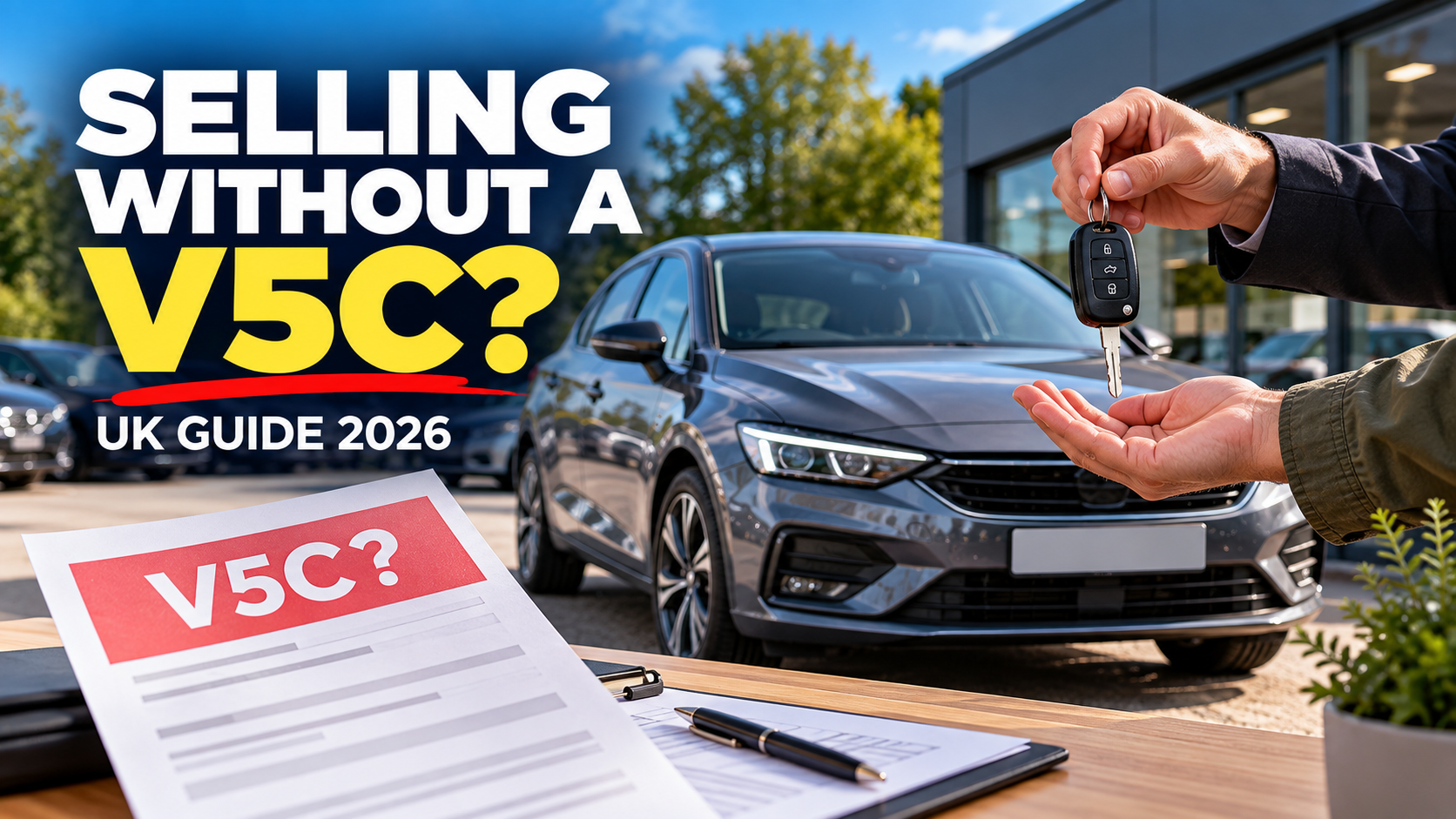
Can You Sell a Car Without a V5C? UK Guide 2026
Lost your V5C log book before selling your car? Learn what DVLA requires, why replacing it first is usually safer, what happens if you sell without it, and how the buyer registers and taxes the vehicle.
In this article
A missing V5C does not automatically make a car impossible to sell, but it makes the transaction less straightforward and can reduce buyer confidence.
The V5C registration certificate — commonly called the log book — records the vehicle and its registered keeper. It is not proof of ownership, but it is an important part of a normal UK vehicle sale because buyers use it to check the vehicle details and the seller normally uses it to notify DVLA of the keeper change.
If your V5C has been lost, stolen, damaged or destroyed, the cleanest approach is usually to replace it before advertising or completing the sale.
This guide explains what happens if you do not have one, what DVLA currently requires, how the buyer may be affected, and how to avoid turning a simple car sale into a paperwork problem.
Can You Legally Sell a Car Without a V5C?
Yes. A vehicle can be sold even if the seller does not physically have the V5C.
However, GOV.UK's current change-of-keeper service says that the normal online service cannot be used when the seller does not have the log book. If you sell or transfer a vehicle without one, DVLA requires the seller to write to them with the seller's name and address, the registration number, make and model, exact date of sale, and the new keeper or motor trader's name and address.
That makes the process slower and less convenient than a normal V5C-backed sale.
More importantly, GOV.UK advises buyers not to buy a used vehicle that does not have a V5C. That advice exists because the document helps the buyer verify that the vehicle details match DVLA records and reduces the risk around stolen or incorrectly identified vehicles.
So while a sale without a V5C is possible, possible does not mean preferable.
What Is the V5C Actually For?
The V5C identifies the vehicle and the person recorded by DVLA as its registered keeper.
It contains information such as:
- registration number,
- vehicle make and model,
- VIN or chassis information,
- keeper details,
- and the document reference used for certain DVLA transactions.
A normal buyer should compare the V5C details with the vehicle itself.
GOV.UK recommends checking the V5C, the vehicle identification number and other vehicle details before buying a used car.
The V5C is not proof that the named keeper legally owns the car. Ownership and registered keepership are different concepts. But the document remains an important provenance check.
Why Buyers Become Nervous When the V5C Is Missing
Imagine two otherwise identical cars.
Car A has:
- V5C present,
- VIN matching the document,
- MOT history matching the mileage,
- service history,
- two keys,
- and a clear seller identity.
Car B has the same mechanical condition but no V5C.
Most buyers will regard Car B as the higher-risk transaction.
They may ask:
- Why is the log book missing?
- Is the seller really entitled to sell the vehicle?
- Is the vehicle stolen?
- Is there a registration problem?
- Will I be able to tax it immediately?
- How long will a replacement take?
- Why did the seller not replace it before advertising?
Even when there is a completely innocent explanation, uncertainty can reduce the number of enquiries and the price buyers are willing to pay.
The Best Option: Replace the V5C Before Selling
If you are the registered keeper and the V5C has simply been lost or damaged, replacing it before sale is normally the most straightforward route.
DVLA provides an online replacement service for eligible cases. Current GOV.UK guidance also explains postal V62 routes where an online application cannot be used.
Replacing the document gives you a cleaner sale because the buyer can:
- inspect the V5C,
- match the vehicle details,
- receive the green new-keeper slip where applicable,
- and follow the normal registration and tax process.
It also allows the seller to use the standard DVLA keeper-change process when eligible.
A small paperwork delay before advertising can therefore prevent a much bigger delay at handover.
What If You Have Already Found a Buyer?
Tell the buyer before they travel.
Do not wait until they arrive and then say:
“By the way, I cannot find the log book.”
That immediately damages trust.
Instead, explain:
- why the V5C is missing,
- whether you have applied for a replacement,
- what other identity/provenance documents are available,
- and whether you are prepared to wait for the replacement before completing the sale.
For most private retail transactions, waiting for the replacement is the better option.
What Happens If You Sell Without the V5C?
If the sale proceeds without a V5C, GOV.UK says the seller must write to DVLA.
The letter needs to include:
- your name and address,
- the vehicle registration number,
- the vehicle make and model,
- the exact date of sale,
- and the full name and address of the new keeper or motor trader.
This is important because you do not want to remain incorrectly associated with a vehicle after it has left your possession.
Keep a copy of the letter and proof of posting.
Also keep a signed sale receipt showing the same handover date and buyer details.
What Does the Buyer Have to Do?
A buyer who acquires a vehicle without a V5C may need to apply for a registration certificate using form V62.
Current GOV.UK guidance says that when a used vehicle does not have a V5C, the buyer may need to register it themselves and pay the applicable £25 fee.
This is one reason buyers may prefer not to complete the transaction until the seller has obtained a replacement document.
The absence of the green new-keeper slip can also affect how quickly the buyer can tax the vehicle.
Can the Buyer Tax the Car Without the V5C?
This is where the missing document can create a practical problem.
Vehicle tax does not transfer with the car when ownership changes. The new keeper needs to tax the vehicle before using it on the road, unless the vehicle is being kept off-road under a valid SORN arrangement where appropriate.
GOV.UK says a buyer normally uses the green new-keeper slip to tax a recently purchased vehicle.
If the new keeper has neither a V5C nor the new-keeper slip, they may need to apply for a new V5C rather than simply taxing the car through the usual new-keeper route.
Do not promise a buyer that they will definitely be able to drive the car away immediately without checking the current DVLA requirements for their circumstances.
A Lost V5C Is Different From a V5C That Never Arrived
These situations can look similar but have different histories.
You Lost Your Existing V5C
If you are already the registered keeper and the document was lost, stolen, damaged or destroyed, use the DVLA replacement process that applies to you.
You Bought the Car but Never Received a V5C
Check whether the previous keeper properly notified DVLA.
GOV.UK provides a V62 process where a buyer has not received a V5C. Do not simply assume the vehicle record is correct.
The Vehicle Has Registration-Detail Problems
If the make, VIN, body type, engine information or keeper details are wrong, resolve the discrepancy before sale where possible.
A missing document plus inconsistent vehicle data is a much bigger red flag than a straightforward lost log book.
Do Not Share a Photograph of the V5C Online
Having a V5C does not mean you should publish it in your advert.
GOV.UK specifically warns sellers not to share the V5C document reference number or pictures/copies of the log book because the information could be misused to obtain a fraudulent copy, increasing cloning or theft risk.
You can show the original document to a genuine buyer so they can check that the details match the vehicle.
But do not upload a full photograph to:
- a marketplace advert,
- social media,
- an open messaging group,
- or a public cloud link.
Protect the document reference.
Does a Missing V5C Reduce the Car's Value?
There is no fixed deduction.
The effect depends on the buyer and the vehicle.
For a normal retail-quality car, the missing V5C can reduce buyer confidence enough to cost more than the effort of simply replacing it.
A buyer may reduce their offer because they are taking on:
- additional paperwork,
- potential delay,
- uncertainty about tax,
- provenance concerns,
- and the risk that the DVLA record is not as expected.
For a trade buyer, the issue may be manageable, but it still needs to be disclosed clearly.
If your car is otherwise ready for sale, replacing the V5C is usually one of the simplest ways to remove an unnecessary objection.
Should You Advertise Before the Replacement Arrives?
You can prepare the advert, photographs and valuation while waiting.
But if you list the vehicle publicly, state the position accurately.
For example:
“Replacement V5C applied for and awaiting arrival. Sale will be completed once the document is available.”
That is better than presenting the car as ready for immediate handover when it is not.
If you want to understand how other presentation factors affect enquiries, read our guide to writing a car advert that builds buyer trust.
Check the Vehicle Before You Sell
The missing V5C should not distract from the rest of the sale preparation.
Before advertising, verify:
- registration number,
- VIN,
- MOT status and history,
- mileage,
- service history,
- outstanding finance position,
- insurance-category history,
- number of keys,
- and known faults.
If something does not match, investigate it before accepting payment.
CarMazium's valuation and listing journey can help you structure the vehicle information before presenting it to buyers. You can start selling on CarMazium.
What If the Car Also Has No MOT?
A missing V5C and missing MOT are separate issues.
A vehicle can be sold without a current MOT, but road-use restrictions may apply and the buyer may need recovery or transport.
Combining no V5C with no MOT increases buyer friction because the buyer now has both a registration/tax issue and a road-use issue to solve.
See our detailed guide: Can You Sell a Car Without an MOT?.
What If the Car Has Outstanding Finance?
Again, this is separate from the V5C.
A seller should not assume that being named on the V5C means there is no finance interest in the vehicle.
If finance is outstanding, obtain the settlement position and handle it correctly before completing the sale.
Read Can You Sell a Car With Outstanding Finance?.
What If You Are Selling to a Motor Trader?
A motor trader may be more familiar with unusual paperwork situations than a private retail buyer.
But do not assume the trader does not care about the V5C.
Tell them before the transaction.
If the vehicle is being sold through a trade auction, disclose the missing document clearly in the listing so bidders can price the administrative risk correctly.
CarMazium's auction route is designed for verified motor traders. Sellers can start a CarMazium auction, but listing information should accurately reflect the vehicle and documentation available.
Keep a Proper Sale Receipt
Whether or not the V5C is present, create a written record of the transaction.
Include:
- seller name,
- buyer name,
- addresses where appropriate,
- registration number,
- VIN,
- mileage,
- sale price,
- date and time of handover,
- payment method,
- known material faults,
- and a note that the V5C was unavailable if that was the case.
Both parties should keep a copy.
This does not replace the DVLA notification, but it gives you evidence of what was agreed and when the vehicle changed hands.
Confirm Payment Before Handover
Do not let missing paperwork create pressure to rush the financial side of the sale.
If the buyer pays by bank transfer, check the funds through your own bank account or banking app.
Do not rely on:
- screenshots,
- emails claiming payment was sent,
- a buyer's phone screen,
- or a promise that the payment will clear later.
Only hand over the vehicle when you are satisfied that the agreed payment has been received and the paperwork/collection position is clear.
Tell DVLA Promptly
Once the vehicle has been sold, notify DVLA using the correct process for your situation.
With the V5C, this is normally much easier.
Without the V5C, current GOV.UK guidance requires the seller to write to DVLA with the sale and new-keeper details.
Do not leave this indefinitely.
Until DVLA updates the keeper record, you may face avoidable complications if the vehicle is involved in:
- parking enforcement,
- road-use enquiries,
- tax issues,
- or other correspondence.
Keep DVLA's confirmation when it arrives.
Common Mistakes to Avoid
Saying “V5C Is Not Proof of Ownership, So It Does Not Matter”
The first part is true; the conclusion is not.
The V5C remains an important registration and provenance document.
Hiding the Missing V5C Until the Viewing
This wastes the buyer's time and damages trust.
Giving the Buyer a Photograph of an Old V5C
A photograph is not a substitute for the current document and may expose sensitive reference information.
Assuming the Buyer Can Tax the Car Normally
Without the new-keeper slip, the buyer's tax/registration route can be different.
Forgetting to Tell DVLA After the Sale
Selling the vehicle does not automatically update the DVLA record.
Dropping the Price Instead of Replacing the Document
If the only problem is a lost V5C, replacing it can be more sensible than accepting a large discount from a nervous buyer.
Frequently Asked Questions
Can I sell my car if I have lost the V5C?
Yes, a sale can take place, but the normal online keeper-change process cannot be used without the log book. Replacing it first is usually the cleaner option.
Should I get a replacement V5C before selling?
For most ordinary private sales, yes. It makes identity checks, keeper transfer and buyer taxation easier.
Can a buyer apply for the V5C after buying the car?
Yes. GOV.UK provides the V62 route for a buyer who acquires a vehicle without a V5C. A fee may apply.
Can the buyer tax the car without the green new-keeper slip?
The normal new-keeper tax route relies on the green slip. Without it, the buyer may need to apply for a V5C using the relevant DVLA process.
Is the V5C proof that I own the car?
No. It identifies the registered keeper, not necessarily the legal owner. But it remains an important part of the vehicle's registration record.
Should I send a buyer a photo of the V5C?
No. GOV.UK warns sellers not to share pictures/copies of the log book or its document reference number.
What should I do if I already sold the car without a V5C?
Write to DVLA promptly with your name and address, the registration, make/model, exact sale date and the new keeper or motor trader's name and address, following current GOV.UK instructions.
The Bottom Line
You can sell a car without a V5C, but in most cases you should not make the transaction harder than it needs to be.
If the log book is simply lost, replace it first where possible.
A current V5C gives the buyer a straightforward way to check the vehicle details, helps the keeper-change process, and normally makes taxation and handover easier.
If you do sell without it, be transparent, keep a written sale record and notify DVLA using the required postal process.
Good paperwork builds buyer confidence just as much as good photographs and a sensible asking price.
When you are ready to sell, start with CarMazium to value and list your vehicle.
Sell your car your way
Ready to turn your research into a real sale?
List in the CarMazium dealer auction for £0, or advertise retail from £1. Qualifying successful auction sales can receive a £100 seller incentive.
Keep reading
Related automotive guides
Does Having Only One Car Key Affect Resale Value? UK Guide 2026
Selling a used car with only one key? Learn how a missing spare key can affect buyer confidence, dealer bids and resale value, plus when replacing it before sale may make sense.
How to Sell a High-Mileage Car in the UK: Pricing & Buyer Trust Guide 2026
Selling a high-mileage car does not mean accepting a poor price. Learn how UK sellers can price fairly, prove maintenance, explain mileage and build buyer confidence.
Can You Sell a Car Without an MOT? UK Guide 2026
Can you sell a car with no MOT in the UK? Learn how expired or failed MOTs affect pricing, road use, tax, recovery, buyer expectations and safe handover.
From the marketplace