
How to Sell an Imported Car in the UK: Documents, Checks & Pricing Guide 2026
Selling an imported car in the UK? Learn how to check DVLA registration, V5C, NOVA, approval, mileage, MOT, insurance, history and pricing before listing.
In this article
An imported car can be perfectly suitable for UK roads and an attractive purchase, but selling one usually requires more explanation than selling an equivalent UK-supplied model. Buyers want to know whether the vehicle is correctly registered, what its history shows, whether its specification is familiar and what future ownership might cost. A clear paper trail can make the difference between a confident enquiry and a buyer walking away.
This guide is for owners selling a used vehicle that was originally supplied overseas, including Japanese imports, European left-hand-drive cars and vehicles returning to the UK after export. It focuses on preparing an accurate listing and a safe, lawful transaction—not on bypassing the import or registration process. Official requirements can differ by origin, age, vehicle type and whether the car has already been registered in Britain.
Can you sell an imported car in the UK?
Yes. An imported vehicle can be sold in the UK, but the documents and practical arrangements matter. A car already registered with DVLA, with a valid UK registration number and V5C, is generally simpler to advertise to ordinary buyers than a vehicle that has arrived but has not completed registration.
If the car is not yet UK-registered, make that explicit before accepting a deposit or arranging collection. The buyer may face registration, approval, tax, insurance and transport requirements. Do not describe an unregistered import as ready to drive on public roads merely because it starts and moves.
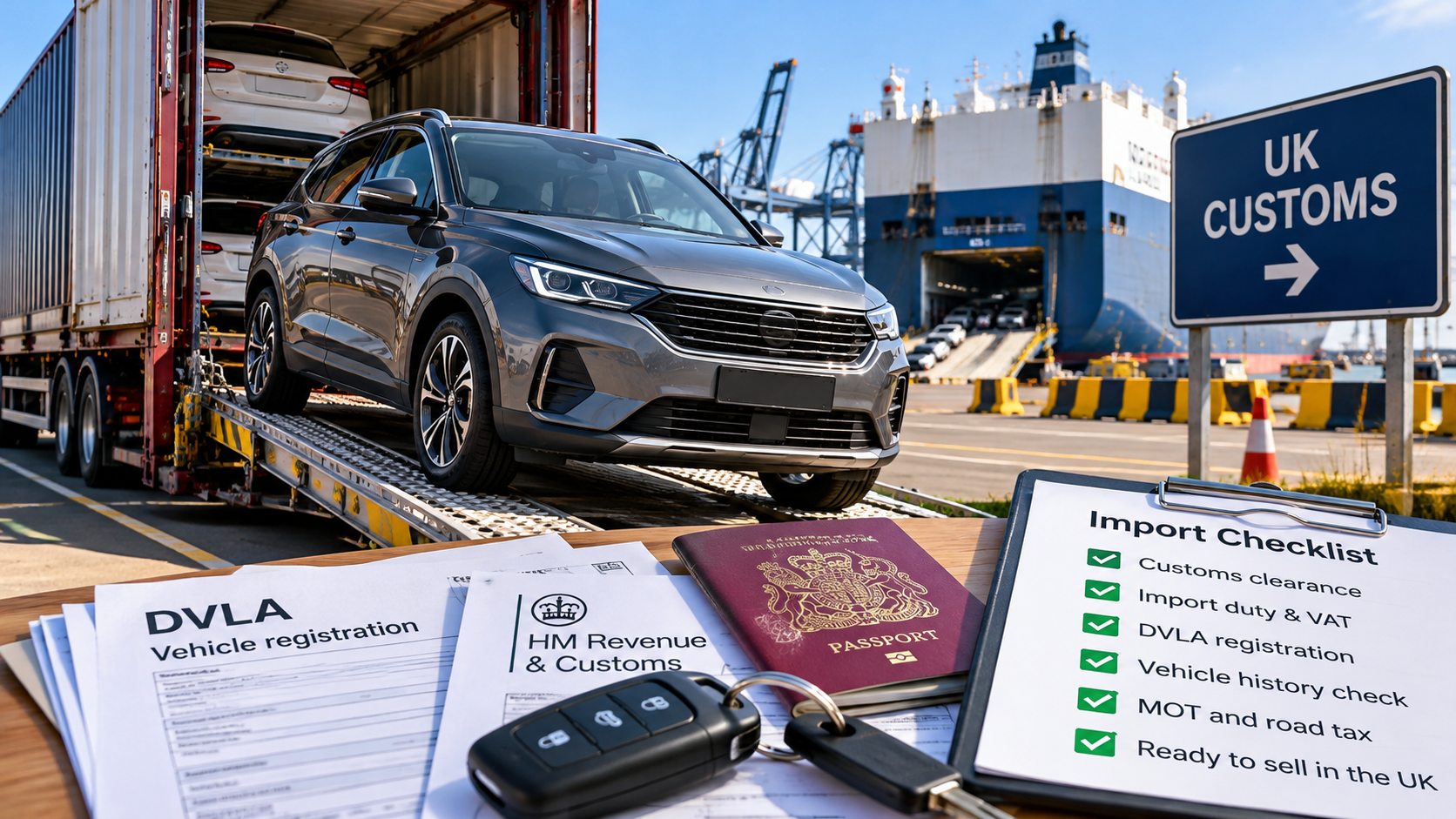
The GOV.UK importing vehicles guide explains the process. It says permanent imports normally require notification to HMRC, any applicable taxes, proof of approval and DVLA registration. Different provisions can apply to temporary imports and vehicles previously registered in the UK.
What counts as an imported car?
A vehicle originally built for and sold in another market is often called a 'grey import' when it enters the UK outside the manufacturer's usual UK distribution route. Common examples include right-hand-drive Japanese-market cars and specialist vehicles brought from the EU, United States or elsewhere.
A UK-supplied car exported and later brought back is a reimport. It may have a different documentary history from a first-time import. Buyers should not assume every imported car has the same approval, equipment or tax position.
Is an imported car automatically worth less?
No. Some imported cars attract specialist demand because of their condition, equipment or rarity; others appeal to a narrower audience and may require more explanation. Price depends on comparable UK sales, specification, mileage, service records, condition, parts availability and buyer confidence. Avoid blanket claims that imports are either always bargains or always worth more.
Check the DVLA registration before advertising
Start with the DVLA vehicle information service. Check the registration, make, year of manufacture, date of first registration, fuel type, engine details, tax and recorded MOT status. Compare those details with the vehicle identification number (VIN), registration document and any foreign export certificate.
The date of first UK registration may be much later than the car's manufacture or original overseas registration. Explain this clearly in your advert. A car manufactured in 2015 and registered in Britain in 2024 is not a 2024-model car simply because the UK plate was issued that year.
Have the correct V5C details
For a UK-registered import, check that your V5C accurately reflects the vehicle and keeper details. A V5C records the registered keeper; it is not, by itself, proof of ownership. If details are wrong, deal with the correction through DVLA before advertising or clearly explain the outstanding issue.
GOV.UK warns sellers not to publish pictures or copies of the log book or reveal its document reference number. You can show relevant details to a genuine buyer securely, but avoid uploading the whole V5C to an advert. See official guidance on selling a vehicle.
If the import is not registered yet
DVLA says permanent imports generally require a completed HMRC notification, payment of applicable duty and VAT, and proof of vehicle approval before registration. Used imported vehicles normally use form V55/5, while new vehicles normally use V55/4. The standard first-registration fee is currently £55, in addition to vehicle tax where due. Do not assume the same requirements apply to a previously UK-registered reimport.
Check the exact route on GOV.UK's imported-vehicle registration page. It states that a V5C can take up to six weeks to arrive after an application. If you are still waiting, do not promise an immediate UK-registered handover.
Build an import-document folder buyers can understand
The strongest evidence is consistent: VIN, dates, registration records and vehicle specification should agree across documents. Prepare a simple digital folder, keeping sensitive personal data private, and bring originals or appropriate copies for serious viewings.
Depending on the vehicle, relevant evidence may include the foreign registration or export certificate, purchase invoice, shipping or customs paperwork, NOVA confirmation, any vehicle approval or exemption evidence, DVLA registration and V5C, MOT history, service invoices, recalls and specialist inspection reports.
NOVA, customs duty and VAT
For many permanent imports, HMRC must be notified within 14 days of arrival. The Notification of Vehicle Arrivals process is usually called NOVA. The route varies according to whether the importer is VAT-registered, the country of origin and where the vehicle entered the UK. The seller should not claim that tax is 'all paid' without knowing the position.
Read HMRC's official guidance and keep confirmation of the outcome. A processed NOVA is part of the registration trail, not a replacement for a UK V5C.
Approval or exemption paperwork
Some imports require Individual Vehicle Approval or other proof that the vehicle meets relevant requirements. Cars over ten years old may be exempt from approval, but exemptions and documentation depend on the vehicle. The official vehicle-approval guidance should be checked for the exact case.
If you cannot produce the evidence or do not know whether an exemption applied, say so and seek clarification before describing the vehicle as fully compliant.
Check MOT, roadworthiness and UK-specific equipment
An MOT record is useful, but it does not replace a mechanical inspection or prove that every feature is suitable for UK use. Check the current status through the official MOT checker and inspect any advisories. Be especially careful when the vehicle has only recently arrived and has limited UK test history.
Speedometer, lights and visibility
Imported vehicles can differ in their instrument displays, lighting and other market-specific equipment. Depending on the original market and approval route, changes may have been needed before UK registration. Confirm that the speedometer and lighting comply with the requirements relevant to the car; do not rely on an informal conversion claim.
A speedometer originally marked in kilometres is not evidence of odometer fraud. However, the distance unit matters. Explain whether the displayed odometer is in miles or kilometres, whether any conversion was performed and how previous service records were recorded.
MOT history cannot show the whole overseas life
The UK MOT database usually begins when the vehicle enters the UK testing system. A missing UK MOT record from earlier years does not automatically mean the vehicle was unused or poorly maintained overseas. Equally, it does not establish that the car was well maintained. Distinguish unknown history from negative history.
The official vehicle roadworthiness guidance says a car must be safe to drive even if it has a current MOT. Check tyres, brakes, warning lights and any known mechanical concerns before allowing a road test.
Explain mileage honestly, especially Japanese imports
A Japanese-market car may have a kilometre-based odometer. The buyer needs to understand what the instrument currently displays, what older records show and whether the display has been altered. Converting distance for an advert is acceptable when accurately explained, but presenting kilometres as miles—or vice versa—can materially mislead a buyer.
For example, 80,000 kilometres is approximately 49,700 miles. A useful advert might say: 'Odometer shows 80,000 km (approximately 49,700 miles); overseas records in kilometres; no claim of UK miles.' If a specialist has converted the display, state when and provide the invoice or report.
Compare the mileage trail
Look at foreign auction sheets or service records where available, shipping paperwork, UK MOT mileages and subsequent invoices. A gap in records should be identified rather than filled with assumptions. If a mileage inconsistency cannot be resolved, disclose the uncertainty and allow the buyer to investigate.
Do not use an unverifiable foreign auction grade as proof of the vehicle's current condition. Condition may have changed since the overseas inspection.
Collect service history and provenance evidence
Imported vehicles may not have a familiar UK stamped service book. Evidence might be in another language, stored electronically or held by an overseas workshop. Preserve the original documents and obtain an accurate translation where it would help a buyer understand major maintenance.
Useful information includes oil and filter changes, timing-belt or timing-chain work where relevant, transmission servicing, accident repairs, corrosion treatment, tyre replacement and any significant recalls. Separate documentary evidence from statements supplied by a previous seller.
What about vehicle-history checks?
A UK vehicle-history check can help identify certain UK-recorded issues, but its coverage of events before import may be limited. Do not advertise a clean UK check as a guarantee of no overseas accident, finance or theft history. For unusual vehicles, a specialist inspection and independent overseas provenance evidence can be especially valuable.
CarMazium's vehicle history check is optional on the free auction and Basic Retail routes; its current pricing page describes which retail packages include a report. Explain the scope of any report accurately.
Insurance, parts and ownership costs affect demand
Buyers may ask whether the model is recognised by mainstream UK insurers, whether replacement parts are readily available and whether servicing requires specialist knowledge. These are reasonable ownership questions, not reasons to dismiss an import automatically.
Before listing, gather the correct engine code, chassis or VIN details, tyre sizes and any non-standard equipment. Obtain a genuine insurance quotation for the specific vehicle if you want to understand its likely market. Avoid promising buyers that their insurance will be cheap: premiums depend on the driver and insurer.
Check Clean Air Zone and ULEZ status
Emissions classification can affect buyers in cities with charging zones. Do not assume a vehicle complies simply because it is petrol, diesel, hybrid or a particular age. Imported vehicles may have incomplete or differently recorded emissions information.
For locations outside London, use the government's Clean Air Zone checker. Birmingham and other charging zones apply different vehicle classes and conditions. For London, consult the official Transport for London vehicle checker and evidence process. Advertise compliance only after checking the exact registration and, where needed, obtaining supporting emissions documentation.
Consider corrosion and underbody condition
Some imports come from climates and road-maintenance environments different from the UK. Buyers may ask about underbody corrosion, rustproofing or winter road-salt exposure. An independent inspection is more persuasive than a broad claim that imports 'never rust'. Photograph the underside where safe and keep any specialist inspection or treatment invoices.
How to price an imported car for the UK market
Do not price the vehicle using only the cost of importing it or a foreign-market asking price. Import duty, shipping and conversion costs are real expenses, but they do not guarantee an equal increase in resale value.
Start with genuinely comparable UK listings and completed transactions where available. Match the model generation, engine, transmission, condition, equipment, mileage and whether the vehicle is already UK-registered. A rare specification may command a premium to an enthusiast, while an unfamiliar one may require a longer selling period.
Compare the right cars
A Japanese-market version may have different trim, engine mapping, safety equipment or features from a UK-supplied car with a similar badge. Explain the exact specification and avoid claiming it is identical to a UK model unless you can verify that.
For a car with little UK sales history, seek quotations from specialist traders as well as general dealers. The spread of offers can reveal whether the vehicle appeals mainly to a niche market.
Price the documentation gap
A UK-registered import with a clear V5C, mileage evidence, invoices and sensible inspection results may be easier to sell than an otherwise similar vehicle with unresolved registration or provenance questions. That difference is not a universal percentage discount. Use real buyer feedback and costs rather than inventing a figure.
Write an advert that answers import-specific questions
Use a clear opening line: 'Imported from Japan in 2022; UK-registered; V5C present; odometer in kilometres; service and import records available.' Adapt every detail to the vehicle you actually own.
Add the UK registration, correct year of manufacture, original market, import date if known, mileage unit, fuel and transmission, MOT position, number of keys, known modifications and defects. Include clear photographs of all sides, interior, wheels, dashboard, relevant labels and any unusual equipment.
For photography advice, see CarMazium's guide to taking car photos that get enquiries. Avoid publishing unredacted identity documents, the full V5C or personal details from old invoices.
Sell by auction or retail on CarMazium
On CarMazium's selling page, you can choose between a dealer auction and a retail listing. A specialist import may appeal to certain traders, while a retail listing may allow more time to find an enthusiast who understands the model.
The current CarMazium pricing lists a £0 seller auction listing fee and Basic Retail at £1 one-off. Auction bidding is restricted to verified motor traders; the £100 auction seller reward is conditional on successful completion and approved handover. Retail buyers pay no CarMazium buyer fee. The vehicle purchase money goes directly between buyer and seller, not through CarMazium.
Describe any import-specific uncertainty accurately. If a registration lookup does not recognise a foreign variant, use the correct details from the V5C and supporting documents rather than selecting an incorrect UK model just to proceed.
Handover and DVLA notification
Before releasing the vehicle, confirm that the agreed funds have genuinely arrived in your account. A screenshot or message claiming payment is not enough. Use a dated sale receipt identifying the vehicle, buyer, seller, agreed price and any known disclosed issues.
For a UK-registered car staying in the UK, follow DVLA's selling-vehicle instructions: notify DVLA of the change of keeper and provide the correct new-keeper slip. The buyer must arrange their own tax and insurance before driving. For an unregistered import, do not substitute an ordinary UK change-of-keeper process for outstanding import registration steps.
Frequently asked questions
Can I sell a Japanese import in the UK?
Yes, provided you describe its registration, condition, documents and mileage accurately. If it is not UK-registered, explain the remaining process and arrange lawful transport rather than promising immediate road use.
Does an imported car need a UK V5C?
A permanently imported vehicle intended for normal UK road use must go through the applicable registration process. A UK-registered vehicle should have the correct DVLA record and V5C; check the rules for unregistered imports and reimports separately.
Is a Japanese auction sheet enough to prove history?
No. It can be useful supporting evidence if authentic and correctly interpreted, but it is not a complete lifetime service, accident or mileage guarantee. Consider independent checks and a physical inspection.
Can I advertise kilometres as miles?
You can state an approximate conversion clearly, but never relabel a kilometre reading as though the odometer displays miles. Explain the unit and any conversion history.
Does a clean UK vehicle history report cover the car's overseas history?
Not necessarily. UK history checks may not include all pre-import events. Ask the provider about its coverage and supplement it with available overseas documents.
Will imported cars pass Clean Air Zone checks?
It depends on the exact vehicle, emissions evidence and local scheme. Use the official checker for the registration and avoid making an unsupported compliance claim.
Final checklist before you list
Confirm the VIN and DVLA record, gather V5C and import documents, establish mileage units, check MOT and roadworthiness, organise maintenance evidence, verify emissions claims, photograph the vehicle accurately and research comparable UK offers. Then choose the selling route that suits your vehicle and timetable.
Ready to sell? Start a CarMazium listing and give buyers the clearest possible account of your imported car's history and condition.
Relevant CarMazium guides and next steps
Continue with the guides and tools most relevant to this article.
Sell your car your way
Ready to turn your research into a real sale?
List in the CarMazium dealer auction for £0, or advertise retail from £1. Qualifying successful auction sales can receive a £100 seller incentive.
Keep reading
Related automotive guides
Selling a Car With a Faulty Turbocharger in the UK: MOT, Repairs & Value (2026)
Selling a car with a faulty turbocharger? Learn UK MOT rules, diagnosis, repair-versus-sale decisions, honest pricing and safe handover.
Selling a Car With an Overheating Engine in the UK: MOT, Repairs & Value (2026)
Selling a car with an overheating engine? Understand UK MOT rules, coolant faults, repair decisions, honest pricing and safe collection before you sell.
Selling a Car With an Exhaust Leak in the UK: MOT, Repairs & Value (2026)
Selling a car with an exhaust leak? Understand UK MOT rules, fumes and safety risks, repair decisions, honest pricing and secure collection before you sell.
From the marketplace