
How to Sell a Flood-Damaged Car in the UK: Safety, Disclosure & Value (2026)
Flood or water damage can hide electrical, mechanical and safety risks. Learn how UK sellers can assess, document, price and disclose a flood-damaged car responsibly.
In this article
Introduction
Floodwater can turn an apparently tidy car into a complicated sale. Water may enter the cabin, wiring, control modules, air-intake system or safety equipment, and some problems do not become obvious until months later. That does not mean every wet car must be scrapped. It means sellers should establish what happened, whether the vehicle is safe, which repairs have been completed and what a buyer is actually being offered.
This UK guide explains the difference between a damp interior and serious flood damage, how insurance write-off categories work, what documents to gather, how to price the vehicle and what to disclose before an auction or retail sale. Private sellers and motor traders have different legal obligations. This is general information, not a technical assessment of an individual car.
What counts as flood or water damage?
Water can enter a car after deep standing water, a flooded street, a river or coastal flood, or through damaged seals. A leaking sunroof may wet the cabin without the vehicle ever being submerged. These scenarios are not equivalent. Ask where the water reached, how long it remained, whether the engine was running, whether it was fresh or salt water and which systems were exposed. Describe the actual event rather than calling serious flooding "a little water ingress".
Why water level and exposure time matter
Water reaching the floor can affect connectors, seat-mounted modules and wiring. Higher levels can reach airbags, the instrument panel, engine intake or high-voltage equipment. Prolonged exposure may increase corrosion and contamination. There is no universal safe waterline: the vehicle's design and inspection findings matter.
First priority: is the vehicle safe to move?
Do not assume a flooded vehicle is safe merely because it starts. Water may compromise brakes, electronics, restraint systems and mechanical components. An engine that stalled in deep water may have ingested water; repeated starting attempts can worsen damage. After substantial submersion, arrange professional recovery and inspection rather than driving to a viewing.
For electric or hybrid cars with suspected battery exposure, do not touch high-voltage cables or attempt a DIY restart. Ask a suitably qualified professional about isolation, recovery and inspection. Do not advertise a vehicle as roadworthy without an adequate basis.
How water damage affects a car over time
Electrical connectors may corrode; sensors can behave intermittently; motors or control modules may fail later. Carpets and insulation retain moisture, causing odours and mould. Mechanical components and fluids may require specialist attention. Safety-related faults may not appear during a short test drive. A dashboard with no warning lights is useful information, not proof that every system is sound. A written assessment from a competent specialist is more persuasive than saying the car "drives perfectly".
Flood damage is not the same as an insurance write-off
Some flooded cars are written off by insurers; others are repaired without a total-loss settlement. The insurance category follows the insurer's assessment and applicable salvage rules, not simply the presence of water.
The GOV.UK write-off guidance explains the categories. Category A vehicles cannot be repaired and must be crushed. Category B vehicles cannot return to the road; the body shell must be crushed although certain parts can be salvaged. Category S covers repairable structural damage; Category N covers repairable non-structural damage. S and N vehicles must be repaired to a roadworthy condition before road use.
Does Category N mean the damage was minor?
No. Non-structural does not mean cosmetic or safe. Significant electrical or safety-related faults can exist without structural damage. A flood incident also does not automatically put a car in Category N. Confirm its actual insurance history.
What if the insurer has not categorised the car?
Do not invent a category. Explain whether a claim was made, whether the insurer assessed the vehicle and what written outcome was provided. Water damage can exist without an insurance marker; a clean history check does not prove the absence of flooding.
What must you do after an insurance write-off?
GOV.UK says insurers tell owners whether a car has been written off and what they will pay. Owners must tell DVLA about a write-off; failing to do so can result in a fine. The paperwork differs by category. Owners retaining a Category S vehicle have particular V5C and replacement-log-book steps; Category N has different arrangements.
Follow the official written-off vehicle instructions and retain category confirmation. Never advertise Category A or B vehicles as ordinary road-going cars. For Category S or N, keep settlement, salvage and repair records. An insurance payout is not proof of a competent repair.
Should you repair before selling?
Obtain a written diagnosis before authorising expensive work. Ask the garage which systems need attention, what testing is possible and which uncertainties remain. Whether repairs make financial sense depends on severity, estimates, vehicle value and safety.
A seller may consider a clearly disclosed repair project for an appropriate buyer instead of paying for every repair. But "spares or repair" is not a magic exemption from roadworthiness, misrepresentation or platform rules. If the car cannot be safely driven, explain that clearly and require suitable collection.
Which inspection records help buyers?
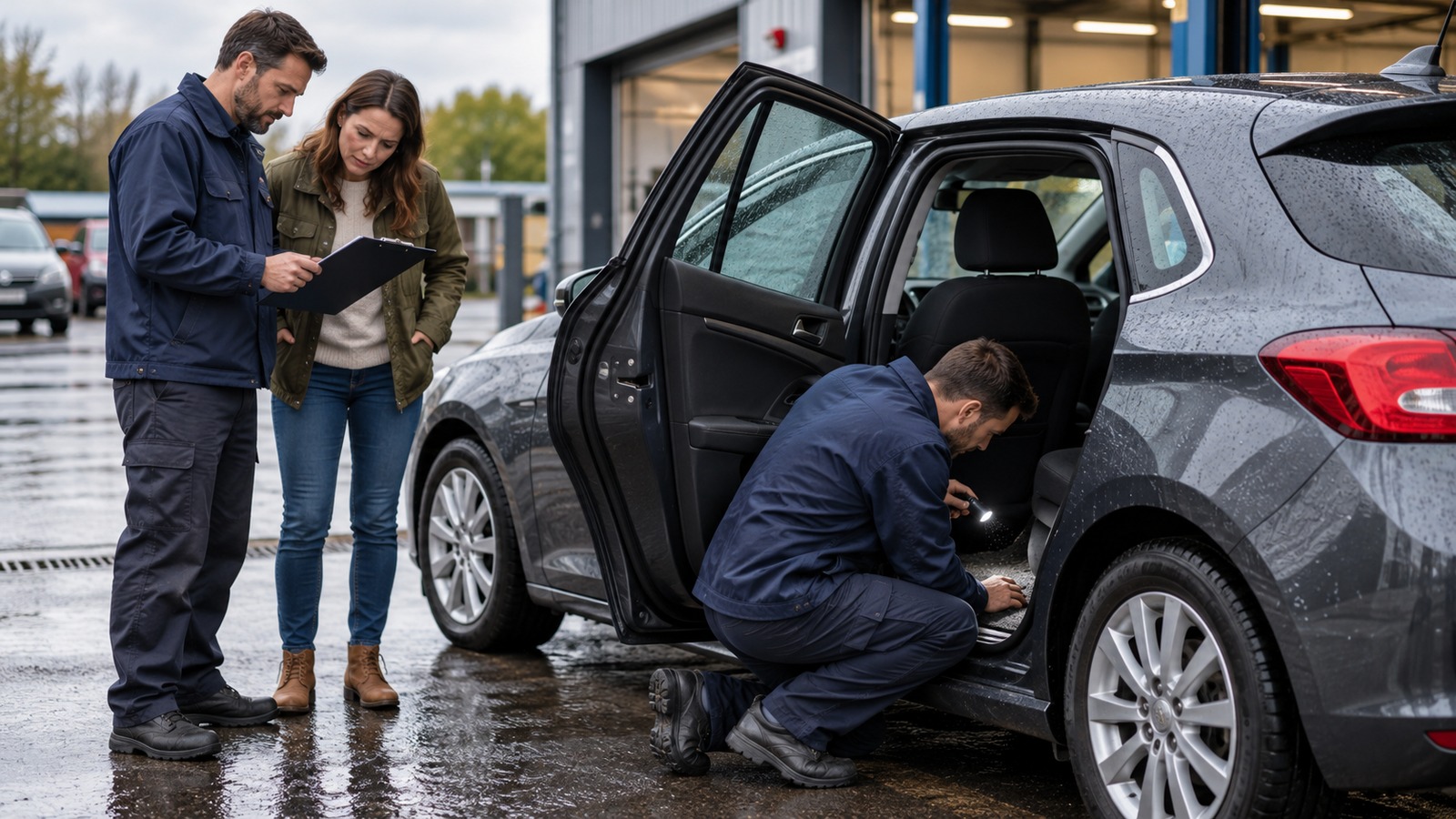
Keep incident photographs, insurer correspondence, a specialist report, workshop job cards, invoices, diagnostic results, replacement-part records and follow-up checks. Record the event date and approximate water level where known. Ask repairers to specify work actually performed rather than issuing vague statements.
Keep original evidence and identify anything that was not inspected. A report with limitations is more credible than an unsupported guarantee. For the wider importance of records, see how service history affects car value.
Does a valid MOT prove flood damage was fixed?
No. An MOT checks prescribed roadworthiness items at the time of the test, not historical water ingress or long-term electronic reliability. Review the official MOT history, but do not treat it as a specialist flood-damage inspection.
Warning signs buyers may investigate
Buyers may check for unusual smells, condensation, water staining, silt, corrosion on seat frames, mismatched trim, intermittent electrical faults or unexplained replacement modules. No single sign proves a car was flooded, and the absence of these signs does not prove it was not.
Do not disguise odours or stains to hide known damage. Cleaning can improve presentation after appropriate repairs, but it cannot replace disclosure. See whether valeting before selling is worthwhile.
How does flood damage affect resale value?
There is no fixed percentage reduction for every flooded car. Value depends on age, mileage, water depth, exposure time, insurance category, repair quality, supporting evidence and remaining uncertainty. Buyers may deduct inspection, recovery and repair costs and a further allowance for risk.
Compare genuinely similar vehicles and distinguish a verified roadworthy repair from an unassessed project. Avoid taking the normal retail price and applying an invented blanket discount. Read how to price a used car in the UK for a broader framework.
A practical pricing example
Two hatchbacks can have the same age and mileage but very different histories. One may have a documented minor leak, professional repair and no unresolved faults. The other may have been submerged and have intermittent electrical problems without inspection. The second carries much greater uncertainty. Price the actual condition and evidence, not the registration year alone.
What must a private seller disclose?
Private sellers should answer accurately and must not misrepresent the car. If you know it was flooded, explain the event, completed repairs, remaining faults and driving restrictions. Do not wait for the buyer to discover the damage.
Private sales usually provide fewer remedies than trader-to-consumer sales, but false descriptions remain problematic. Devon and Somerset Trading Standards explains roadworthiness and accurate-description principles. Keep the advert, written answers and receipt consistent.
What are a motor trader's obligations?
Traders selling to consumers have additional obligations. The vehicle must meet applicable consumer-law standards, including being as described, of satisfactory quality and fit for purpose, assessed in context. A dealer cannot simply write "sold as seen" to remove statutory rights. See Trading Standards guidance on used motor vehicles.
Dealers should assess known water damage at stock intake, retain inspection records, disclose material history and avoid presenting an unsafe car as roadworthy. Trade-to-trade sales have a different framework, but clear disclosure remains important. Obtain specialist advice when legality or safety is uncertain.
How to write an honest flood-damage advert
Use factual wording. An appropriate example, only where true, is: "Water entered the passenger footwell in August 2026. Inspected by an independent garage on [date]. Drying and replacement of [parts] completed; invoices available. Independent inspection welcome."
For unresolved damage, state: "Known flood-damaged vehicle. Electrical faults remain. Not advertised as roadworthy. Recovery required; no test drives." Never claim a car is fault-free or professionally repaired without evidence. State any recorded insurance category accurately.
What photos should the listing include?
Show exterior angles, cabin, carpets, boot, dashboard and known defects. Where useful, include dated incident and post-repair photographs, clearly distinguished. A clean interior photo does not prove that hidden wiring is sound.
Do not publish sensitive V5C reference numbers or private personal documents. Provide appropriately redacted evidence to serious buyers. For better presentation, read how to take car photos that attract enquiries.
CarMazium Auction or Retail: which route?
The route depends on the vehicle's condition, safety, eligibility and likely buyer. CarMazium offers free seller auctions with bidding restricted to verified motor traders, plus retail listings starting at £1. Trade buyers may be familiar with repair costs; retail buyers may want detailed reassurance and independent inspection.
Neither route makes an unsafe car roadworthy. A seriously damaged vehicle may need repair, specialist sale or disposal rather than an ordinary consumer advert. Review current listing eligibility and make full disclosures before using the CarMazium Sell page.
Current CarMazium fees and payments
The CarMazium pricing page lists a £0 auction seller fee and £1 one-off Basic retail listing. Standard retail is £10 and Premium £25, with additional features. The successful verified trader currently pays a £125 auction buyer fee; retail buyers pay no CarMazium buyer fee.
A qualifying auction sale may earn a £100 seller incentive after approved handover evidence, but it is not automatic and does not apply to ordinary retail sales. The buyer pays the vehicle price directly to the seller; CarMazium does not hold those funds. a vehicle history report is optional for auction and Basic retail, and included in higher retail packages. A history report cannot replace a flood inspection.
Safe viewings, collection and payment
Explain any driving restrictions before buyers travel. Never arrange a test drive of a vehicle known to be unsafe or unroadworthy. If recovery is needed, agree who will arrange and pay for it. For a lawful road test of a safe vehicle, check the driver's licence and insurance.
Record the agreed price, condition disclosures and collection terms. Verify cleared funds in your own bank before releasing the car. A payment screenshot is not proof of receipt. Keep a dated receipt that records the known water-damage history.
Completing the DVLA transfer
The seller must tell DVLA when the vehicle changes keeper. The GOV.UK selling guidance explains UK transfers and the V5C new-keeper slip. Do not publish the V5C document reference number. Vehicle tax does not transfer to the buyer.
If the vehicle was written off, complete the separate insurer and DVLA requirements. An ordinary keeper transfer does not resolve an outstanding write-off notification. If scrapping, follow the authorised treatment and DVLA process instead of treating it as a normal road-going sale.
A practical flood-damage selling checklist
Record the flood event and avoid unsafe starts or driving. Check whether an insurance claim or category applies and complete notifications. Obtain a competent inspection, then decide whether to repair, sell a properly disclosed project where lawful, or scrap. Collect photos, invoices, reports and category evidence.
Set a price based on condition and uncertainty. Describe the damage and unresolved faults accurately. Agree safe viewing and collection, verify payment and complete the DVLA transfer. This approach protects buyers and reduces avoidable disputes.
Frequently asked questions
Can I legally sell a flood-damaged car in the UK?
It depends on condition, write-off category, description and roadworthiness. Category A and B vehicles cannot return to the road. Other vehicles require accurate disclosure and appropriate safety checks. Seek advice if legality is uncertain.
Does flood damage automatically mean Category N?
No. The insurer assesses the vehicle under salvage rules. Category N means non-structural damage, not necessarily minor damage.
Will an MOT show previous flooding?
Not reliably. An MOT is not a complete historical water-damage inspection. Seek specialist evidence where appropriate.
Must I tell a buyer the car was flooded?
Do not conceal or misrepresent known material damage. Explain the event, repairs and unresolved faults. Traders have additional consumer-law obligations.
Can I use a CarMazium auction for a flooded car?
Only if eligible under current platform rules and accurately described. Only verified motor traders bid. Never present an unsafe vehicle as roadworthy.
Is a vehicle history check proof that a car has never flooded?
No. Some water damage may have no recorded insurance write-off. Combine history checks with suitable physical inspection.
Final advice and official sources
A responsible sale starts with evidence: what happened, which systems were affected, who inspected the car, what repairs were completed and whether it is safe for the proposed use. Neither a clean interior nor an MOT guarantees the absence of hidden problems. When safety is uncertain, professional inspection and appropriate recovery matter more than a quick sale.
Check GOV.UK write-off categories, GOV.UK selling a vehicle, Trading Standards used-car guidance and CarMazium terms. Reviewed 15 October 2026. Rules, insurance decisions and platform pricing can change.
Relevant CarMazium guides and next steps
Continue with the guides and tools most relevant to this article.
Sell your car your way
Ready to turn your research into a real sale?
List in the CarMazium dealer auction for £0, or advertise retail from £1. Qualifying successful auction sales can receive a £100 seller incentive.
Keep reading
Related automotive guides
How to Sell a Left-Hand-Drive Car in the UK: Pricing, Paperwork & Buyer Guide 2026
Selling a left-hand-drive car in the UK? Check registration, MOT, mileage, lighting, insurance, paperwork and realistic pricing before advertising.
Does Timing-Belt or Timing-Chain History Affect Car Value? UK Guide 2026
Timing-belt and timing-chain history can influence buyer confidence and offers. Learn what proof matters, when to repair and how to sell accurately in the UK.
How Gearbox Problems Affect Used-Car Value in the UK: 2026 Guide
Understand how manual and automatic gearbox faults affect UK used-car value, when to repair, how to price accurately and how to sell with honest disclosure.
From the marketplace