
Does a New Battery Increase a Used Car's Value? UK Guide 2026
A new battery can improve reliability and buyer confidence, but does it raise resale value? Learn when replacement makes sense before selling a car in the UK.
In this article
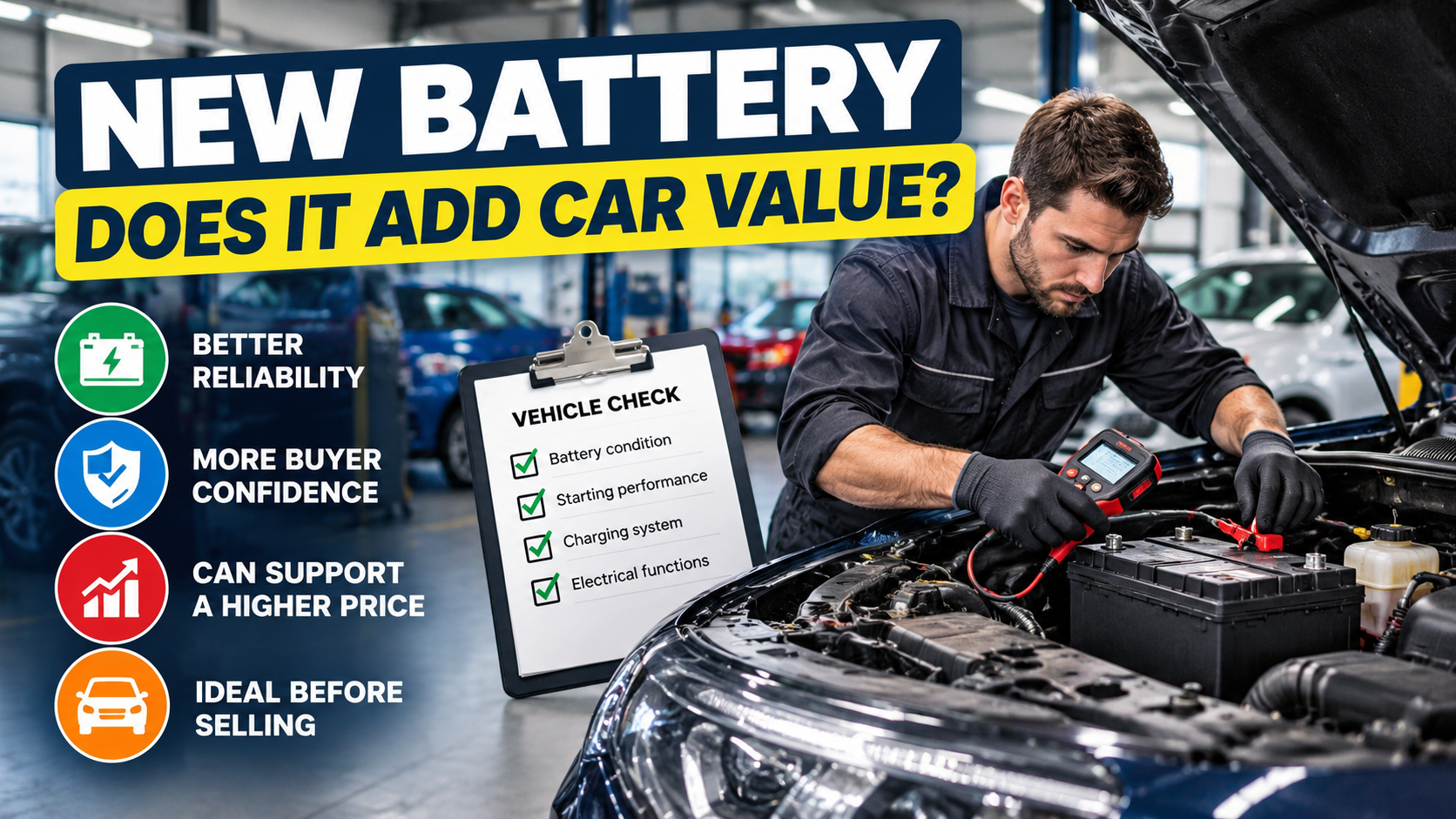
A new 12-volt starter battery can make a used car easier to start and more reassuring to inspect, but it does not usually add its full purchase price to the vehicle's resale value. In most cases, replacing a weak battery protects the car's existing value rather than creating a large premium.
For UK sellers, the useful question is not simply “will a new battery increase the price?” It is whether the current battery creates a reliability concern that could reduce offers, interrupt a viewing or make the vehicle appear poorly maintained.
This guide explains when replacement makes commercial sense, what evidence buyers value, how battery condition relates to the MOT, and how to present a recent replacement accurately.
Does a new car battery increase resale value?
Usually, only indirectly. A healthy battery helps the car start normally and allows its electrical systems to operate as expected. That removes an obvious objection for a buyer. If the old battery was failing, replacing it can prevent a buyer from discounting the vehicle for immediate repair cost, inconvenience and uncertainty.
That is different from saying a £200 battery automatically makes a car worth £200 more. Buyers compare the complete vehicle: age, mileage, specification, service history, cosmetic and mechanical condition, MOT history, tyres, keys and market demand all matter.
A new battery is therefore best viewed as a maintenance item. It can preserve confidence and saleability, particularly where the existing battery is demonstrably weak.
When battery condition starts to affect buyer confidence
A buyer may become cautious if the engine cranks slowly, the vehicle needs a jump-start, electrical systems behave unpredictably or warning lights appear. These symptoms do not prove the battery itself is faulty, because charging-system, starter, wiring and other electrical faults can produce similar behaviour.
RAC guidance lists slow starting, dim or flickering lights, electrical problems and a battery warning light among signs that merit investigation. It also notes that the dashboard battery light can indicate a charging problem rather than simply a failed battery.
That distinction is important when selling. Do not describe an alternator or electrical-system problem as “just needs a battery” unless testing supports that conclusion.
How long does a typical 12-volt car battery last?
Battery life varies with battery type, vehicle use, climate, maintenance and charging conditions. RAC guidance says conventional car batteries commonly last around three to five years, although individual batteries can last for shorter or longer periods.
Frequent short journeys can be difficult for a battery because the charging system may not have enough time to replace the energy used during starting. Long periods of inactivity can also leave a battery discharged. Temperature extremes, terminal corrosion, electrical drain and charging faults can shorten useful life.
Age alone should not decide whether you replace a battery before sale. Test its condition and consider the symptoms.
Flat battery or failed battery: know the difference
A battery can be discharged without being permanently defective. A car left unused, a light left on or repeated short journeys can leave an otherwise serviceable battery flat.
A proper battery test can help distinguish a low state of charge from deterioration. RAC guidance explains that professional testers can identify a battery that needs charging, one that is deteriorating and one that needs replacement. Testing can also point towards charging or starter-system issues.
For a seller, this is valuable evidence. If the battery is healthy after charging and the underlying cause was temporary, replacement may achieve little. If testing shows poor health, replacement before advertising can remove a predictable problem.
Should you replace the battery before selling?
Replace it when failure is confirmed
If a competent test shows the battery is failing, replacement can be sensible. A car that starts reliably is easier to demonstrate, photograph, move and hand over. A buyer is less likely to build an immediate battery expense and breakdown risk into their offer.
Keep the invoice and, where supplied, the battery test result and warranty details.
Investigate repeated flat batteries first
A brand-new battery will not solve every repeated no-start problem. Parasitic drain, an alternator fault, poor connections or another electrical issue can flatten a replacement battery too.
If the vehicle repeatedly needs a jump-start, ask a garage to investigate the charging and electrical system before fitting parts by guesswork.
Consider the economics on low-value vehicles
On an inexpensive older car, the cost of a premium battery can be meaningful relative to the vehicle's value. Compare the fitted replacement cost with genuine offers and the effect the fault has on saleability.
A correctly specified, dependable battery is normally more useful to the sale than buying the most expensive option purely to advertise it as an upgrade.
How much does battery replacement cost in the UK?
There is no single price because battery technology, capacity, vehicle access and programming requirements vary.
As a current reference point, RAC's battery-replacement page says standard lead-acid batteries can commonly cost about £50–£150 and AGM batteries about £100–£250 before considering the exact service and vehicle. RAC also reports an average £214 replacement price from its Mobile Mechanics data for 1 January to 30 March 2026.
Those figures are service-specific examples, not a universal UK market price. Obtain a current quote for the exact registration and battery specification before making a repair-versus-sell decision.
Start-stop cars, AGM and EFB batteries
Modern vehicles with stop-start and energy-management systems may require a specific battery technology such as AGM or EFB. Do not fit a cheaper conventional battery simply because its dimensions appear similar.
Use the vehicle handbook, manufacturer specification or a competent battery fitter to identify the correct type. Some vehicles require the replacement battery to be registered or coded to the battery-management system.
For a buyer, an invoice showing the correct battery specification and professional fitting can be more reassuring than a vague claim that the car has a “brand-new battery”.
What does the UK MOT check about the battery?
The MOT does include a battery inspection, but it is not a comprehensive battery-health or remaining-life test.
The current DVSA MOT inspection manual requires the battery to be inspected. An insecure battery can receive a minor or major defect depending on severity, and a leaking battery is a major defect. The inspection does not tell a buyer how many months of useful starting capacity remain.
This matters when advertising. A recent MOT pass should not be presented as proof that a starter battery is healthy.
GOV.UK also makes the broader point that a vehicle can be unsafe even when it has a current MOT certificate. Owners remain responsible for roadworthiness and should follow the vehicle handbook's maintenance guidance.
Does a battery warning light mean the battery needs replacing?
Not necessarily. The battery-shaped warning commonly relates to the charging system. A failing alternator, belt, wiring or connection can trigger a warning even when the battery itself is not the root cause.
If the light remains illuminated while the engine is running, arrange diagnosis rather than immediately ordering a battery. Selling a car after fitting a new battery while an unresolved charging fault remains can create a poor handover and a dispute.
Describe the confirmed diagnosis, not an assumption.
Will a new battery improve a dealer offer?
It can improve the condition presented to the dealer, but there is no guaranteed pound-for-pound increase.
A motor trader prices the whole vehicle and may consider preparation costs, margin, demand and risk. If the car arrives with a failed battery, the trader has an immediate cost and cannot easily verify starting behaviour or some electrical functions. That can influence a bid.
If a new battery is correctly fitted and documented, it removes that specific uncertainty. Whether the offer rises enough to recover the replacement cost depends on the car and the market.
What evidence should you keep?
Keep the purchase or fitting invoice, the battery specification, installation date, warranty information and any diagnostic report.
If the battery was replaced because of a specific fault, keep evidence that the charging system was checked where appropriate. A receipt showing a recent battery plus a report showing normal charging gives a buyer more useful context than the phrase “new battery” alone.
Do not claim a transferable warranty unless its terms actually allow transfer to the new keeper.
How to mention a new battery in your advert
Keep the wording factual. For example:
“12V battery replaced September 2026; invoice included.”
If a garage also tested the charging system, you can state that accurately:
“New AGM battery fitted and charging system tested by independent garage; invoice available.”
Avoid claims such as “electrics perfect” or “will never need a battery” because a replacement battery cannot guarantee the future condition of the whole electrical system.
CarMazium's guide to writing a trustworthy car advert explains how maintenance evidence can sit alongside the rest of the vehicle description.
Should you replace a battery just because it is old?
Not automatically. An older battery that tests healthy and starts the vehicle reliably may not need pre-sale replacement. Conversely, a younger battery can fail because of damage, deep discharge, charging faults or manufacturing issues.
Test rather than guess. If the battery is approaching the age where failure becomes more common, you can disclose its age if known and allow the buyer to inspect it.
Replacing a healthy battery solely to add “new battery” to the advert is unlikely to create a meaningful profit.
Battery condition on cars that have been stored
Cars held for sale, second cars and seasonal vehicles can suffer from low charge because they are used infrequently. A battery maintainer may be appropriate where the vehicle and battery manufacturer allow it.
Before advertising a stored car, make sure it starts normally on more than one occasion. If you have to jump-start it immediately before every viewing, investigate the cause rather than hiding the symptom.
A buyer who sees jump leads attached at a viewing may reasonably assume there is unresolved electrical risk.
Hybrid and electric cars: do not confuse the 12V battery with the traction battery
Hybrid and battery-electric vehicles normally have a small low-voltage battery as well as a high-voltage propulsion battery. Replacing the 12V battery does not mean the expensive traction battery has been replaced or its state of health has improved.
Make the distinction explicit in an advert. “New 12V auxiliary battery” is clearer than “new EV battery”.
The value implications of high-voltage battery health are much larger and require separate evidence. CarMazium's electric-car selling guide covers battery health, range and value for EV sellers.
How battery condition fits into overall used-car value
A battery is one part of the vehicle's preparation picture. A recent replacement cannot compensate for major mechanical faults, poor tyres, serious body damage or missing history.
Start with a realistic valuation based on registration, mileage, specification, condition and current demand. Then assess whether immediate maintenance items are likely to reduce buyer confidence.
CarMazium's used-car pricing guide explains why retail asking prices and trade values are different. Do not add the cost of every recent service item directly onto the asking price.
Selling through CarMazium after replacing the battery
CarMazium currently gives sellers two principal routes.
The dealer auction costs sellers £0 to list, runs for 24 hours and allows verified motor traders to bid. Eligible successful auction sales can qualify for a £100 seller reward after approved handover.
Retail starts with the £1 Basic one-off listing. Current Standard and Premium packages add other features, and retail buyers pay no CarMazium buyer fee. Vehicle purchase money is paid directly from buyer to seller; CarMazium does not hold the vehicle sale price.
Check current CarMazium pricing before listing because package details can change.
Whether you choose auction or retail, disclose any unresolved starting or electrical problem. A new battery is useful evidence only when it genuinely resolves the issue it was fitted to address.
Seller checklist before spending money on a battery
First, confirm the symptom. A slow crank, repeated flat battery or charging warning deserves testing.
Second, obtain a battery-health and charging-system check if the cause is uncertain.
Third, identify the correct battery specification for the vehicle.
Fourth, compare the fitted cost with the likely effect on saleability rather than assuming the full cost will be added to the car's price.
Fifth, retain the invoice, test results and warranty details.
Finally, test the vehicle before the viewing and disclose any problem that remains.
Frequently asked questions
Does a new battery add £200 to a car's value?
Not automatically. A new battery can remove a maintenance concern, but buyers value the entire vehicle. The benefit is often avoiding a discount for a weak or failed battery rather than adding the replacement cost pound-for-pound.
Should I replace a three-year-old battery before selling?
Age alone is not enough. Test the battery and consider its starting performance, use pattern and condition. Many batteries last roughly three to five years, but actual life varies.
Can a car pass an MOT with an old battery?
Age is not itself an MOT failure. The MOT checks relevant battery security and leakage, among other electrical items. It does not provide a full battery-capacity test.
Does the battery warning light mean I need a new battery?
No. It can indicate a charging-system problem. Have the system diagnosed before replacing parts.
Is a jump-started car okay to sell?
A single flat battery can have a simple cause, but repeated jump-starting should be investigated. Tell the buyer about any known unresolved fault and do not disguise a recurring starting problem.
Should I fit the cheapest battery before selling?
Fit the correct specification for the vehicle. Cars with stop-start or battery-management systems may require specific technology and procedures. An unsuitable battery can create new problems.
Does a new 12V battery improve an EV's traction-battery health?
No. They are different systems. State clearly which battery has been replaced.
The bottom line
A new battery rarely creates a large standalone increase in used-car value. Its strongest benefit is removing an immediate reliability concern and helping the vehicle present as properly maintained.
Test first, diagnose repeated discharge or warning lights, fit the correct specification when replacement is justified and keep the paperwork. Then price the car based on its overall condition and current market rather than simply adding the battery invoice to the asking price.
When you are ready to sell, start your CarMazium listing and choose between the free verified-trader auction or a retail listing from £1.
Sell your car your way
Ready to turn your research into a real sale?
List in the CarMazium dealer auction for £0, or advertise retail from £1. Qualifying successful auction sales can receive a £100 seller incentive.
Keep reading
Related automotive guides

Does Timing-Belt or Timing-Chain History Affect Car Value? UK Guide 2026
Timing-belt and timing-chain history can influence buyer confidence and offers. Learn what proof matters, when to repair and how to sell accurately in the UK.
How Gearbox Problems Affect Used-Car Value in the UK: 2026 Guide
Understand how manual and automatic gearbox faults affect UK used-car value, when to repair, how to price accurately and how to sell with honest disclosure.
Does a Worn Clutch Reduce a Car's Value? UK Guide 2026
A worn clutch can reduce resale value, but should you repair it before selling? Learn how UK buyers and dealers assess clutch wear, repair risk and pricing.
From the marketplace