

AdBlue Warning Problems: What UK Used-Car Sellers Should Know
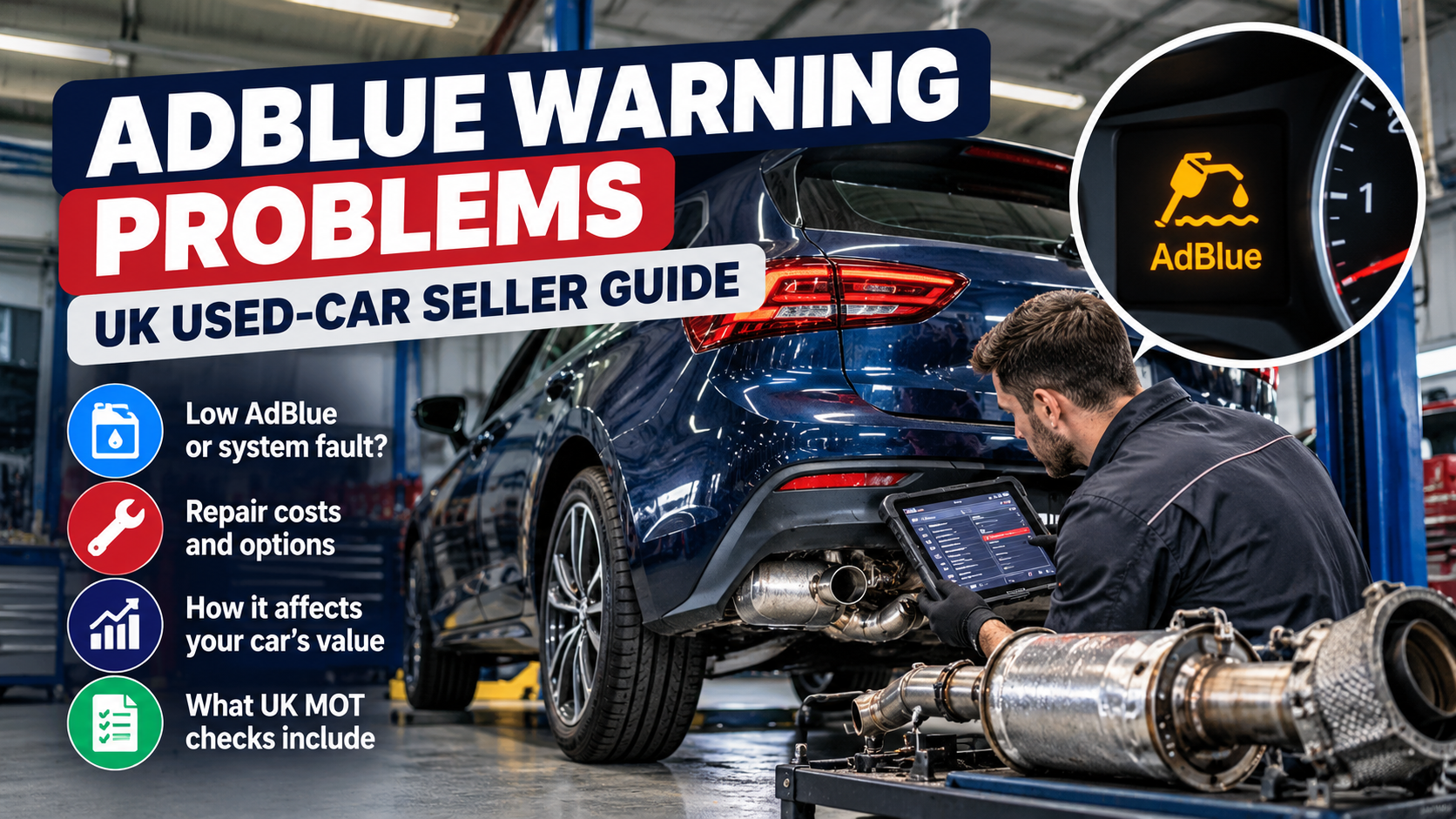
An AdBlue warning can affect diesel car value and buyer confidence. Learn when to diagnose, repair or disclose a fault before selling in the UK.
In this article
A dashboard AdBlue warning can mean something as straightforward as a low fluid level—or an emissions-system fault that needs professional diagnosis. For UK used-car sellers, the distinction matters. Buyers want to know whether the warning has been resolved, whether the car can reliably restart and whether the repair has been documented. A warning alone does not establish the cost of a repair or a fixed percentage loss in value.
This guide explains what to check, when to obtain a written diagnosis and how to sell a diesel car transparently without automatically accepting an unnecessarily low offer.
What does an AdBlue warning actually mean?
AdBlue is a diesel exhaust fluid used by vehicles fitted with selective catalytic reduction (SCR). The system doses fluid into the exhaust to help reduce nitrogen oxide emissions. It is separate from the diesel fuel supply and separate from the diesel particulate filter (DPF), although some vehicles have both systems.
A low-level warning is normally a prompt to add the correct fluid following the vehicle handbook. An SCR or emissions-system fault is different: it may involve a sensor, pump, injector, heater, wiring or system-performance problem. A message that includes a countdown to a possible no-restart condition deserves particular attention.
Do not assume every warning means the whole AdBlue tank needs replacing. Equally, do not assume that adding fluid will cure a system fault.
Low fluid, system fault or no-restart countdown?
A straightforward low-fluid warning
Read the exact message and consult the handbook. Use fluid that meets the vehicle manufacturer's specified standard and follow its filling instructions, including any minimum refill quantity. Some vehicles take time or a specified procedure to recognise a top-up.
Keep the receipt if you are preparing to sell. If the message clears and does not return, explain the top-up accurately rather than describing it as a major repair.
An AdBlue or SCR system-fault message
A fault warning can remain even when the tank is full. The vehicle's control system may have detected incorrect pressure, dosing, temperature, fluid-level reporting or emissions performance. The diagnostic trouble codes and relevant live data should guide the next step.
Ask the garage to identify the fault and explain its evidence. Replacing expensive components solely because a warning is present risks spending money without resolving the cause.
A countdown warning
Some diesel vehicles display a remaining-distance warning before they may refuse a subsequent engine restart. The exact conditions depend on the model and the cause of the warning. A car that currently drives normally is not necessarily safe to ignore until collection day.
If the countdown is active, arrange diagnosis promptly. Do not promise a buyer that the warning will disappear after a refill unless you have verified that the warning genuinely relates to low fluid.
Common causes worth investigating
Low fluid or an unrecognised refill
Check the handbook's filling instructions before treating the issue as a component failure. Incorrect filling procedures, insufficient fluid and delays in recognition can complicate the initial assessment. Do not pour AdBlue into the diesel tank or add diesel to the AdBlue reservoir.
NOx sensors and electrical faults
NOx sensors provide information about exhaust emissions. Sensor or wiring faults can cause an SCR warning even where the fluid supply itself is satisfactory. A competent technician should inspect stored codes, relevant readings and wiring before recommending replacement.
Pump, pressure and dosing problems
The SCR system must deliver the correct quantity of fluid. Pressure faults can relate to a pump, supply restriction, leak or another component. A dosing injector can also become restricted or malfunction. A fault code points towards an area to investigate, not always a definitive replacement part.
Crystallisation or contamination
Dried fluid can leave deposits around certain components. The garage should determine whether deposits are contributing to a restriction and whether a leak or dosing fault caused them. Cleaning alone may not solve an underlying problem.
If the wrong liquid entered the reservoir, tell the garage immediately and avoid running a procedure that could spread contamination. Follow professional advice on draining and checking the system.
Heater, level and quality sensing
Vehicles may monitor fluid temperature, level and quality. A sensor fault can mimic a supply problem. Cold-weather or intermittent warnings deserve diagnosis against the manufacturer's procedures rather than guesswork.
Is an AdBlue warning an MOT failure in the UK?
An AdBlue message does not automatically mean every vehicle fails an MOT: the relevant inspection result depends on what the tester finds. However, the current DVSA MOT manual classifies manufacturer-fitted emissions-control equipment that is missing, obviously modified or obviously defective as a major defect. It also specifies checks for the engine malfunction indicator lamp on applicable diesel vehicles.
A warning that illuminates the engine-management lamp, an obvious emissions-control defect or another applicable failure can therefore create an MOT problem. The exact vehicle age and test criteria matter. Consult the DVSA MOT inspection manual rather than relying on a seller's claim that a car has previously passed.
A current MOT is useful evidence but is not a warranty that the SCR system will remain fault-free. An MOT pass also does not cancel the obligation to describe known problems accurately when advertising a vehicle.
Why an unresolved warning can affect resale value
Buyers are pricing uncertainty as well as the fault itself. They may worry about the potential repair bill, the time needed to investigate it, the possibility of a no-restart condition and whether another problem is hidden behind the warning.
A motor trader considering an auction purchase may also allow for workshop time, transport, parts availability and the risk that diagnosis reveals a different issue. A private buyer may simply prefer a comparable car with no warning lights and a documented maintenance history.
There is no reliable universal deduction such as 'every AdBlue fault reduces value by £1,000'. The effect depends on the vehicle, exact fault, repair quotation, condition, local demand and selling route. Compare like-for-like vehicles and obtain evidence before setting a discount.
For a broader explanation of how other dashboard messages affect confidence, read CarMazium's warning-light guide.
Diagnose before deciding whether to repair or sell
Step 1: Record the exact symptoms
Photograph the dashboard message and note the mileage, date, remaining countdown distance and when the problem occurs. Record whether the engine-management light is also illuminated and whether the car has lost power.
Avoid clearing codes merely to make the dashboard appear normal for photographs. That can remove useful diagnostic evidence and undermine buyer confidence if the warning returns.
Step 2: Check the simple items correctly
If the message is clearly low fluid, follow the handbook and use the correct specification. Do not overfill or experiment with additives. If the warning persists, appears alongside other faults or shows a countdown, arrange professional checks.
Step 3: Obtain a written diagnostic report
Ask the garage to record fault codes, relevant test findings and the proposed repair. Where appropriate, request a distinction between a confirmed failure and components that still need investigation.
A written estimate should clarify labour, parts, VAT, whether further testing could change the quote and any guarantee offered on completed work.
Step 4: Compare the economics
Consider the expected sale price after a properly documented repair against the likely achievable price with the fault disclosed. Subtract repair costs and allow for your time, the risk of further work and how urgently you need to sell.
For example, if a hypothetical repaired car might achieve £6,500 and a genuine as-is offer is £5,700, there is an £800 difference to evaluate. A £300 confirmed repair may make sense; an uncertain repair that could exceed the difference may not. These figures illustrate the method, not current market valuations.
Use a CarMazium valuation as one input, and check comparable advertisements and any written offers. An asking price is not proof of the amount a car will sell for.
Repairing the fault before sale: potential benefits
A confirmed, correctly completed repair can remove an important objection. Keep the invoice, diagnostic findings, replacement-part details and evidence that the warning has cleared after appropriate testing.
The benefit is strongest when the repair addresses the root cause and the documentation is easy to understand. An invoice saying only 'AdBlue reset' provides less reassurance than a clear record of the fault, testing and work performed.
Do not guarantee that a repaired system can never develop another fault. Describe what was repaired, when and by whom.
Selling with an unresolved AdBlue problem
It is possible to market a faulty diesel vehicle, provided its condition and relevant limitations are described accurately and the sale complies with applicable law. A transparent listing is usually more useful than vague wording such as 'small sensor issue' when no diagnosis confirms that description.
Include the exact dashboard message, whether a countdown is active, the vehicle's starting and driving status, any diagnostic findings and the repair quotation if available. State explicitly when the cause is unconfirmed.
Upload clear photographs and relevant paperwork. Agree in writing what the buyer has been told and avoid making unsupported claims that the repair is cheap or straightforward.
Choosing a selling route
A retail advertisement may reach buyers willing to investigate a known problem, but expect questions and inspections. A dealer auction may be suitable if you want verified motor traders to assess the vehicle's condition and submit bids.
CarMazium currently offers free auction listing and a £1 retail listing route. Auction bidding is restricted to verified motor traders; the platform's published fees and eligibility terms should be checked when listing. You can start from CarMazium and choose the selling route that suits your vehicle.
If the vehicle is not roadworthy or could be immobilised by a countdown, agree safe collection arrangements rather than assuming it can be driven away.
What should an advert disclose?
An effective advert should answer the questions a serious buyer will ask. State the car's age, mileage, service history, MOT status and overall condition alongside the warning details.
Distinguish a low-fluid reminder that has cleared from an active SCR fault. If the vehicle has an active countdown, include the displayed distance as of the photograph and explain that it may change. Do not advertise an unverified repair diagnosis as fact.
If a garage has recommended replacing a component, say it was recommended rather than claiming that it is certainly the only fault. Provide receipts and a copy of the diagnostic report where appropriate, with personal information removed.
The CarMazium guide to writing a trustworthy advert explains how to organise the rest of your vehicle description.
What buyers should check at inspection
Ask to see the warning with the ignition switched on and the engine started, as appropriate for the model. Compare the seller's description with the dashboard and paperwork. A brief test drive is not proof that an intermittent emissions fault has disappeared.
Where there is a countdown or unresolved SCR fault, consider an independent inspection or specialist diagnostic assessment before committing to the purchase. Confirm whether collection will require transport if the vehicle may not restart.
Check the official MOT history and review the dates and advisories, but remember that the MOT record is not a complete mechanical history.
Why deleting or disguising the system is not a selling solution
Avoid treating an AdBlue or SCR 'delete' as an acceptable shortcut for a UK road vehicle. The DVSA manual identifies missing, obviously modified or defective manufacturer-fitted emissions equipment as an MOT issue. Tampering can also create legal, insurance and resale complications.
A cleared fault code without a completed repair is not evidence that the emissions system is functioning correctly. A buyer may later discover the unresolved problem, damaging trust and potentially leading to a dispute.
Ask a reputable repairer about compliant diagnosis and repair instead of modifying the system to conceal a fault.
How to set a realistic asking price
Start with the market value of a comparable vehicle in similar age, mileage, specification and condition, without the known fault. Then assess the evidence you actually have: a verified minor issue, a fixed-price repair quotation or an undiagnosed system warning carry different levels of uncertainty.
Use recent comparable listings as context, but be cautious about unusual prices and unsold advertisements. Obtain multiple offers where practical. A trader's offer reflects preparation and commercial risk; it should not be compared directly with a retail asking price without adjustment.
If you have completed a repair, retain proof and explain it in the listing. If you sell as-is, set expectations clearly and leave room for a sensible inspection-based discussion.
Frequently asked questions
Will topping up AdBlue always clear the warning?
No. A genuine low-level reminder may clear when the vehicle recognises a correct refill. A sensor, dosing, pressure or other SCR fault may remain until the underlying problem is diagnosed and resolved.
Can I sell a diesel car with an AdBlue countdown?
You can market a vehicle with a known fault, but describe the countdown accurately and plan collection safely. Obtain advice on the vehicle's roadworthiness and do not suggest it will reliably restart if that has not been verified.
Does an AdBlue warning automatically fail an MOT?
Not every AdBlue message automatically means failure. The applicable MOT checks include emissions equipment and, for relevant diesel vehicles, the engine malfunction indicator lamp. A specific defect found by the tester may result in failure.
Is an AdBlue problem the same as a DPF problem?
No. The SCR/AdBlue system reduces nitrogen oxide emissions, while a DPF captures particulate matter. Some vehicles use both and may display different warnings. Read the separate CarMazium DPF guide for that issue.
Should I pay for a repair before selling?
Compare a written, evidence-based repair estimate with genuine offers for the car in its present condition. A predictable, documented repair may improve buyer confidence; a costly or uncertain repair may not be economical.
Can I simply reset the warning before a viewing?
A reset is not a substitute for diagnosis or repair. Disclose known faults honestly and keep evidence of any work performed. A returning warning can create a much larger problem after the sale.
Final checklist before you advertise
Record the exact warning, check the handbook, seek diagnosis when needed and retain written evidence. Decide whether a confirmed repair is economical rather than guessing at its cost. Set a price using comparable vehicles and genuine offers, disclose unresolved faults clearly and arrange appropriate collection.
If you are ready to compare selling routes, visit CarMazium to explore its UK retail and verified-trader auction options. A clear account of the car's actual condition gives buyers better information and gives your asking price a defensible basis.
Information reviewed for October 2026. Always check the current vehicle handbook, DVSA guidance and CarMazium's live terms before acting.
Sell your car your way
Ready to turn your research into a real sale?
List in the CarMazium dealer auction for £0, or advertise retail from £1. Qualifying successful auction sales can receive a £100 seller incentive.
Keep reading
Related automotive guides

Does a New Battery Increase a Used Car's Value? UK Guide 2026
A new battery can improve reliability and buyer confidence, but does it raise resale value? Learn when replacement makes sense before selling a car in the UK.

Does Timing-Belt or Timing-Chain History Affect Car Value? UK Guide 2026
Timing-belt and timing-chain history can influence buyer confidence and offers. Learn what proof matters, when to repair and how to sell accurately in the UK.
How DPF Problems Affect Diesel Car Value and Saleability: UK Guide 2026
DPF warning or blocked filter? Learn how diesel particulate filter problems affect UK used-car value, MOT prospects, repair decisions and selling options.
From the marketplace