
Best Car Selling Platforms in the UK 2026: Which Is Right for You?
Compare the main ways to sell a car in the UK, including dealer auctions, online marketplaces and instant-buying services, and find the right option for your priorities.

Best Car Selling Platforms in the UK 2026: Which Is Right for You?
Selling a car used to be relatively straightforward.
You could put a handwritten sign in the window.
Advertise it in the local paper.
Part-exchange it at a dealership.
Or sell it privately.
Today, UK motorists have considerably more choice.
You can advertise directly to millions of potential retail buyers.
You can put your car in front of thousands of dealers.
You can use an instant car-buying company.
You can part-exchange it.
Or you can use newer marketplaces such as CarMazium that offer different selling routes.
So which is the best place to sell your car in the UK?
There isn't one answer for everybody.
The right platform depends on what matters most to you:
Getting the highest possible price.
Selling quickly.
Avoiding private buyers.
Having dealers compete.
Keeping control of your asking price.
Minimising fees.
Let's compare the main options.
The Five Main Ways to Sell a Car Online
Most UK car-selling services fall into a few basic models:
-
Retail/classified marketplace — you advertise the vehicle and deal with potential buyers.
-
Dealer auction — multiple motor dealers can compete to buy the vehicle.
-
Instant car buyer — one company provides an offer and buys the vehicle directly.
-
Part-exchange — a dealership takes your existing car against another vehicle.
-
Hybrid marketplace — platforms provide more than one route.
Understanding this difference is more useful than simply asking which website has the biggest name.
Auto Trader remains one of the UK's dominant automotive marketplaces.
For sellers, it now offers two substantially different routes.
You can advertise your car directly to its large consumer audience, or use its dealer-selling service where verified dealers make offers.
Auto Trader currently says its adverts reach more than 9.5 million people each month. Its dealer route allows sellers to receive offers from thousands of verified dealers and advertises free collection and same-day payment.
Why choose Auto Trader?
Its major advantage for private advertising is audience.
You're effectively trying to find the end consumer for the vehicle rather than immediately selling into the motor trade.
That can potentially produce a higher selling price.
But there is a trade-off.
When advertising privately, you may need to:
answer enquiries,
negotiate,
arrange viewings,
deal with test drives,
manage payment,
and complete the sale yourself.
Auto Trader itself emphasises that private sellers communicate directly with prospective buyers and negotiate the price.
Best suited to:
Sellers who are prepared to put some effort into achieving a strong retail price.
Motorway helped popularise another model:
Let dealers compete for the car.
Instead of advertising your vehicle to the general public and waiting for individual buyers, vehicle details are presented to a network of motor dealers.
Those dealers compete to buy the vehicle.
This can be an attractive middle ground between private selling and accepting an instant-buying company's first offer.
One important change sellers should know about is pricing.
Carwow's March 2026 comparison reports that Motorway introduced seller service fees based on the vehicle's final selling price, citing fees ranging from £29.99 for certain lower-value sales to £99.99 for cars selling at £20,000 or more. Sellers should check Motorway's current terms before listing because fees can change.
Why choose a dealer-auction model?
Competition.
One dealer may have too many examples of your particular vehicle.
Another might desperately need one.
A BMW specialist might value a certain BMW differently from a general used-car dealer.
A dealer in Scotland may have different demand from one in London.
Putting multiple professional buyers in competition can help expose those differences in demand.
Best suited to:
Someone who wants dealer competition without managing a traditional private sale.
Carwow also operates a competitive dealer-auction model.
As of September 2026, Carwow says sellers can put their vehicle in front of 6,000+ dealers.
The process is essentially:
Get a valuation.
Complete the vehicle details.
Upload photographs.
Set a reserve.
Dealers compete.
The winning dealer arranges collection and payment.
Carwow currently advertises this service as free to the seller.
That makes it a direct competitor to dealer-auction services.
An important lesson for sellers
Motorway and Carwow demonstrate something fundamental about modern car selling:
A valuation isn't necessarily the same thing as a market-tested offer.
A valuation is an estimate.
An actual dealer bid represents what a particular buyer is prepared to offer for that vehicle at that moment.
Best suited to:
Sellers who want a relatively hands-off dealer-auction process without privately advertising the car.
- WeBuyAnyCar
This represents a different business model.
Rather than primarily putting your car in front of thousands of dealers and asking them to compete, an instant-buying service focuses heavily on:
speed and convenience.
You enter the vehicle information.
Receive a valuation.
Take the car for inspection.
The final purchase price is confirmed.
If you accept it, the vehicle is sold.
This can be extremely useful for someone whose priority is:
“I just want the car gone.”
But convenience and maximum sale price aren't necessarily the same objective.
A seller should therefore compare the final amount they would actually receive against other available routes before deciding.
Best suited to:
Someone prioritising simplicity and speed over testing the vehicle against a wider buyer market.
CarMazium takes a hybrid approach.
A seller currently has two main routes.
Dealer Auction — FREE to list
The vehicle can be entered into a live auction where verified dealers compete.
CarMazium currently charges the seller £0 to list through the auction route.
The seller can set a reserve price.
The platform includes real-time bidding and anti-snipe protection.
And CarMazium currently offers something unusual:
a £100 seller incentive following a qualifying successful auction sale.
That means the proposition isn't simply:
“Pay us to sell your car.”
It is:
List through the auction for free, let verified dealers compete, and if the qualifying auction sale completes successfully, receive the advertised £100 seller incentive.
Terms and eligibility naturally apply.
Retail — from £1
There's another route.
Instead of selling to the motor trade, a seller can advertise the vehicle on CarMazium's retail marketplace.
The current entry-level retail listing is £1.
That gives sellers a choice between:
Dealer competition
and
Retail advertising.
Best suited to:
Sellers who want the choice of auctioning to professional dealers or advertising directly to retail buyers.
Dealer Auction vs Private Advert vs Instant Buyer
This is the comparison sellers should really make.
Selling method Main advantage Main compromise
Private/retail advert Potential access to retail price More seller involvement Dealer auction Multiple professional buyers can compete Offers reflect trade buying economics Instant buyer Speed and convenience Limited competitive price discovery Part exchange Very convenient when changing cars Harder to separate purchase and sale negotiations Hybrid marketplace Multiple selling routes Experience depends on platform reach and buyer activity
There is no universally correct option.
The best method depends on the seller.
Which Is Likely to Get the Highest Price?
This requires some nuance.
A private retail sale can potentially produce more because you're selling directly to the person who will ultimately use the vehicle.
A dealer buying your car needs room for costs such as:
Preparation.
Servicing.
Repairs.
Warranty.
Advertising.
Staff.
Premises.
Finance costs.
Risk.
And profit.
So logically, a dealer normally cannot pay the same amount they expect to retail the vehicle for.
But private selling comes with additional work and uncertainty.
A £10,000 private asking price doesn't mean someone will actually pay £10,000.
The relevant comparison is:
What can I realistically complete a sale for?
Not:
What is the highest advertised price I can find online?
Which Is the Fastest Way to Sell?
An instant-buying service can be extremely fast.
Dealer-auction services can also move quickly.
Auto Trader currently advertises its dealer-selling route as capable of selling a car in as little as 48 hours.
Carwow operates daily online auctions and says the winning dealer then arranges collection and payment.
Private advertising is less predictable.
You might sell tonight.
Or you might still be answering messages three weeks later.
Speed depends heavily on:
Vehicle desirability.
Price.
Condition.
Location.
Specification.
Time of year.
And how accurately the vehicle is advertised.
Which Is Easiest?
For minimum seller involvement, instant-buying and dealer-auction services generally have an advantage.
Private selling requires considerably more interaction.
However, some sellers prefer that.
They want control over:
the asking price,
who buys the vehicle,
negotiation,
viewings,
and when they sell.
That's why “easiest” and “best” aren't synonyms.
Why Dealer Competition Can Matter
Suppose your vehicle receives these hypothetical offers:
Dealer A — £7,850
Dealer B — £8,100
Dealer C — £8,250
Dealer D — £8,700
Dealer E — £8,900
Without competition, you might have accepted £7,850.
With multiple buyers exposed to the vehicle, you discover that another dealer values it differently.
This is the fundamental attraction of dealer-auction platforms such as Motorway, Carwow and CarMazium.
But competition doesn't guarantee a particular price.
Dealer demand varies enormously by vehicle.
What About Part Exchange?
Part exchange remains extremely convenient.
Imagine you're buying another vehicle for £20,000.
The dealer offers £8,000 for yours.
You simply pay the difference.
No separate advertisement.
No strangers visiting your house.
No waiting for collection after finding another car.
But there is an important psychological trap.
Don't concentrate solely on the “price to change.”
Understand separately:
How much am I paying for the new car?
and:
How much am I actually receiving for mine?
That makes comparison easier.
Get More Than One Valuation
This may be the most useful advice in this entire article.
Before committing, get several valuations.
Suppose you receive:
Instant buyer — £7,900
Part exchange — £8,300
Dealer marketplace — £8,750
Another dealer auction — £8,950
Likely private-sale range — £9,500–£10,000
Now you have useful information.
You can decide whether potentially spending more time selling privately is worth the additional money.
Don't Compare Headline Numbers Incorrectly
Be careful.
A valuation isn't necessarily a guaranteed purchase price.
A reserve isn't necessarily a sale price.
An asking price isn't necessarily what the seller receives.
And an auction estimate isn't necessarily the winning bid.
Always compare the actual final amount payable to you, including applicable fees and any adjustments.
This is particularly important because platform fee structures can change.
What Happens at Collection?
This deserves far more attention than it usually receives.
On dealer-platform sales, the winning dealer or collection agent will normally inspect the vehicle.
Carwow explicitly tells sellers that the dealer may conduct a thorough inspection and short test drive before taking the vehicle.
If your listing says:
No damage
but the collector discovers:
a dent,
warning light,
badly damaged wheel,
missing key,
incorrect mileage,
or undisclosed mechanical problem,
the buyer may reconsider the agreed price.
This is why accurate vehicle descriptions matter.
Should You Accept the First Offer?
Not necessarily.
If speed is critical and the offer is reasonable, perhaps.
But modern online selling makes comparison relatively easy.
Before accepting, ask:
What is my car realistically worth?
What would another platform offer?
Would dealer competition help?
Would selling privately justify the extra work?
Are there seller fees?
Is collection included?
Those questions are more useful than simply recognising a famous brand.
Best Platform for Maximum Control
A traditional retail/classified listing generally gives you the greatest control.
You choose:
Your asking price.
Your photographs.
Your description.
When to reduce the price.
Who to speak to.
Whether to accept an offer.
When to sell.
Auto Trader is the obvious established example, while CarMazium also provides a retail listing route starting at £1.
Best Platform for Dealer Competition
There are now several options.
Motorway.
Carwow.
Auto Trader's dealer-selling service.
CarMazium.
The fundamental model is similar:
Expose the vehicle to professional buyers rather than relying on one buyer's valuation.
But compare:
Dealer network size.
Seller charges.
Auction structure.
Reserve rules.
Collection process.
Payment process.
Customer support.
What happens if the winning buyer changes the offer.
And any seller incentives.
Best Platform for Selling Quickly
If speed outweighs everything else, an instant-buying service can make sense.
But dealer marketplaces have significantly narrowed the convenience gap.
Auto Trader advertises dealer sales in as little as 48 hours.
Carwow operates daily auctions.
So sellers no longer necessarily have to choose between:
competitive bidding
and
a reasonably quick sale.
Best Platform for a Specialist Car
This is where thinking beyond the platform name becomes useful.
Imagine you're selling:
A Porsche.
A rare performance BMW.
A classic car.
A modified vehicle.
A wheelchair-accessible vehicle.
A specialist 4x4.
A very high-value car.
A generic buyer may value it conservatively.
A specialist buyer may understand:
Rare options.
Desirable colours.
Limited production.
Performance packages.
Specialist modifications.
Collector demand.
For unusual vehicles, reaching the right buyer can matter as much as reaching lots of buyers.
Best Platform for an Older or Damaged Car
Again, shop around.
Some platforms and dealers have restrictions regarding:
Age.
Mileage.
Insurance categories.
Non-runners.
Major mechanical faults.
Commercial use.
Modified vehicles.
Don't conceal these issues to get through an online valuation.
Describe the car accurately and find a buyer whose business model accommodates that type of stock.
What Should You Check Before Choosing a Car-Selling Website?
Before entering your vehicle, check:
Is there a seller fee?
Is the valuation guaranteed or provisional?
Will buyers compete?
Can you set a reserve?
Who actually buys the vehicle?
Who collects it?
Is collection free?
When do you get paid?
Can the price change after inspection?
What happens if you reject the final offer?
What happens if the buyer doesn't collect?
How is outstanding finance handled?
Can you sell privately instead?
What documentation will you need?
Spend five minutes understanding the process before committing your car.
It can save considerable frustration later.
So, What Is the Best Car Selling Platform in the UK?
There isn't one winner for every seller.
If maximum retail exposure matters:
A major classified marketplace such as Auto Trader deserves consideration.
If you want established dealer competition:
Motorway, Carwow and Auto Trader's dealer service are major options worth comparing.
If convenience and immediate disposal matter most:
An instant car-buying service may suit you.
If you're replacing the vehicle:
Get a part-exchange valuation as another benchmark.
If you want dealer bidding plus another option to advertise directly:
CarMazium provides both auction and retail routes, with its current proposition of free auction listing and retail listings starting from £1.
The strongest strategy isn't necessarily choosing one website immediately.
It is:
Understand your car's value first.
Compare selling methods.
Understand all fees.
Decide how much effort you're prepared to make.
Then choose the route that best matches your priorities.
Frequently Asked Questions
What is the best website to sell a car in the UK?
It depends on your objective. Private marketplaces can provide retail exposure, dealer-auction platforms create competition between professional buyers, and instant-buying services prioritise speed and convenience.
Is it better to sell privately or to a dealer?
Private selling can potentially achieve a higher price because you're selling closer to retail value, but it usually requires more work. Selling to a dealer is generally easier and faster.
Is Auto Trader good for selling a car?
Auto Trader has an exceptionally large consumer audience and currently says sellers can advertise to more than 9.5 million people monthly. It also offers a separate dealer-selling route.
How does Carwow sell my car?
Carwow currently puts completed seller listings in front of 6,000+ dealers, who can compete for the vehicle. Carwow advertises the service as free to sellers.
Is CarMazium free for sellers?
CarMazium currently offers free auction listings. Its separate retail marketplace starts at £1. Qualifying completed auction sales can also receive the advertised £100 seller incentive, subject to the applicable terms.
Should I get several offers before selling?
Yes. Comparing different selling routes gives you a much better picture of what the market may actually pay for your vehicle.
Final Thoughts
The UK car-selling market has changed.
Sellers are no longer limited to:
take the local dealer's offer
or:
put an advert online and hope somebody calls.
You can now compare instant buyers, retail marketplaces, dealer auctions and part-exchange offers relatively easily.
That competition is valuable.
But don't simply ask:
“Which company is biggest?”
Ask:
“Which selling method works best for my car and my priorities?”
If your priority is maximum control, retail advertising may make sense.
If your priority is convenience, an instant buyer may be attractive.
If you want professional buyers competing against one another, consider a dealer-auction marketplace.
And if you want to test different options, compare them before committing.
The best car-selling platform isn't necessarily the one that makes the loudest promise.
It's the one that produces the right combination of price, speed, cost, convenience and confidence for you.
Sell your car your way
Ready to turn your research into a real sale?
List in the CarMazium dealer auction for £0, or advertise retail from £1. Qualifying successful auction sales can receive a £100 seller incentive.
Keep reading
Related automotive guides
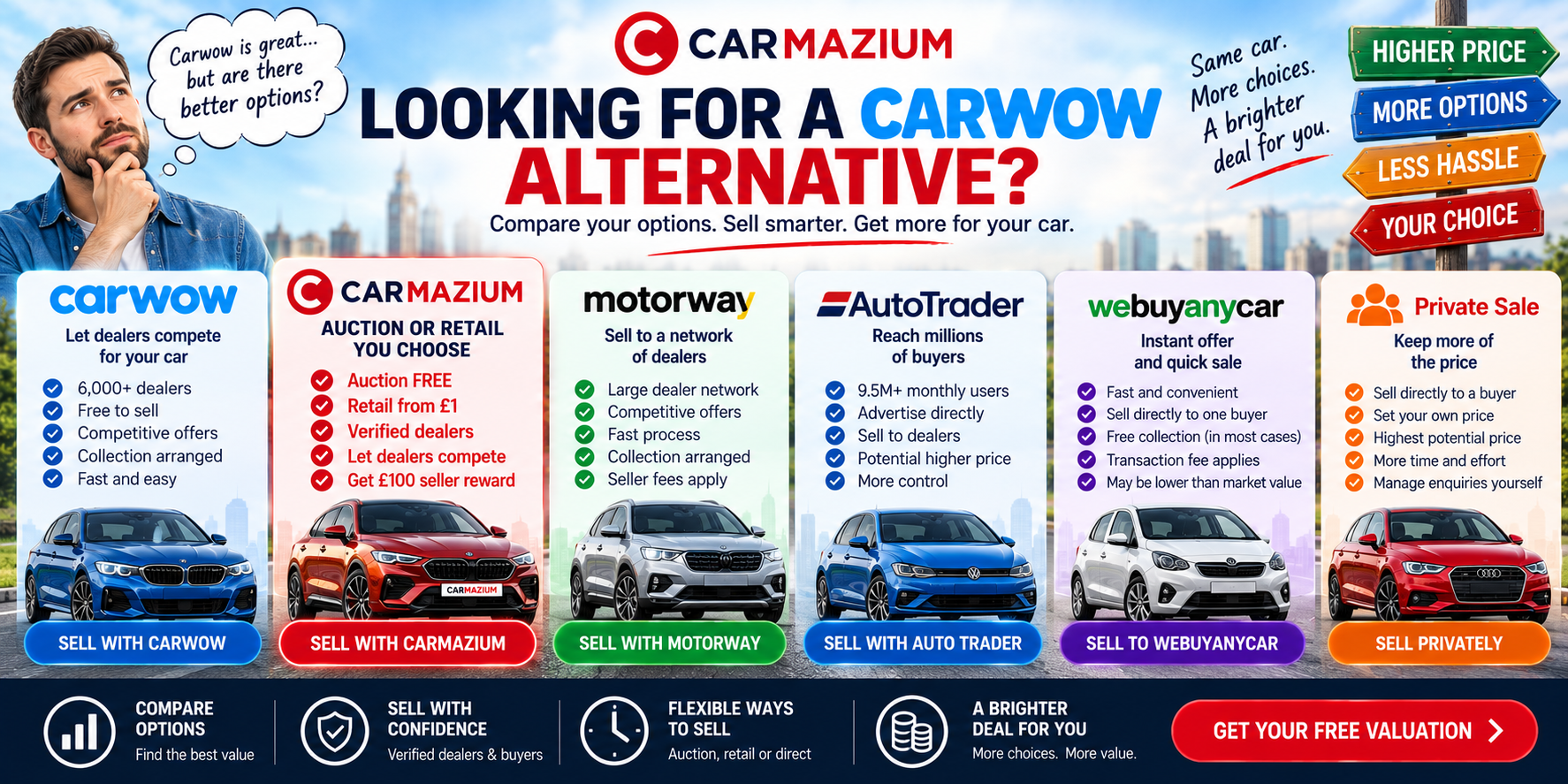
Carwow Alternatives UK 2026: Best Ways to Sell Your Car
Looking for a Carwow alternative? Compare CarMazium, Motorway, Auto Trader, instant car buyers and private selling to find the right way to sell your car in the UK.
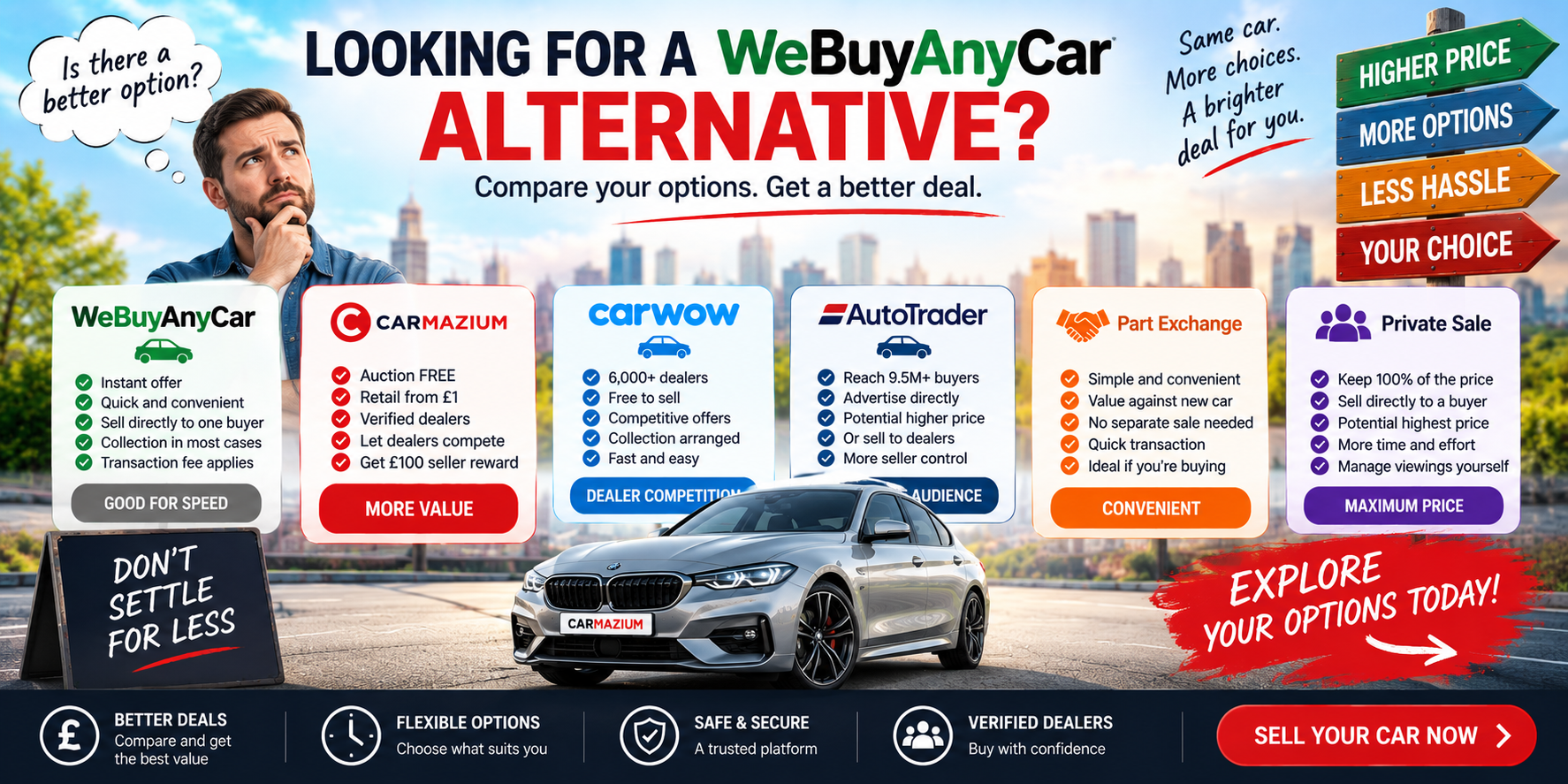
WeBuyAnyCar Alternatives UK 2026: Compare Better Ways to Sell Your Car
Looking for an alternative to WeBuyAnyCar? Compare CarMazium, Carwow, Auto Trader, dealer auctions and private selling to find the right way to sell your car.
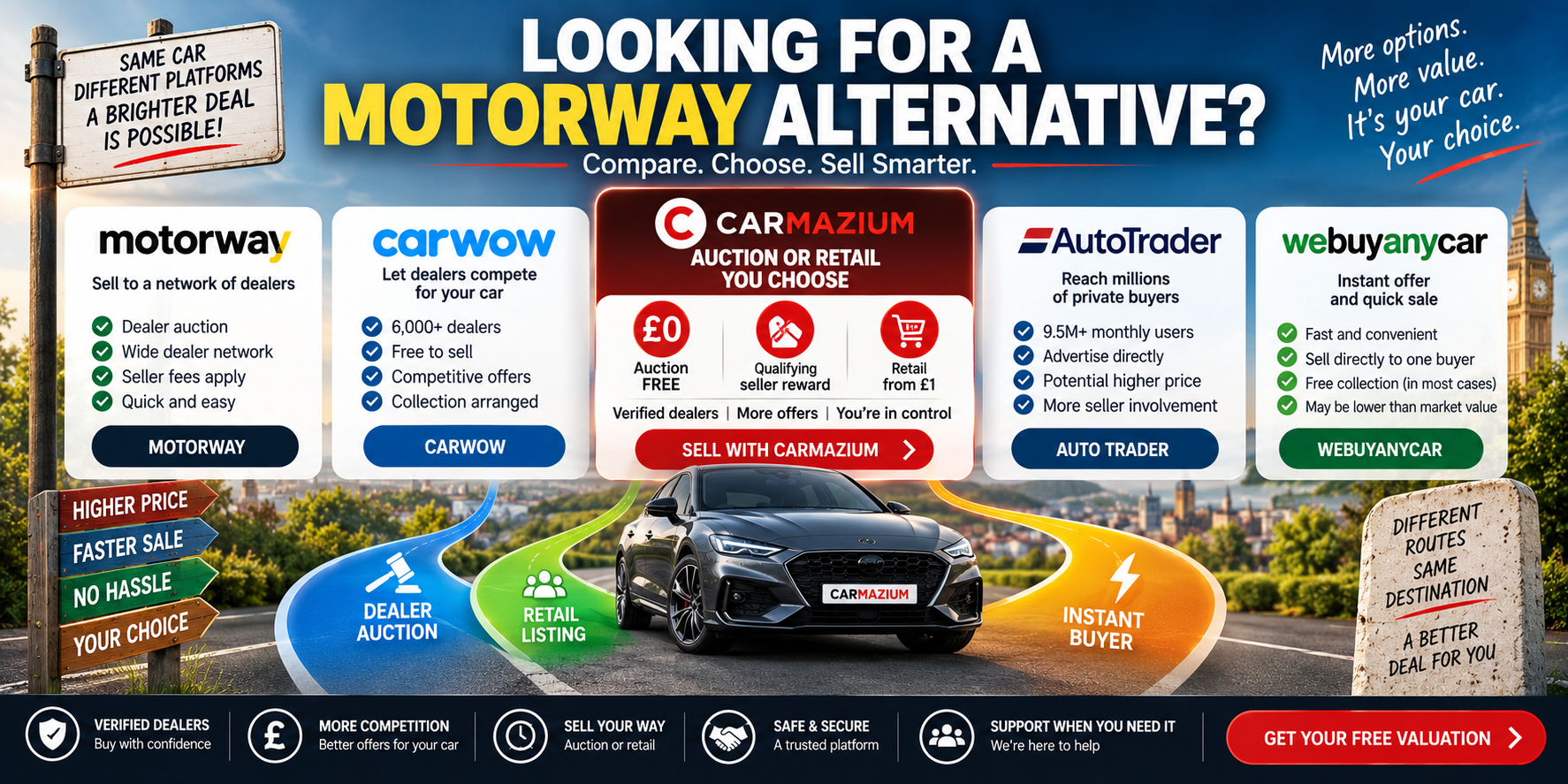
Motorway Alternatives UK 2026: Best Places to Sell Your Car
Looking for an alternative to Motorway? Compare CarMazium, Carwow, Auto Trader, WeBuyAnyCar and other ways to sell your car in the UK based on fees, dealer competition, speed and convenience.
From the marketplace